PRESS
PRESS 


Quick answer: The Dubai visitor visa policy is not one single visa rule. It is the set of UAE immigration rules that decides whether a traveller needs advance permission, which short-stay route applies, how long the person may remain, whether re-entry is allowed, what documents and travel conditions apply, and what happens if the stay expires.
For Dubai-issued tourist visas, GDRFA Dubai is the main authority. Standard tourism routes currently use 30-day and 60-day stays, with single-entry and multiple-entry options. Other purposes—such as visiting relatives or friends, job exploration, business exploration, study, treatment or long-term tourism—use different visit services and can have different stay limits, guarantees and documents.
Dubai Visitor Visa Policy — 2026 Quick Guide
- GCC citizens: normally do not need a UAE visa for entry.
- Other travellers: may have visa-free, visa-on-arrival, GCC-resident or advance-visa routes depending on the passport and status.
- Standard Dubai tourist stays: 30 days or 60 days.
- Entry types: single entry or multiple entry.
- Core standard tourist documents: photo + passport copy, with national ID additionally listed for Iraq, Pakistan, Iran and Afghanistan.
- Travel conditions: passport normally valid for at least 6 months, onward/return travel and UAE-valid medical insurance.
- Current GDRFA service time: 48 hours after a complete request reaches the tourist service.
- Overstay: current federal services commonly use AED 50 per chargeable day after the authorised stay and any applicable grace period end.
Not Sure Which Entry Rule Applies to Your Passport?
Check citizenship, residence status and any visa-on-arrival route before you prepare a paid tourist visa application.
Check Dubai Visa EligibilityDubai Visitor Visa Policy 2026: What the Policy Actually Covers
The official GDRFA single-entry tourist visa service currently grants tourism visas for 30 or 60 days. GDRFA also publishes a separate multi-entry tourist service for the same 30-day and 60-day stay categories.
That standard tourist policy covers only tourism. It should not be used as the document or fee rule for every visitor. GDRFA separately publishes visit services for relatives and friends, job exploration, business exploration, study or training, medical treatment and a five-year multi-entry tourist route.
This distinction matters because different visit purposes can use different documents, financial guarantees, insurance amounts, stay periods and extension limits. A “visitor visa” label on a website does not override the legal category shown on the issued permit.
Who Needs to Follow UAE Visit Visa Rules Before Travel?
The UAE visit visa rules begin with the traveller's passport and legal status. Country of residence alone does not decide whether someone needs an advance visa.
| Traveller Type | Policy Route to Check |
|---|---|
| GCC citizen | Normally visa-free for UAE entry. |
| Passport with visa-free / arrival rights | Use the current passport-specific entry rule. |
| Foreign GCC resident | Check the GCC-resident eVisa if eligible. |
| Advance-visa traveller | Obtain the correct approved visa before departure. |
A fixed table such as “US/UK/EU = 30 days” can become inaccurate because UAE entry arrangements differ by passport and may change. Some conditional routes also depend on a valid foreign visa or residence permit.
Once you know the passport needs advance approval, choose the visa from the real purpose. Tourism, visiting a spouse, attending training and exploring a job opportunity can all use different legal routes.
Dubai Visitor Visa Validity vs Permitted Stay
Dubai visitor visa validity and stay duration are not the same thing. The issued visa can contain an entry window or “use by” date, while the permitted stay tells the traveller how long they may remain after entry.
Do not hard-code one universal pre-entry validity period for every visitor visa. Different visa categories can have different entry-validity rules. Read the dates on the actual visa and the service terms for that route.
For the standard GDRFA tourist route, the stay category itself is 30 days or 60 days. For some other visit routes, 90-day stays also exist. A relative-or-friend visit visa, for example, currently has 30-day, 60-day and 90-day options and uses different documents and financial guarantees.
The traveller must leave, extend or lawfully change status before the authorised stay ends. Do not treat the visa issuance date, entry-by date and stay end date as interchangeable. Track them separately.
Entry Requirements for Dubai Visitors
The standard tourist route does not require the long universal checklist shown in many older articles. Current GDRFA guidance lists one personal photo, a passport copy and a national identity card for applicants from Iraq, Pakistan, Iran and Afghanistan.
The service conditions also require a passport or approved travel document with at least six months of validity, a ticket to continue the journey or leave the UAE, and medical insurance valid in the UAE.
Proof of accommodation and bank statements are not published as universal core documents for every standard 30-day or 60-day tourist application. A tourism office or immigration officer can still request extra material for a specific case.
For the full current checklist and the difference between official documents and provider-requested documents, use the Dubai Visitor Visa Requirements guide.
Visa Approval vs Permission to Enter
An approved visa is important, but it does not mean every border check disappears. The traveller should still arrive using the passport linked to the visa and be ready to show the onward or return ticket and other travel evidence connected to the route.
Immigration officers can review whether the person matches the visa record and whether the stated trip still fits the permission granted. This is why the name, passport number, nationality, entry type and stay details should be checked before departure.
If the passport was replaced after visa issuance, or if the visa contains a material error, resolve that issue before flying rather than assuming the airport can correct it automatically.
Standard Tourist Visa Types and Current Government Fees
The source article used AED 350 for a 30-day single-entry visa, AED 650 for 60 days and AED 1,150 for a generic 90-day multiple-entry visa. Those figures should not be presented as the current standard GDRFA government visa fees.
| Standard Tourism Route | Stay | Current GDRFA Fee |
|---|---|---|
| Single entry | 30 days | AED 200 + 5% VAT |
| Single entry | 60 days | AED 300 + 5% VAT |
| Multiple entry | 30 days | AED 300 + 5% VAT |
| Multiple entry | 60 days | AED 500 + 5% VAT |
GDRFA currently lists no security-deposit amount on these standard single-entry and multi-entry tourist services. Provider fees, insurance or other private service costs can still increase the final amount paid by the traveller.
A 90-day visitor visa is not the next standard tourism-establishment product in this table. Current 90-day options belong to other visit categories, including relative/friend visits, and use different policy conditions.
Need to Compare More Than the Standard Tourist Routes?
Check transit, relative/friend, GCC-resident, five-year tourist and other visit categories separately before choosing a visa.
Compare Dubai Visitor Visa TypesSingle Entry vs Multiple Entry Policy
A single-entry visa permits one UAE entry under that visa. After the traveller exits, do not assume the same single-entry permission can be reused because unused stay days remain.
A multiple-entry visa permits more than one UAE entry under the issued terms. It can be useful for a route such as Dubai → Oman → Dubai or another trip that genuinely leaves the UAE and returns.
Abu Dhabi, Sharjah, Ajman, Ras Al Khaimah, Fujairah and Umm Al Quwain are inside the UAE. Travelling from Dubai to one of those emirates does not require a multiple-entry visa because the traveller has not left the country.
Also avoid saying multiple entry means a completely fresh 30-day or 60-day stay after every arrival. The traveller should follow the dates and stay conditions shown on the issued visa.
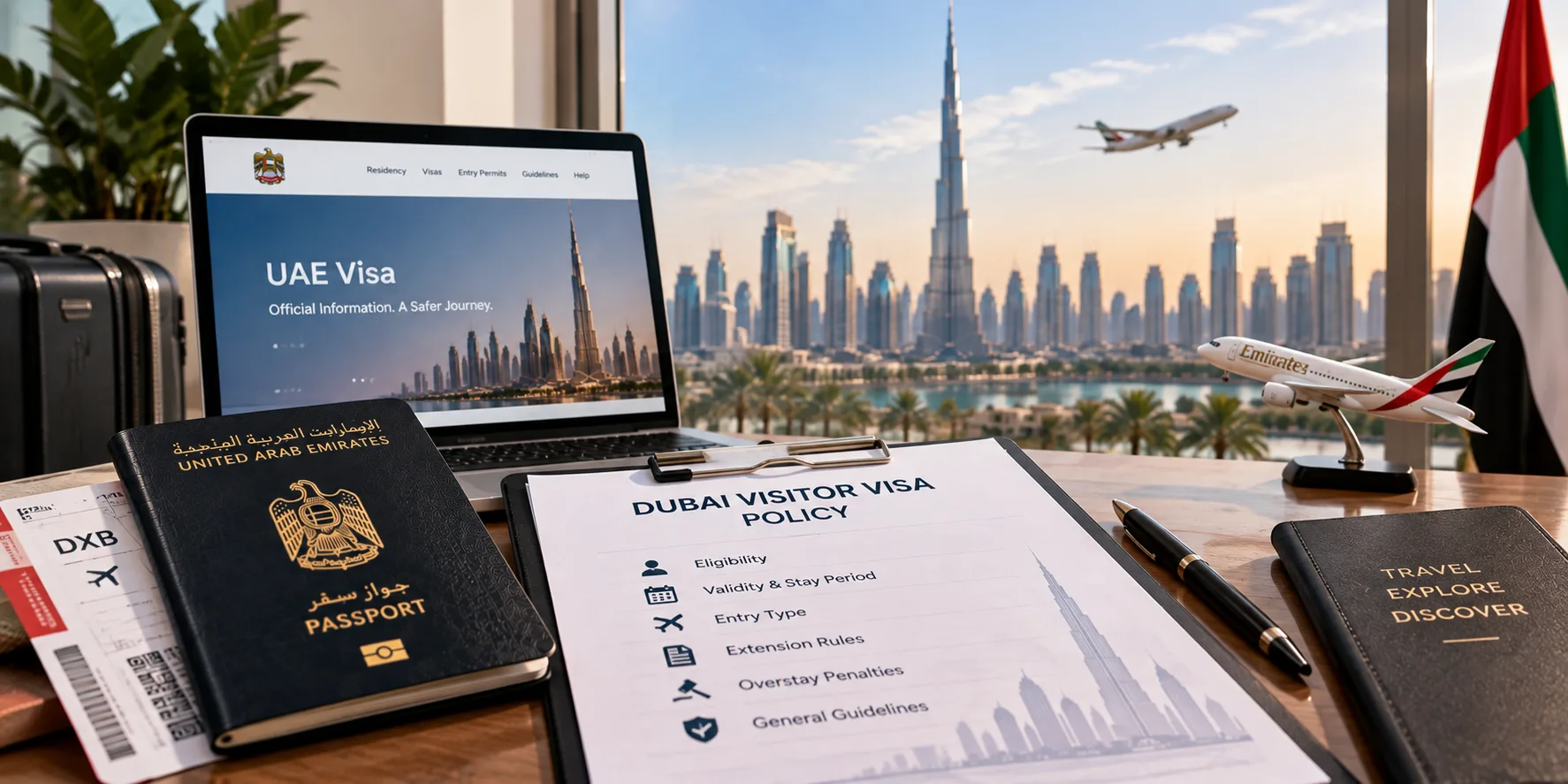
Dubai Visitor Visa Policy: Overstay and Lawful Stay
The Dubai visa overstay rules begin with the authorised stay shown on the visa record. When that stay and any grace period applicable to the specific permit end, current federal immigration services commonly list a fine of AED 50 per chargeable day.
The source article went further and claimed repeat overstays can produce an automatic UAE travel ban of 1–5 years. That should not be published as a universal rule. Immigration consequences depend on the actual violation, case history and authority decision.
It is also unsafe to invent a fixed “exit permit after 30 days” rule. Current federal departure-permit services do not use one universal 30-day trigger for every tourist or visitor. When a case actually requires a departure permit, outstanding fines must be settled and separate permit rules apply.
Check the live immigration record rather than calculating a penalty only from an old article. The Dubai Visa Overstay Rules guide explains current fine checks, chargeable days and departure-permit handling.
Work, Business Meetings and Visitor Status
A visitor or tourist visa is not work authorisation. A traveller should not start paid employment merely because they entered Dubai legally as a visitor.
Business meetings, exhibitions or opportunity exploration can be lawful under the correct visit route, but the purpose should match the visa. If the person is coming specifically to explore a job or business opportunity, current GDRFA and ICP services include dedicated visit categories for those purposes.
Once someone accepts employment, the employer and worker must complete the required work and residence process before the person starts working under that new status.
These Dubai immigration rules for visitors are about legal status, not only border entry. A person can enter lawfully and still breach the conditions later by overstaying or working without the required permission.
Dubai Visitor Visa Extension Policy
The current Dubai visitor visa extension policy depends on the visa type. There is no one extension period that applies to every tourist, family, job-search, business or medical visit permit.
For the standard GDRFA tourist-extension service, the authority can extend an eligible single-entry or multiple-entry tourist visa for the same period. GDRFA says one or more extensions may be approved, with the extension allowance not exceeding 120 days in total under that service's terms.
GDRFA currently lists AED 600 + 5% VAT as the tourist-extension fee. When the sponsored person is inside the UAE, it also lists an AED 500 inside-country fee, AED 10 Knowledge Dirham and AED 10 Innovation Dirham.
The source article said extensions are “typically 30 days” and can simply be done through ICP. That is too broad for a Dubai-issued tourist file. Dubai files normally use GDRFA, while ICP handles most relevant files issued through the other emirates.
For the current authority routing, same-period rule, fees and A2A distinction, use the Dubai Visitor Visa Extension guide.
Why A2A Is Not the Same as an Extension
Airport-to-Airport, or A2A, is a travel-industry term. The traveller physically exits the UAE and returns under a new visa route after the required approval. That is different from extending the existing visa while remaining inside the UAE.
An A2A trip also creates airline and destination-entry requirements. A traveller cannot assume that a passport eligible to leave the UAE may automatically enter or transit every nearby country.
Use A2A only when it is the lawful route for the actual file and travel plan. Do not market it as a government “renewal” product simply because it results in more time in the UAE.
Dubai Immigration Rules for Visitors at Entry and During the Stay
The Dubai immigration rules for visitors apply both at the border and after entry. Approval of the visa does not remove the need to meet the conditions attached to that permission.
- Travel using the passport linked to the visa.
- Check the entry-by date and stay duration separately.
- Carry or access the issued visa and supporting travel information.
- Do not work without the proper work authorisation.
- Do not remain beyond the legal stay without an approved extension or lawful status change.
- Follow UAE law throughout the visit.
- Check whether a multiple-entry visa is needed before leaving and returning to the UAE.
Immigration can also review the person's travel purpose and records at entry. A visa approval is permission to seek entry under that route; the traveller must still satisfy the border process.
Common Policy Mistakes to Avoid
- Using an old nationality table instead of checking the current passport rule.
- Treating “visitor visa” as one universal visa with one document list.
- Confusing visa entry validity with permitted stay.
- Calling a 90-day relative/friend route a standard 90-day tourist visa.
- Using private package prices as official GDRFA government fees.
- Buying multiple entry for trips only between Dubai and other UAE emirates.
- Assuming multiple entry resets a full stay after every arrival.
- Publishing a universal 1–5 year travel-ban rule for repeat overstay.
- Assuming every Dubai visa extension uses ICP.
- Calling an A2A trip the same thing as an inside-country extension.
A rejection should also be tied to the real file rather than guessed from one general list. The Dubai Visa Rejection Reasons guide explains document, immigration-record and wrong-route issues separately.
Final Policy Check Before You Fly
Recheck the visa close to departure. Confirm that the passport number still matches, the visa can still be used for entry, and the trip does not require a different entry type because the itinerary changed.
If you added an international side trip after receiving a single-entry visa, review the re-entry plan before leaving the UAE. If your departure moved beyond the authorised stay, solve the extension or status issue before the deadline rather than after an overstay begins.
Also keep the current authority distinction clear: a Dubai-issued immigration file belongs with GDRFA, while most equivalent files from the other emirates use ICP. Using the wrong portal can waste time even when the traveller otherwise qualifies.
Dubai Visitor Visa Policy: Final 2026 Checklist
- Check whether the passport needs advance UAE permission.
- Choose the visa from the real travel purpose.
- For standard tourism, compare 30 vs 60 days.
- Choose single vs multiple entry from actual border crossings.
- Keep the passport valid for the period required by the route.
- Separate visa entry validity from permitted stay.
- Follow the official document and insurance rules for the chosen service.
- Leave, extend or lawfully change status before the authorised stay ends.
- Do not work merely because you hold a visitor visa.
- Use GDRFA for a Dubai-issued file and the correct ICP route where applicable.
- Check the issued visa rather than relying on generic online tables.
A reliable Dubai visitor visa policy guide should help travellers understand the legal route, not turn every visitor into the same case. The safest Dubai visitor visa policy check is to review the passport, visa type, entry window, permitted stay and issuing authority separately.
Ready to Use a Pre-Arranged Visitor Visa Route?
If your passport needs advance approval, choose the visa from the actual trip purpose, stay length and entry plan.
Review Dubai Visitor Visa Options