PRESS
PRESS 

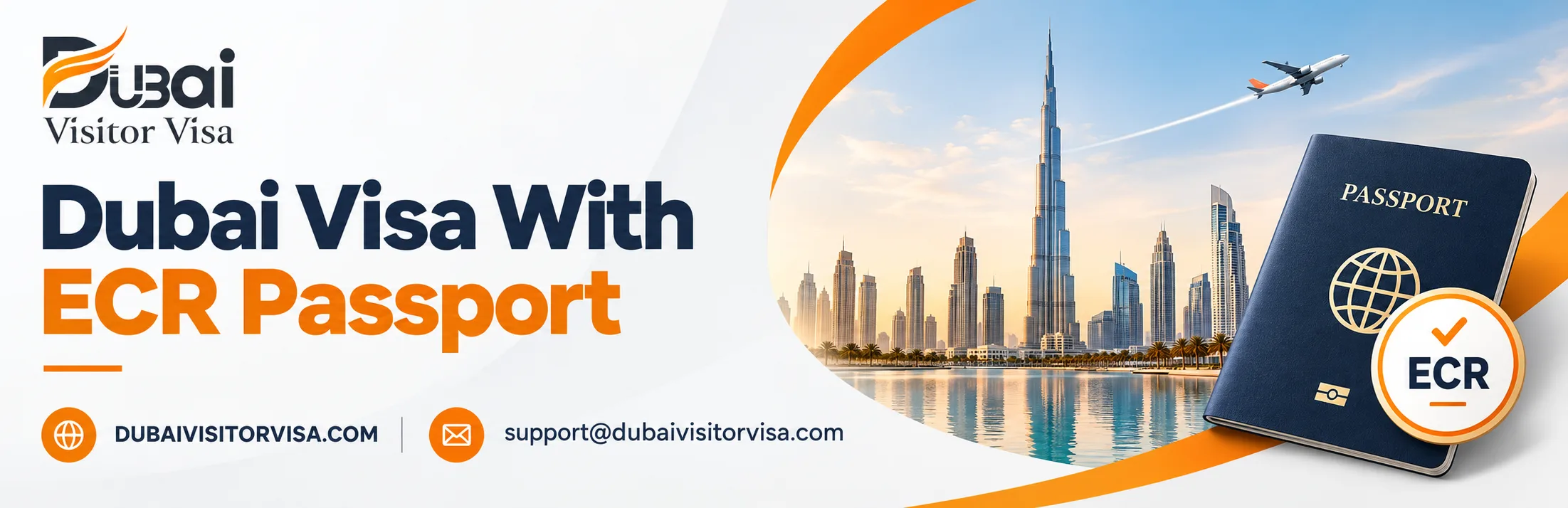
A Dubai visa with ECR passport is therefore not a special UAE visa category. ECR is an Indian emigration-control status, while the UAE separately decides which entry visa or permit your passport and travel purpose require. Most Indian ordinary-passport holders still need UAE entry permission before travel unless they qualify for a current special entry route.
Quick answer: An Indian traveller can visit Dubai with an ECR passport for tourism, family visits, study or other non-employment purposes without obtaining emigration clearance from the Protector of Emigrants. The ECR rule becomes important when an ECR passport holder leaves India to take up employment in the UAE or another notified ECR country.
ECR Passport + Dubai — 2026 Quick Guide
- Tourism / family visit: no Indian emigration clearance merely because the passport is ECR.
- Employment in UAE: ECR passport holders need emigration clearance before departure from India.
- Non-ECR passport: generally no Protector of Emigrants clearance is required.
- How to identify ECR: the passport itself carries the ECR endorsement; no ECR text normally means Non-ECR.
- Current notified ECR countries: 17.
- UAE visa: determined separately from ECR status.
- Indian special UAE routes: some ordinary-passport holders with qualifying foreign visas/residence permits can use special 14-day or 60-day entry routes.
Indian Passport Holder Planning a Dubai Visit?
Check the current India-specific UAE entry routes before choosing a standard tourist visa.
Review Dubai Visa Rules for IndiansDubai Visa With ECR Passport: What ECR Actually Means
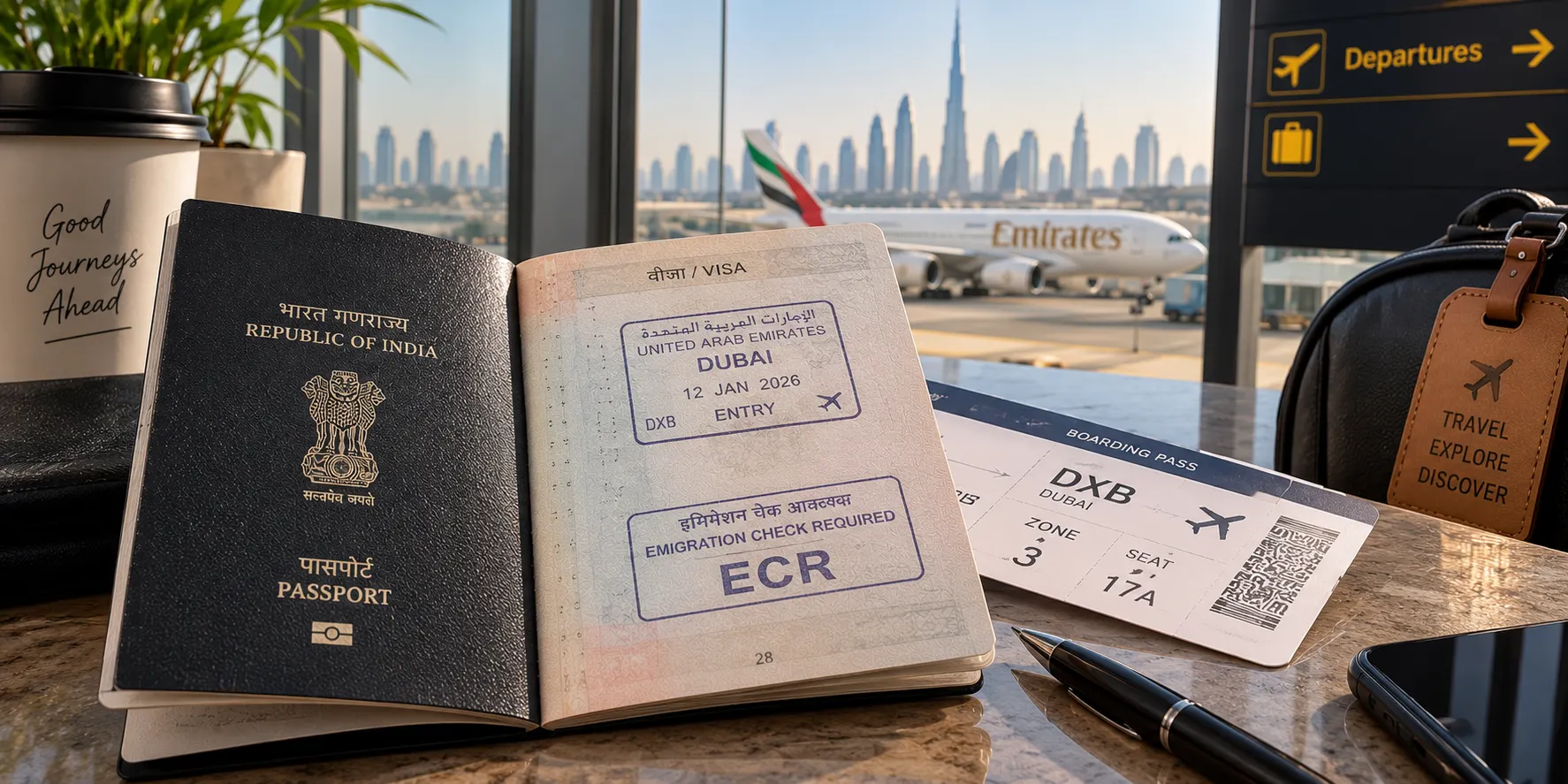
ECR stands for Emigration Check Required. It is an endorsement used on certain Indian passports under India's emigration-control system. The rule is designed to protect workers travelling to notified countries for overseas employment.
The key point is purpose. The current Ministry of External Affairs emigration guidance says ECR passport holders need emigration clearance when going to a notified ECR country for employment. It separately states that ECR passport holders travelling to those countries on visit, residence, study or other non-employment visas can travel with the required passport, visa and return ticket.
So an ECR passport Dubai visa question should never be answered with “ECR cannot travel to Dubai.” ECR does not block tourism. It creates an extra Indian emigration step for the employment route.
ECR vs ECNR Passport: How to Check Your Status
The modern term used by Passport Seva is Non-ECR, although many travellers still say ECNR. For an ECR vs ECNR passport check, the practical difference is simple.
| Status | What You See | Employment Travel to ECR Country |
|---|---|---|
| ECR | Passport carries an ECR / Emigration Check Required endorsement | PoE emigration clearance required |
| Non-ECR / ECNR | No ECR endorsement; Non-ECR is not separately printed | PoE clearance generally not required |
Passport Seva currently confirms that ECR status is printed in the passport for applicants who fall in the ECR category. For Non-ECR holders, there is no separate “ECNR” stamp or label.
The source article told travellers to register on eMigrate and look for an ECR/Non-ECR status inside a passport profile. I could not verify that as the current public method for checking passport category. eMigrate is central to overseas-employment registration and emigration-clearance workflows, but the clearest official status check remains the passport endorsement itself.
If you are unsure because an old booklet is damaged, unclear or being replaced, Passport Seva can confirm the category during a passport service or reissue process.
Does an ECR Passport Holder Need Emigration Clearance for Dubai Tourism?
No. An ECR passport holder Dubai trip for tourism or a family visit does not require PoE emigration clearance merely because the destination is the UAE.
MEA guidance allows ECR passport holders travelling to notified ECR countries for purposes other than employment to depart with the valid documents required for that journey. For a tourist, that means the Indian emigration issue is separate from obtaining the correct UAE visa or entry permission.
Do not confuse “ECR country” with “country you cannot visit.” The UAE appears on the employment-clearance list because of Indian worker-protection rules. It does not prevent ordinary tourism.
For the UAE side of the trip, start with the Dubai Visa on Arrival guide if you hold a qualifying foreign visa, residence permit or Green Card that may give you a special entry route.
Dubai Visa With ECR Passport: UAE Entry Rules for Indians
The source said every Indian passport holder needs a pre-arranged Dubai visitor visa regardless of circumstances. That is no longer accurate.
Most Indian ordinary-passport holders still need UAE entry permission before travel. However, current UAE rules also provide special entry options for qualifying Indian passport holders.
In June 2026, ICP expanded the “nationals of certain countries residing abroad” routes. For Indians, qualifying ordinary-passport holders can use special 14-day or 60-day visa routes when they hold a valid US, UK or EU visa/residence permit or US Green Card, or a qualifying residence permit from Japan, South Korea, Australia, Canada, Singapore or New Zealand, subject to the current service conditions.
Dubai also has a GDRFA arrival-related service for certain Indian citizens with qualifying US, UK or EU status. Because the exact channel and qualifying document matter, do not assume every Indian traveller uses the same arrival route.
ECR Status Does Not Create a Separate UAE Visa Category
The UAE does not publish one tourist visa called “ECR visa.” When immigration reviews a visitor application, it looks at the actual UAE service, passport, documents, travel purpose and immigration record. ECR is an Indian passport/emigration classification used for the employment-clearance system.
That means two Indian travellers can have different UAE entry routes even if both hold ECR passports. One may need a standard pre-arranged tourist visa, while another may qualify for a special 14-day or 60-day route because of a valid foreign visa or residence permit.
Check the qualifying foreign document itself as well as its validity; a residence permit, visa and Green Card are not interchangeable in every route. The Dubai Visitor Visa Types guide compares standard tourist visas with transit, visa-on-arrival/special entry and other visitor routes.
When Is Emigration Clearance for Dubai Required?
Emigration clearance for Dubai is required when an Indian citizen holds an ECR-endorsed passport and is travelling from India to the UAE to take up employment under the notified emigration system.
Current MEA guidance allows employment through:
- a registered recruiting agent;
- direct recruitment by a foreign employer; or
- a project exporter.
The source incorrectly suggested that ECR workers must always travel through a government-registered recruitment agency. Registered recruiting agents are one route, but direct foreign-employer recruitment also exists under the official system.
Likewise, Indian Mission attestation of the employment contract is not a universal requirement for every skilled worker. MEA guidance applies stricter attestation requirements to unskilled workers, women workers and certain specific employment situations.
How the Emigration Clearance Process Works for UAE Employment
If you hold an ECR passport and have a genuine UAE job offer, the process should run through the official overseas-employment system rather than through a tourist visa.
- Confirm the job and employer. Verify the foreign employer or recruiting agent before paying money or handing over original documents.
- Register through eMigrate where required. Direct recruits can register in the eMigrate system; recruiting agents use the same official framework for worker processing.
- Prepare the valid employment visa and contract. Requirements differ between skilled, semi-skilled, unskilled and vulnerable worker categories.
- Arrange PBBY insurance where required. MEA lists Pravasi Bharatiya Bima Yojana insurance in the emigration-clearance documentation for ECR workers.
- Submit the clearance request through the authorised channel. The Protector of Emigrants reviews the documents and can ask for corrections if anything is incomplete.
- Travel only after the required clearance is granted. Do not use a visitor visa as a shortcut to leave India for employment when the ECR route applies.
The source quoted a universal “3–7 working days” clearance time. I could not verify a single current MEA service standard that guarantees that timeline for every worker and document category, so the revised guide avoids promising it.
Current List of 17 ECR Countries
The current MEA page lists 17 countries for which ECR passport holders need emigration clearance when travelling for employment:
Afghanistan
Bahrain
Iraq
Indonesia
Saudi Arabia
Kuwait
Jordan
Libya
Lebanon
Malaysia
Oman
Qatar
Sudan
Syria
Thailand
United Arab Emirates
Yemen
The source mixed older references that showed 18 countries and included Brunei. The current MEA “Emigration Abroad for Employment” page lists 17 and does not include Brunei, so this guide follows the current 17-country list.
Who Qualifies for a Non-ECR Passport?
A Non-ECR passport is not limited to Class 10 graduates. Passport Seva currently lists multiple categories that can qualify when the applicant provides the required evidence.
Important examples include:
- persons who passed Matriculation/Class 10 or higher;
- gazetted government servants and qualifying spouses/dependent children;
- income-tax payers and qualifying spouses/dependent children;
- professional degree holders and qualifying family members;
- recognised nurses;
- persons above 50 years of age;
- children up to 18 years, subject to the passport rules that apply when they later reach adulthood;
- persons who stayed abroad for more than three years and qualifying spouses;
- certain recognised vocational/polytechnic diploma holders;
- eligible seafarers/cadets; and
- holders of specified permanent immigration visas or residence documents.
The source also listed “former government employees with three years of service” as a general Non-ECR category. That is not part of the current Passport Seva Non-ECR document list I verified, so it has been removed.
How to Remove ECR From an Indian Passport
If you now qualify for Non-ECR status, you can apply for passport reissue/deletion of the ECR endorsement through Passport Seva.
The current reissue process asks whether the applicant is eligible for Non-ECR and directs the applicant to submit the supporting evidence for the relevant category. Passport Seva's current fee structure lists ECR deletion under passport reissue: ₹2,500 for a 36-page 10-year booklet or ₹3,500 for a 60-page booklet, with the applicable Tatkaal fee added if used.
Typical supporting evidence depends on the category. For example, a Class 10 pass applicant uses the matriculation/higher-education pass certificate; an income-tax category has its own current proof requirements; a professional category uses the relevant qualification.
Do not assume Aadhaar, utility bills and passport-size photographs are always the defining ECR-removal documents. Passport reissue has its own document-advisor rules, and the Non-ECR proof is category-specific.
Dubai Tourist Visa Documents for an ECR Passport Holder
ECR status does not create a special tourist-document list for Dubai. The UAE tourist application follows the requirements of the visa service you actually use.
For the standard GDRFA tourist route, current published conditions include passport validity of at least six months, a travel ticket to continue the journey or leave the UAE, and UAE-valid medical insurance. The standard document list also includes a personal photo and passport copy, with additional national-ID requirements for certain nationalities.
For an Indian visitor, the Dubai Visitor Visa Requirements guide keeps the current immigration checklist separate from ECR employment rules.
What to Carry at the Indian Airport on an ECR Tourist Trip
For non-employment travel to a notified ECR country, keep the purpose of travel easy to demonstrate. The immigration officer may need to distinguish a genuine visit from overseas employment that should have gone through the emigration-clearance system.
- Valid passport: use the same passport linked to the UAE entry permission.
- Valid UAE visa or entry permission: keep a digital and offline copy.
- Return/onward ticket: MEA guidance specifically lists a return ticket for ECR passport holders travelling to notified countries for non-employment purposes.
- Trip evidence: hotel, host or itinerary information can help explain the visit if an airline or immigration officer asks about the purpose.
- Employment documents only when relevant: if the true purpose is work, do not present the trip as tourism to bypass the clearance process.
The goal is not to create an extra tourist-document burden. It is to keep the Indian emigration purpose and the UAE visa purpose consistent with each other. For an ECR passport Dubai visa trip, that consistency matters more than carrying a generic stack of unrelated papers.
Return Ticket and Indian Emigration Check for Non-Employment Travel
MEA guidance for ECR passport holders travelling to notified countries for purposes other than employment includes a valid passport, the valid visit/residence/study visa or other permission, and a return ticket.
That return-ticket point is an Indian departure/emigration consideration as well as a common UAE tourist condition. Make sure the onward or return travel genuinely takes you out of the UAE and remains consistent with your authorised stay.
Recheck the return booking after any airline schedule change so the itinerary still matches the intended non-employment visit. The Dubai Flight Ticket Requirement guide explains the difference between a genuine return/onward booking, a temporary reservation and a fake “dummy ticket.”
If Your Trip Changes From Visit to Employment
This is one of the most important ECR risk points. A traveller may enter or plan to enter the UAE for a visit and later receive a job offer. That does not mean the original visitor journey can automatically be treated as the correct Indian emigration route for employment.
If you are still in India and the real purpose has changed to taking up a UAE job, check the employment visa, eMigrate and PoE requirements before departure. Do not rely on a visitor visa merely because it was already issued.
If you are already in the UAE, UAE work-authorisation and residence rules also apply before employment starts. The Indian ECR system and UAE work-permit system solve different legal problems, so satisfying one does not replace the other.
Using a tourist route to avoid an employment-clearance requirement can create airport problems and reduce the protections the emigration system is designed to provide. An ECR passport holder Dubai employment case should therefore be handled as employment from the beginning, not converted informally at the airport.
Ok to Board for Indian ECR Passport Holders
Ok to Board is an airline document-verification process, not an Indian ECR clearance and not a second UAE visa.
The source handled this point cautiously, and that is the right approach. OTB requirements vary by airline, departure airport, passport/visa status and route. ECR alone does not create one universal OTB rule. Check the operating carrier again if the flight or visa details change.
Flying From India on a UAE eVisa?
Check the operating airline's current Ok to Board rule instead of assuming every ECR passport needs the same airline verification.
Check Dubai Ok to Board RulesCommon ECR Passport Mistakes Before a Dubai Trip
- Assuming ECR passport holders cannot visit Dubai for tourism.
- Confusing Indian emigration clearance with a UAE tourist visa.
- Using an old 18-country list instead of the current MEA 17-country list.
- Including Brunei in the current ECR-country list.
- Relying on an unverified “online ECR checker” instead of the passport endorsement.
- Assuming every Indian passport holder needs the same pre-arranged UAE tourist visa.
- Travelling on a visitor visa when the true purpose is employment.
- Believing every ECR worker must use a recruiting agent; direct foreign-employer recruitment can also exist under the official system.
- Assuming every employment contract needs the same Indian Mission attestation process.
- Using a fixed 3–7 day emigration-clearance promise without a current service guarantee.
Dubai Visa With ECR Passport: Final 2026 Checklist
- Check whether the passport actually carries the ECR endorsement.
- If there is no ECR endorsement, treat the passport as Non-ECR unless Passport Seva advises otherwise.
- Decide whether the Dubai trip is tourism/visit or employment.
- For non-employment travel, do not apply for PoE clearance merely because the UAE is an ECR country.
- For UAE employment on an ECR passport, complete the required emigration-clearance process before departure.
- Use the current 17-country MEA list, not older 18-country references.
- Check whether your Indian passport qualifies for a special UAE 14-day or 60-day entry route.
- Keep the correct return/onward ticket for non-employment travel.
- Check airline OTB requirements separately from ECR.
- If you qualify for Non-ECR, use Passport Seva reissue/deletion of ECR rather than relying on informal workarounds.
A Dubai visa with ECR passport is mainly a question of keeping Indian emigration law and UAE immigration law separate. For tourism, ECR does not stop you from visiting Dubai. For employment, it can trigger the Indian emigration-clearance process. A final Dubai visa with ECR passport check should confirm your passport endorsement, travel purpose, UAE entry route and airline requirements before departure.
Need a Pre-Arranged Dubai Visitor Visa?
If your Indian passport does not qualify for a special entry route, choose the visitor visa from your stay length and number of entries.
Review Dubai Visitor Visa Options