PRESS
PRESS 


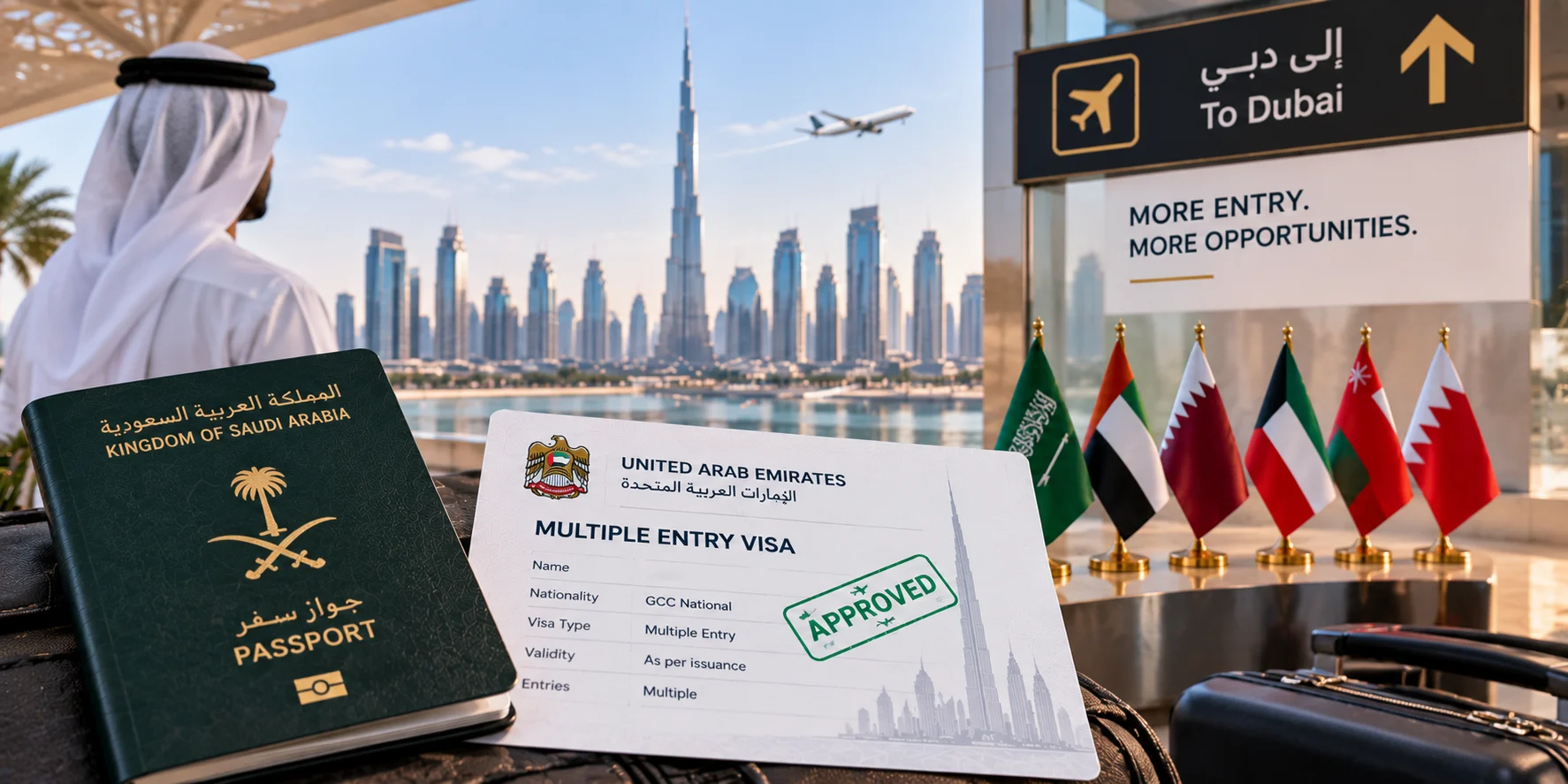
Quick answer: A Dubai multiple entry visa for GCC nationals is normally unnecessary. Citizens of Bahrain, Kuwait, Oman, Qatar and Saudi Arabia do not need a UAE visa for normal entry. They use the GCC citizen entry arrangement instead of buying a 30-day, 60-day or 5-year tourist visa.
The key distinction is citizenship versus residence. A foreign national living in a GCC country is a GCC resident, not a GCC national. That traveller may need a UAE eVisa or another route, depending on passport nationality and current eligibility.
GCC Travel to Dubai — Quick 2026 Guide
- GCC citizens: Bahrain, Kuwait, Oman, Qatar and Saudi Arabia passport holders do not need a UAE visa for normal entry.
- GCC residents: foreign passport holders living in a GCC country use a separate UAE entry-permit route if eligible.
- GCC resident eVisa stay: current UAE guidance lists 30 days, extendable once for another 30 days.
- GCC residence validity: normally at least 1 year from arrival for the GCC-resident eVisa route.
- Passport validity: at least 6 months for the GCC-resident route.
- Short tourist multiple entry: GDRFA currently lists 30-day and 60-day tourism-establishment-sponsored options.
- 5-year tourist visa: self-sponsored route for qualifying foreign travellers; GCC citizens do not need it merely to enter Dubai repeatedly.
Not Sure Whether You Are Visa-Free?
Check your passport nationality first. GCC citizenship, GCC residence and visa-on-arrival eligibility are different entry routes.
Check Dubai Visa EligibilityDubai Multiple Entry Visa for GCC Nationals: Do Citizens Need One?
No. The official UAE entry guidance states that GCC citizens do not need a visa to enter the UAE.
This covers citizens of Bahrain, Kuwait, Oman, Qatar and Saudi Arabia. UAE citizens are already nationals of the country. For these GCC passport holders, normal Dubai travel does not require a pre-arranged tourist visa.
That means a UAE visa for GCC citizens should not be sold as if it were a standard requirement. Repeat trips also do not make a GCC citizen need a tourist multiple-entry visa. Each trip must still meet current border and travel-document rules. The entry basis is GCC citizenship, not a 30-day or 60-day tourist visa.
GCC Nationals vs GCC Residents: The Difference That Matters
| Traveller Type | Example | Normal UAE Entry Position |
|---|---|---|
| GCC national / citizen | Saudi, Omani, Bahraini, Kuwaiti or Qatari passport holder | No UAE visa normally required |
| GCC resident | Indian, Pakistani, Filipino, Egyptian or another foreign passport holder living in a GCC country | May need the GCC-resident eVisa or another eligible UAE entry route |
| Visa-on-arrival passport holder | Traveller whose passport qualifies under current UAE arrival rules | May not need a pre-arranged tourist visa |
| Advance-visa traveller | Passport holder without visa-free or arrival eligibility | Needs the correct approved visa before travel |
This distinction fixes the main issue in the old article. It discussed general multiple-entry tourist visas under a GCC-national URL, even though GCC citizens do not need that product for normal entry.
If you live in Saudi Arabia, Kuwait, Qatar, Bahrain or Oman but hold another country's passport, you are a GCC resident rather than a GCC national. Use the separate resident eVisa rules instead of treating residence as citizenship.
Dubai Visa for GCC Residents: Current eVisa Route
A Dubai visa for GCC residents is relevant to expatriates who legally live in another GCC state. Current UAE guidance says GCC residents and companions should obtain the eVisa before arrival unless another passport-based route already applies.
The current GCC-resident route lists these key conditions:
- Stay: 30 days from entry.
- Extension: once for another 30 days.
- GCC residence: normally valid for at least 1 year from the UAE arrival date.
- Passport: at least 6 months from arrival.
- Profession: subject to the professions accepted by the concerned authority.
This is not the standard 30-day multiple-entry tourist visa. The GCC-resident entry permit has its own rules. If the traveller's passport already qualifies for visa-free entry or visa on arrival, that route may be simpler than applying as a GCC resident.
Country of residence alone does not decide most visa-on-arrival cases. Passport nationality and any special qualifying status must be checked separately.
What Counts as GCC Residence?
A GCC residence permit can be a Saudi Iqama, Kuwait residence card, Qatar residence permit, Bahrain residence permit or Oman residence status issued to a foreign national. It does not change the nationality printed on the passport.
That distinction matters at airline check-in. A traveller should present the passport and the valid GCC residence document that supports the eVisa route. If either document is close to expiry, the route may fail even though the person has lived in the GCC for years.
Do not select “GCC citizen” on an application simply because you work or live in a GCC state. Citizenship is a nationality status. Residence is an immigration status. Using the wrong category can cause an avoidable application problem.
Living in a GCC Country but Not a GCC Citizen?
Use the GCC-resident route only if it matches your passport, residence status and profession. Do not select GCC citizenship unless you actually hold a GCC passport.
Review GCC Resident Visa RulesBefore using the GCC-resident route, check the residence card itself. Make sure the name matches the passport, the residence has enough remaining validity, and the job or profession details are current where the authority evaluates them. An expired or mismatched GCC residence record can block a route that otherwise looks eligible.
Could a GCC Resident Use Visa-Free or Visa-on-Arrival Entry Instead?
Sometimes. A foreign resident of a GCC country may hold a passport that already qualifies for visa-free entry or a visa-on-arrival route. In that case, applying through the GCC-resident eVisa can be unnecessary.
Check the passport before the residence card. A British, French, Australian or other passport with its own UAE arrival rule does not lose that passport-based route simply because the traveller also lives in Saudi Arabia, Qatar or another GCC state.
Special conditional routes can also depend on a foreign visa or residence document. Those rules are different from GCC residence. Keep each eligibility basis separate so the airline can see exactly why the traveller expects entry.
If two routes appear possible, use the one clearly supported by the current authority guidance and your documents. Do not buy a pre-arranged visa only because it looks more formal.
For example, residence in Saudi Arabia does not cancel the traveller's passport rights. If the passport itself has a UAE arrival route, check that route first. The same principle applies to a traveller who qualifies under a special foreign-residence or foreign-visa category.
Do not assume the GCC-resident permit is automatically the “strongest” option. The best entry route is the one the traveller actually qualifies for and can prove at check-in and immigration.
Before paying for any pre-arranged visa, compare the passport rules in the Dubai Visa on Arrival guide.
At check-in, carry the document that supports the route you plan to use. That may be a GCC passport, a GCC residence card, or another qualifying visa or residence permit. An airline agent needs to verify the actual entry basis, not a general statement that you “live in the Gulf.”
When a Multiple-Entry Tourist Visa Is Actually Relevant
A short tourist multiple-entry visa suits a traveller who needs an advance visa and plans to leave the UAE and return. It is not a special visa for GCC citizens.
Current GDRFA tourism-establishment services list two standard short multiple-entry tourist durations: 30 days and 60 days. A licensed tourism establishment sponsors or hosts that tourist route.
Current government fees are AED 300 plus 5% VAT for 30 days and AED 500 plus 5% VAT for 60 days. GDRFA's current service page does not list a security-deposit amount for these standard tourism-establishment multiple-entry visas.
Who Should Not Buy a Short Multiple-Entry Tourist Visa?
A GCC citizen should not buy one merely because they plan several Dubai trips. A traveller who needs only one UAE entry should compare the cheaper single-entry route. A person who already has visa-free or arrival-based entry should check whether a pre-arranged tourist visa adds any real benefit.
A multiple-entry tourist visa is useful when the itinerary actually contains an exit and return. Examples include Dubai plus Oman, a cruise itinerary with another UAE call, or repeat business meetings where the traveller must leave the country between visits.
Choose from the travel pattern, not from the idea that “multiple entry is better.” It normally costs more than the equivalent single-entry product, and unnecessary complexity does not improve approval chances.
Before buying either product, check the wider Dubai Visitor Visa Types guide. A single-entry visa, arrival route, GCC-resident permit or five-year tourist visa may fit better.
Also separate visa validity from permitted stay. A multiple-entry label tells you that re-entry is allowed under the permit. It does not by itself tell you how many days you may remain after each entry or whether unused days carry forward. Read the issued visa rather than relying on a generic product name.
30 Day Multiple Entry Dubai Visa
A 30 day multiple entry Dubai visa can suit an advance-visa traveller who needs more than one UAE entry during a short trip. A common example is a traveller who visits Dubai, takes a regional side trip and then returns to the UAE.
GDRFA currently lists AED 300 plus 5% VAT as the government visa fee for the 30-day short tourist multiple-entry service. The public service also lists a personal photo and passport copy as core documents, with normal passport, ticket and insurance conditions applying to the tourist route.
Do not assume the stay automatically resets after each re-entry. The issued visa and authority record control the exact stay and re-entry conditions. Check the last-entry date and permitted stay on the actual visa before booking a trip that depends on re-entry.
30-Day Multiple Entry vs GCC-Resident eVisa
These routes can look similar because both use a 30-day figure, but they are not the same service. The GCC-resident permit is based on residence in another GCC country and has its own profession and residence-validity conditions.
The short multiple-entry tourist visa is based on a tourism-establishment-sponsored tourist route and is designed for more than one UAE entry. Do not switch between the two labels when comparing fees or documents.
The dedicated 30-Day Multiple Entry Dubai Visa page keeps the short product separate from the GCC-resident and five-year routes.
Choosing Between 30 and 60 Days
The decision should come from the total travel plan. If all UAE stays fit comfortably inside the shorter product, paying for 60 days may add no value. If the trip includes a longer family visit, extended business schedule or several regional movements, the 60-day category can provide more room.
Count the planned UAE days conservatively and leave a buffer. Do not build the itinerary around the final legal day. Flight changes, medical issues or a missed connection can turn an exact-limit plan into an overstay problem.
Also check whether you truly need multiple entry. A traveller spending 45 continuous days in Dubai needs a longer stay, but not necessarily multiple entry. A traveller spending 15 days in Dubai, 5 days in Oman and then returning to Dubai needs re-entry capability even though the total UAE stay is shorter.
60 Day Multiple Entry Dubai Visa
A 60 day multiple entry Dubai visa gives the same general re-entry benefit but with a longer permitted stay category. It is useful when 30 days is too short and the traveller still needs to leave and re-enter.
GDRFA currently lists AED 500 plus 5% VAT as the government visa fee for the standard 60-day tourism-establishment-sponsored multiple-entry service.
As with the 30-day option, do not invent an “unlimited entries” rule or a guaranteed reset after every arrival. The public GDRFA service confirms multiple entry, but the exact entry and stay conditions on the issued permit should guide the itinerary.
Keep the approved visa PDF available while travelling. Check the passport number, visa type, last-entry date and stay details before every planned return to the UAE. If the wording is unclear, confirm it with the sponsor or issuing authority before leaving the country.
For the product-specific details, use the 60-Day Multiple Entry Dubai Visa page.
What About a 90-Day Multiple-Entry Visa?
The old article treated 30, 60 and 90 days as one tourist multiple-entry ladder. Current GDRFA services show a different structure.
The standard tourism-establishment multiple-entry service currently lists 30 and 60 days. GDRFA separately publishes a multi-entry visa for visiting a relative or friend for 30, 60 or 90 days. That relative/friend route has different documents, insurance charges and a financial guarantee.
Do not market the relative/friend 90-day service as if it were simply the “next tourist visa size.” The purpose and document route matter.
Dubai 5-Year Multiple-Entry Tourist Visa
The five-year visa is a separate product. It suits foreign travellers who make repeat UAE tourism visits and meet the financial and document rules.
GDRFA currently lists:
- Five-year visa validity.
- No UAE guarantor or host required.
- Passport valid for at least six months.
- Six-month bank statement.
- Valid health insurance.
- Round-trip or onward travel evidence.
- Bank balance of USD 4,000 or equivalent during the six months before application.
- Up to 90 days in a year, extendable for a similar period, with the total stay capped at 180 days in that year.
- Expected service completion of 48 hours after a complete request reaches the service.
The current GDRFA fee schedule totals about AED 3,713 including the AED 3,000 guarantee and listed service components, although the final amount can vary by the case.
For a GCC citizen, none of this is needed merely to make repeated normal trips to Dubai. A GCC citizen already uses the GCC visa-free entry arrangement.
Dubai Multiple Entry Visa for GCC Nationals: Common Misunderstandings
- “I live in Saudi Arabia, so I am a GCC national.” Not unless you hold Saudi or another GCC citizenship.
- “A GCC residence card gives unlimited UAE entry.” No. Foreign GCC residents follow their own eVisa or passport-based route.
- “Every repeat traveller needs a multiple-entry visa.” No. GCC citizens and some visa-on-arrival travellers may not need a pre-arranged tourist visa.
- “A 90-day multi-entry visa is just the larger tourist version.” Not under the current GDRFA service structure; the 90-day relative/friend route is a different service.
- “The five-year visa is best for every frequent traveller.” No. It has financial conditions and is unnecessary for GCC citizens who already enter visa-free.
- “Multiple entry means the stay always resets.” Do not assume that. Follow the issued visa conditions.
The GCC nationals Dubai visa search often starts from the wrong assumption that nationality and residence are interchangeable. For a normal UAE visa for GCC citizens search, the correct answer is usually visa-free GCC entry. Check the passport first, then residence status, then the trip pattern.
Documents for GCC Citizens vs GCC Residents
For a GCC nationals Dubai visa trip, a GCC citizen travelling under the GCC entry arrangement should carry the current travel document accepted for that trip and comply with airline and border checks. They do not prepare the passport/photo/sponsor pack used for a standard tourist multiple-entry visa simply because they plan to visit Dubai more than once.
A foreign GCC resident applying for the separate resident route should prepare the passport and GCC residence evidence required by the issuing authority. Residence validity and profession are important parts of that route.
An advance-visa traveller applying for a short tourist multiple-entry visa uses the relevant tourist documents. A five-year applicant adds the bank and insurance evidence required for that self-sponsored service.
Processing Time and Approval
Do not use one processing promise across every route. GCC citizens do not have a tourist-visa application to process for normal entry. GCC-resident eVisas, short tourist multiple-entry visas and the five-year tourist visa are different services.
GDRFA lists 48 hours as an expected completion benchmark on several current visitor services after a complete request reaches the authority. That does not guarantee approval within 48 hours.
Document corrections, immigration review, sponsor handling, weekends and public holidays can extend the end-to-end time.
Dubai Multiple Entry Visa for GCC Nationals: Which Route Actually Applies?
| Your Situation | Likely Route to Check First |
|---|---|
| Saudi, Omani, Bahraini, Kuwaiti or Qatari citizen | GCC citizen visa-free entry arrangement |
| Foreign passport holder living in a GCC country | GCC-resident eVisa or another passport-based route |
| Advance-visa traveller needing one UAE entry | Single-entry tourist visa |
| Advance-visa traveller needing exit and re-entry | 30-day or 60-day tourist multiple-entry visa |
| Frequent foreign tourist over several years | Five-year multiple-entry tourist visa if financial conditions are met |
| Visiting relative/friend with 30/60/90-day need | Relative/friend multi-entry visit service |
When the passport and travel pattern are still unclear, use the visa-type comparison before paying. The goal is simple: do not buy a visa your passport does not need.
Need an Advance Visa After Checking Eligibility?
If you are not a GCC citizen and your passport needs a pre-arranged visa, choose the entry type from your actual stay and re-entry plan.
Review Dubai Visitor Visa OptionsFinal GCC Citizen and Resident Checklist
- Check whether you are a GCC citizen or only a GCC resident.
- If you hold a GCC passport, do not buy a normal tourist multiple-entry visa just for repeat Dubai visits.
- If you are a GCC resident with another passport, check the resident eVisa rules.
- Check whether your passport already qualifies for visa-free or visa-on-arrival entry.
- If you need an advance tourist visa and plan to exit and return, compare the 30-day and 60-day multiple-entry routes.
- Use the five-year tourist visa only when its financial and travel pattern make sense.
- Do not treat the 90-day relative/friend service as a generic tourist multiple-entry product.
- Read the conditions printed on the issued visa before planning re-entry.
The safest answer to the Dubai multiple entry visa for GCC nationals query is simple: GCC citizens normally do not need a UAE tourist visa at all. A Dubai multiple entry visa for GCC nationals should therefore not be sold as a routine requirement. The visa question becomes relevant when the traveller is a foreign GCC resident or another passport holder who needs advance permission to enter.