Dubai Free Zone Visa 2026: Cost, Types, Requirements & Application Process
07-Aug-2026 0 Comments 1000 Views
Priyanshu Raghav
Dubai Free Zone Visa — Information Verification
Last fully checked: 7 August 2026
Official and free-zone sources checked: UAE Government Portal (u.ae), GDRFA Dubai, ICP UAE, Jebel Ali Free Zone (JAFZA) Resource Centre, DMCC official guidance, plus multiple current UAE business-setup and immigration publications for cost cross-referencing.
Free-zone visa rules, fees, visa quota and residence validity vary by authority. Any specific price, quota or validity example on this page is labelled with the applicable free zone and the date it was checked. Where our research found differing figures across sources, we show the range rather than picking one number.
Search "Dubai free zone visa" and you'll get a different answer depending on who's writing: one guide quotes AED 3,500, another quotes AED 22,000, and a third skips cost entirely. None of them are lying — they're describing different free zones, different visa categories and different packages as if they were one product. They aren't. This guide starts from that fact and works through what actually changes the number: your route (investor or employee), your free zone, your office/licence package, and whether you're applying from inside or outside the UAE.
What Is a Dubai Free Zone Visa?
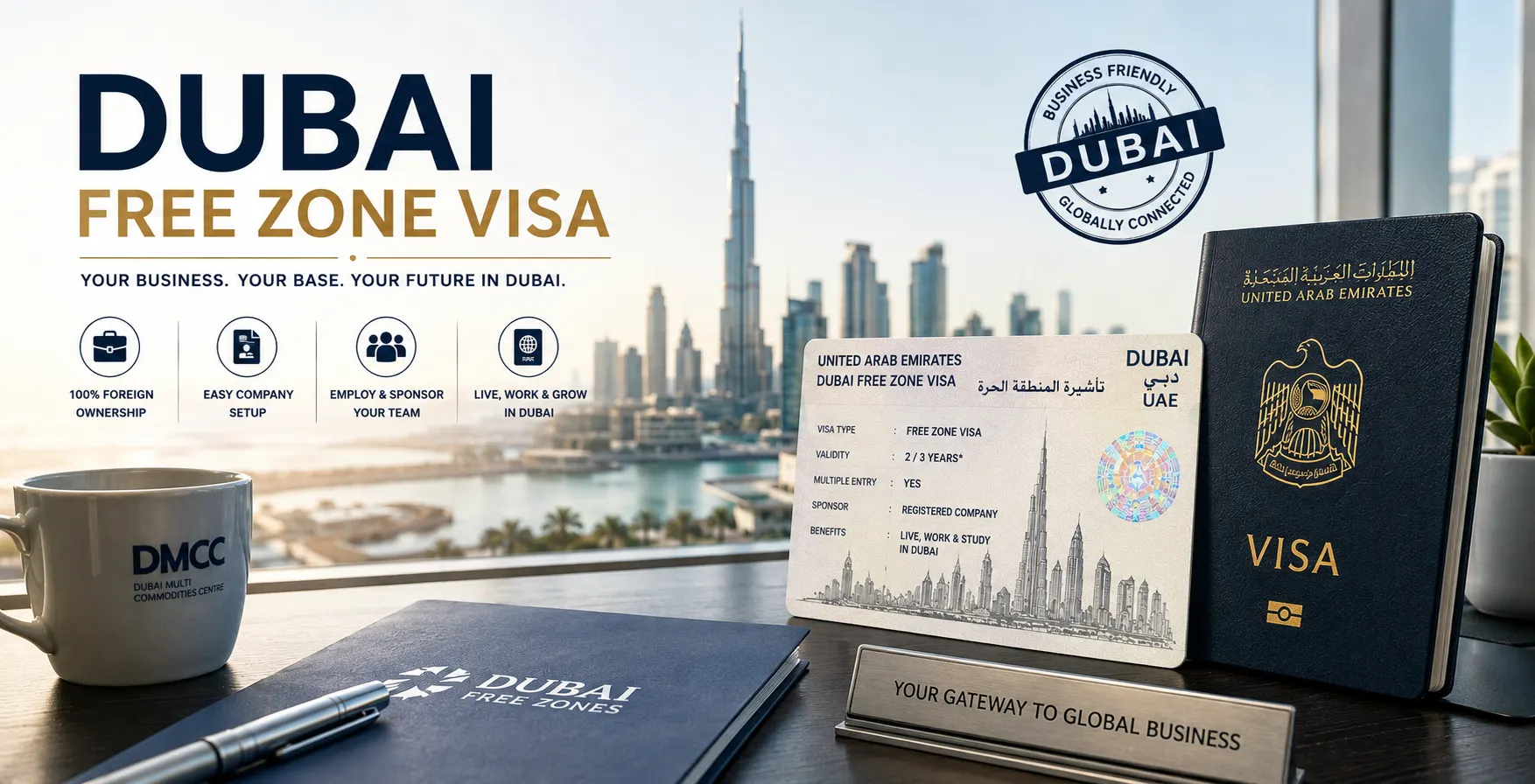
"Dubai free zone visa" is an umbrella term, not one official visa product. It covers any UAE work/residence route connected to a Dubai free-zone company or authority. A company owner or shareholder typically uses an investor or partner residence route; an employee typically follows their employer's work-authorisation and residence process. Costs, visa quota, validity and documents are set by the individual free zone and applicant type — not by one federal price list. If a page promises one universal fee, one universal quota or one universal validity for "the" free zone visa, treat that as a red flag rather than a fact.
The foundation of this whole guide: Free Zone Visa is an umbrella term → identify your applicant route → identify the company relationship → confirm visa quota → calculate the full cost → complete the residence process. A free-zone company licence, a work permit and a UAE residence visa are related but legally separate things, and a cheap "company setup" headline price is rarely the full cost of UAE residence.
Which Free Zone Visa Route Do You Need?
| Your Situation | Route to Research |
|---|---|
| Starting your own free-zone company | Investor / partner residence |
| Shareholder in a free-zone company | Investor / partner route |
| Hired by a free-zone company | Employee work + residence route |
| Already a UAE resident, joining a free-zone employer | Authority-specific work authorisation |
| Working independently across multiple clients | Freelancer permit route (separate product) |
| Sponsoring a spouse or children | Dependent residence, added after your own visa |
Dubai Free Zone Visa — Quick Facts
| Question | Answer |
|---|---|
| One universal free-zone visa? | No — it depends on the free zone and applicant type |
| Investor route available? | Yes, subject to company ownership/shareholding |
| Employee route available? | Yes, employer-sponsored |
| Does the licence always include a visa? | No — depends on the package tier |
| Is visa quota universal? | No — depends on free zone, package and workspace |
| Is a work permit the same as a residence visa? | No — related but legally separate |
| Establishment/immigration card needed? | Yes, before any visa can be sponsored |
| Medical fitness required? | Yes, for adult residence applicants |
| Emirates ID required? | Yes, as part of residence processing |
| Is the cost universal? | No — see the cost breakdown below |
| Is validity universal? | No — commonly 1, 2 or 3 years depending on zone and package |
| Final authority | The relevant free zone, GDRFA Dubai and ICP |
Who Can Get a Dubai Free Zone Visa?
At least four distinct situations fall under this search term, and each has a different process.
Business Owners and Shareholders
Residence is tied to a genuine, documented ownership or shareholding relationship in a free-zone-licensed company — not simply to "wanting" a visa.
Employees
Residence follows from an employment relationship plus the sponsoring free-zone company's work-authorisation and immigration process.
Existing UAE Residents
Some applicants already hold UAE residence through another route and only need authority-specific work authorisation to take up a free-zone role, rather than a brand-new residence visa.
Freelancers
Freelancing is a related but structurally different route — a freelance permit paired with a self-sponsored residence visa, rather than a company-and-employee or company-and-investor relationship. It isn't covered in depth here; see your site's dedicated freelancer visa guide for eligibility, cost and process specific to that route.
Dubai Free Zone Investor Visa
A free-zone investor or partner visa is linked to a real, licensed business relationship — documented company ownership or shareholding — not to a payment on its own. The general sequence is: company incorporation and trade licence → establishment/immigration registration → investor/partner entry permit → medical fitness → Emirates ID → residence issuance. Eligibility thresholds are set by the individual free zone, not federally. As one concrete, dated example: DMCC's published guidance (checked 7 August 2026) states that partner and investor visas at DMCC require a share certificate showing a minimum of 50 shares, amounting to a total share capital of AED 50,000, and that a DMCC investor visa is valid for three years. That figure applies to DMCC specifically — it is not a UAE-wide investor-visa threshold, and other free zones set their own share-capital and eligibility rules. For the full cross-route cost comparison — including how a free-zone investor visa compares against a mainland company investor visa and a property investor visa — see our dedicated Dubai Investor Visa Cost guide, which carries a full free-zone cost table. This page focuses on where the free-zone investor route sits inside the wider free-zone visa journey — company relationship, quota and process — rather than repeating that cost table in full.
Dubai Free Zone Employment Visa
The employee route is the most commonly searched free-zone visa type. Conceptually, the flow looks like this: Employment relationship → Free-zone work authorisation → Entry permit / in-country status change → Medical fitness → Emirates ID → Residence issuance The employer — not the employee — initiates and funds the process in the large majority of cases. The free-zone authority manages its side of the immigration relationship with GDRFA Dubai (or ICP at the federal level), so an employee typically deals with one authority end-to-end rather than the two separate systems (MOHRE plus GDRFA/ICP) that apply to Dubai mainland employment. Not every free zone runs an identical workflow — some steps, timelines and document requirements differ by authority — so treat the sequence above as the general shape, not a fixed script for every zone.
Free Zone Visa vs Work Permit
| Free-Zone Work Permit / Authorisation | UAE Residence Visa |
|---|---|
| Authorises legal work with the sponsoring employer | Authorises UAE residence |
| Employment-related | Immigration-related |
| Linked to the employer/free-zone authority | Tied to UAE residence status generally |
| Does not by itself grant residence | Does not by itself authorise a different job |
They are related but are not the same document or the same legal function. For the mainland/MOHRE side of work authorisation specifically, see our UAE Work Permit guide.
Free Zone Visa vs Freelancer Visa
| Feature | Free-Zone Company Route | Freelancer Route |
|---|---|---|
| Company entity | Usually required for the owner route | Typically a permit, not a full company |
| Staff hiring | Possible, subject to visa quota | Generally not — individual-focused |
| Shareholders | Possible | Not the same structure |
| Business activities | Set by the trade licence | Set by the approved freelance activity list |
| Residence route | Company/free-zone linked | Self-sponsored, permit-linked |
If independent, multi-client work without a company structure is what you're actually looking for, the freelancer route is usually the better starting point than a full free-zone company.
Free Zone Investor Visa vs Employee Visa
| Feature | Investor / Partner | Employee |
|---|---|---|
| Basis | Ownership / shareholding | Employment relationship |
| Company relationship | Owner or shareholder | Staff member |
| Employment contract | Not the same requirement as the employee route | Usually required |
| Trade licence | Applicant/company relationship is central | Employer owns and holds the licence |
| Visa sponsorship | Company/free-zone structure | Employer/company |
| Effect on quota | Company may go on to sponsor staff | Employee consumes part of the company's quota |
| Renewal driver | Business/licence status | Employment status |
Never treat one universal validity figure as applying to both routes — DMCC's investor visa, for example, is quoted at three years, while employee visas across free zones are more commonly quoted at two years, renewable. Confirm the figure for your specific zone before relying on it.
Dubai Free Zone Visa Requirements
Investor / Partner — Typical Documents
- Passport and photograph
- Company trade licence
- Incorporation and shareholding documents (e.g. share certificate)
- Establishment/immigration card
- Entry permit or in-country status-change documents
- Medical fitness clearance
- Emirates ID application
- Health insurance where applicable
- Free-zone-specific forms
Employee — Typical Documents
- Passport and photograph
- Offer letter / employment contract
- Employer sponsorship documents
- Education certificate, where the role or free zone requires it
- Work-authorisation documents from the free zone
- Medical fitness clearance
- Emirates ID application
- Health insurance
- Free-zone-specific forms
Exact requirements must be checked with the chosen free-zone authority — the lists above are typical, not a guaranteed or universal checklist.
Do You Need a Company Before Getting a Free Zone Visa?
For the investor/company-owner route, yes in effect: the residence application generally depends on a qualifying licensed company or ownership relationship already existing. The typical sequence is: Choose free zone → Create company/licence → Establishment/immigration registration → Confirm visa quota → Residence process For the employee route, the company already exists — it's your prospective employer's, not yours — so this step doesn't apply to you directly, but it does explain why an employer's own establishment card and quota status affects how quickly your visa can move.
What Is a Free Zone Establishment Card?
An establishment (or immigration) card is company-level registration that creates the company's immigration profile with GDRFA Dubai (or ICP for the other emirates), so the company can then apply for entry permits and residence visas on behalf of eligible applicants. Per the UAE Government's own guidance on recruiting in free zones, a free-zone company generally needs this registration — and confirmed visa quota — in place before any employment or investor visa can be processed. The trade licence and the immigration profile are not automatically the same thing, and some advertised "cheap setup" packages do not include every immigration-side component needed to actually sponsor a visa.
Does a Dubai Free Zone Licence Include a Visa?
Not always. Package structures typically fall into a few tiers: licence-only/zero-visa packages, one-visa packages, multi-visa packages, and packages that separate the establishment card and immigration setup from the licence fee entirely.
Free-zone licence price and complete UAE residence cost are not the same figure. A headline "company setup from AED X" quote frequently covers only the trade licence and registration — the establishment card, visa allocation, entry permit, status change, medical, Emirates ID and insurance are commonly priced on top, and sometimes only appear once you ask for an itemised breakdown.
Dubai Free Zone Visa Quota Explained
There is no single UAE-wide free-zone visa quota. Quota is set per company by the free-zone authority and typically depends on:
| Factor | Can Affect Visa Quota? |
|---|---|
| Free zone | Yes |
| Package/licence tier | Yes |
| Office/workspace type | Often — a flexi-desk vs a leased office typically carries a different allowance |
| Lease/facility size | Can, in zones that scale quota to floor area |
| Business activity | Can |
| Company structure | Can |
| Authority approval | Yes — quota increases are generally requested, not automatic |
Never assume every flexi-desk gives an identical number of visas across every free zone — treat any specific number you see quoted as belonging to that named authority only.
How Many Visas Can a Dubai Free Zone Company Get?
There is no single number of visas that every Dubai free-zone company receives. Two dated, named examples from our research (not representative of every free zone):
DMCC
DMCC's own published guidance (checked 7 August 2026) states each company may apply for up to three business-visitor-type visas per application under one specific facility it offers, and separately confirms that its standard visa quota is tied to the company's office solution — quota can be increased by moving to a larger facility, subject to DMCC's approval.
General free-zone pattern (multiple zones)
Multiple current UAE business-setup sources describe a common pattern where a flexi-desk allows up to roughly three visas as a starting allocation, with larger physical office space unlocking a higher allocation on request. This is a pattern seen across several zones in our research, not a confirmed rule for every authority — verify the number for your specific free zone before budgeting around it.
Dubai Free Zone Visa Cost in 2026
There is no single Dubai free-zone visa price. Independent guides we reviewed while researching this page quote wildly different "total" figures for what they each call a Dubai free-zone visa — anywhere from roughly AED 3,500 up to over AED 20,000 — because they are quietly describing different scopes: some quote only the per-visa government-side cost, others quote a full company-and-visa package, and a few appear to combine unrelated packages into one average. Rather than pick one of those numbers, here is the cost broken into its actual components.
| Cost Component | What It Covers | Typical Range (AED) | Included in Advertised Licence Price? |
|---|---|---|---|
| Company licence + registration | Legal trade licence, business activity approval | From ≈ 5,000 (zero-visa, entry-tier zones) up to 20,000–30,000+ (mid-tier zones) and 50,000+ (premium zones) | Sometimes |
| Establishment/immigration card (GDRFA + ICP) | Opens the company's immigration file | Published estimates vary roughly from 650 up to 4,000/year combined, depending on zone and source | Often separate |
| Per-visa allocation/processing fee | Free-zone authority's charge to issue one visa slot | ≈ 2,000–6,000 per visa | Depends on package tier |
| Entry permit | Pre-arrival or in-country authorisation | ≈ 350–1,200 | Often separate |
| In-country status change | If applicant is already inside the UAE | ≈ 250–1,000 | Often separate |
| Medical fitness test | Mandatory residence health screening | ≈ 250–500 standard; more for express service | Often separate |
| Emirates ID | Resident ID card | ≈ 370–570 (2-year); ≈ 570–1,070 (3-year) | Often separate |
| Health insurance | Mandatory UAE cover | ≈ 700–3,000+/year, plan-dependent | Depends |
| Residence processing/stamping | Final visa issuance | Frequently bundled into the visa allocation fee above | Depends |
| Dependent visa | Per family member sponsored | Broadly similar cost structure to the main applicant | Always separate |
As two rough, sourced anchor points: a straightforward employee visa joining an existing free-zone employer (licence, quota and establishment card already in place) is commonly cited in the region of AED 3,500–7,500 total across entry permit, medical, Emirates ID, insurance and issuance. A new investor/partner company setting up from scratch with one visa is a different calculation entirely, starting from the licence tier — see the section above. USD/INR conversions move with exchange rates; treat the AED figures as the primary reference and convert at the current rate before quoting a client.
Free Zone Licence Cost vs Visa Cost vs Total Setup Cost
A package advertised as "company setup from AED 5,000" may refer only to the business licence and registration. A complete residence setup can additionally involve immigration registration, the investor or employee visa charge itself, status change, medical fitness, Emirates ID and insurance — several thousand additional AED, not a rounding error.
Before Paying, Ask for an Itemised Quote
- Licence
- Incorporation
- Establishment card
- Visa quota / allocation fee
- Entry permit
- Status change
- Medical fitness
- Emirates ID
- Insurance
- Residence processing
- Renewal cost
- Cancellation cost
- Dependant visas
Investor Visa Cost vs Employee Visa Cost
| Investor Route Cost Drivers | Employee Route Cost Drivers |
|---|---|
| Company formation and licence tier | Employer already owns the licence — no formation cost to the employee |
| Immigration/establishment registration | Work-authorisation processing through the existing establishment card |
| Investor/partner visa allocation fee | Entry permit / status change |
| Medical, Emirates ID, insurance | Medical, Emirates ID, insurance (commonly employer-paid) |
Neither route is reliably "cheaper" in every case — an investor absorbs company-formation cost but may spread it across several future employee visas from the same company, while an employee has no formation cost but no control over the employer's package tier. For the detailed cross-route investor cost comparison, see the Dubai Investor Visa Cost guide.
How to Apply for a Dubai Free Zone Visa
- Identify your route — investor/partner or employee.
- Choose or confirm your free zone.
- Complete company setup, where the investor route applies.
- Open the immigration/establishment registration.
- Confirm available visa quota.
- Prepare documents per the route-specific list above.
- Apply for the entry permit (outside UAE) or begin the work/residence process (inside UAE).
- Complete in-country status change, if applicable.
- Complete the medical fitness test.
- Complete Emirates ID registration and biometrics.
- Complete residence issuance.
- Verify your digital residence and Emirates ID details once issued.
Applying From Outside UAE vs Inside UAE
| Situation | Typical Process Difference |
|---|---|
| Applicant outside UAE | Entry permit issued first → enter UAE → complete residence stages |
| Applicant already inside UAE | In-country status change may replace the exit/re-entry step |
| Existing UAE resident | Authority-specific work authorisation may apply instead of a fresh residence visa |
Exact procedure depends on the applicant's current immigration status and the selected free zone — this is one of the areas most worth confirming directly with the authority before booking flights or resigning from an existing role.
Medical Fitness Test for Free Zone Residence
Adult residence applicants generally complete a medical fitness test as part of the residence process — commonly a blood test and, for new applications, a chest X-ray at a government-approved centre. The exact centre, booking channel and turnaround depend on the current setup in your emirate; this page doesn't duplicate a full medical-test walkthrough — check your site's dedicated Dubai visa medical test guide for centre-by-centre detail once that page's URL is confirmed in your CMS.
Emirates ID After Free Zone Visa Approval
Emirates ID registration is part of standard UAE residency formalities and typically involves biometric capture. The Emirates ID and the residence visa/stamp are two different outputs of the same overall process — don't refer to the Emirates ID as "the visa" in client-facing communication, since the two documents serve different legal functions and are renewed on related but distinct timelines.
How Long Is a Dubai Free Zone Visa Valid?
Validity is not universal. It depends on the free zone, applicant category and residence product — never state that all Dubai free-zone visas run for a fixed two years.
| Route / Free Zone | Validity (as checked) | Date Checked |
|---|---|---|
| DMCC — investor/partner visa | 3 years | 7 August 2026 |
| General free-zone pattern — employee visa (multiple zones, not universal) | Commonly 2 years, renewable; some zones/packages offer 3-year options | 7 August 2026 |
The residence record issued to the applicant — not any marketing page, including this one — is the final authority on that person's actual validity.
Can Free Zone Visa Holders Sponsor Family Members?
Eligible UAE residents may potentially sponsor a spouse, children and, in some cases, other dependants, subject to residence status, financial/salary requirements, accommodation, relationship evidence, insurance and current immigration rules. For the full walkthrough of eligibility and documents, see our Dubai Family Visa guide.
Can a Free Zone Company Hire Multiple Employees?
Yes, subject to available quota, package tier, workspace and authority approval. Issuing a trade licence is not the same as unlimited employee sponsorship — a company that has outgrown its current allocation typically needs to request a quota increase, which is commonly tied to moving to a larger office or facility rather than granted automatically.
What Happens If You Leave Your Free Zone Job?
Work authorisation tied to that employer needs to be formally resolved — the sponsorship/residence linked to the old role is generally cancelled or transferred as part of leaving, and a new employer typically starts a fresh process rather than simply continuing the old one. Grace-period and current-status rules vary and change, so this is one of the areas to confirm directly with GDRFA/the free zone rather than assume a fixed universal number of days.
What Happens If the Free Zone Company Licence Expires?
An investor/business-owner residence is tied to a valid underlying business structure. Failing to renew the company licence or immigration registration can affect the ability to renew existing visas or sponsor new ones going forward. This page does not claim that residence is automatically cancelled on the exact date the licence lapses — the practical effect depends on the free zone's own rules and how long the lapse continues, so confirm directly with the authority rather than assume a fixed grace period.
Can You Change From a Free Zone Visa to Another UAE Visa?
Potential transitions include moving to a new free-zone employer, mainland employment, an investor/company-owner route, family sponsorship, or a long-term route such as Green Residency or Golden Visa. These are not automatic conversions — existing sponsorship/status generally needs to be formally handled under current immigration procedures before or alongside the new route, not simply assumed to carry over.
Free Zone Visa vs Green Residency
| Feature | Free-Zone Residence | Green Residency |
|---|---|---|
| Main basis | Company/employer relationship | Self-sponsored, federal eligible-category route |
| Sponsor | Company/free-zone structure | Self |
| Duration | Route-specific (commonly 1–3 years) | Federal duration — verify the current figure before quoting it |
| Eligibility | Business or employment relationship | Federal criteria for skilled/self-sponsored categories |
| Automatic upgrade from the other? | No | No |
For more on the self-sponsored residence categories this compares against, see our Dubai Residence Visa guide.
Free Zone Visa vs Golden Visa
| Feature | Free-Zone Residence | Golden Residency |
|---|---|---|
| Basis | Business or employment relationship | Investment, talent or professional criteria |
| Sponsor | Company/employer-linked | Long-term, self-sponsored |
| Duration | Route-specific (commonly 1–3 years) | Category-specific — typically 10 years for qualifying routes |
| Qualification | Free-zone legal relationship | Golden Visa criteria (investment/talent thresholds) |
| Automatic conversion? | No | No |
See our full Dubai Golden Visa guide for eligibility categories and current thresholds.
Common Dubai Free Zone Visa Mistakes
- Treating "Dubai free zone visa" as one universal, standardised visa.
- Comparing only the headline licence price across free zones.
- Assuming the cheapest package automatically includes residence issuance.
- Assuming every package includes exactly one free visa.
- Assuming every flexi-desk gives the same quota across every zone.
- Confusing a work permit with a residence visa.
- Assuming every free-zone visa runs for a fixed two years.
- Forgetting the establishment/immigration registration cost.
- Forgetting the in-country status-change cost, where applicable.
- Forgetting medical, Emirates ID and insurance in a headline quote.
- Choosing the freelancer route when a company ownership structure is actually what's needed, or vice versa.
- Buying a company package without verifying the actual visa allocation in writing.
Dubai Free Zone Visa — Quick Reference
| Question | Short Answer |
|---|---|
| Is there one Dubai free zone visa? | No — it's an umbrella term covering investor and employee routes across dozens of authorities |
| Does the licence include the visa? | Not always — confirm the package tier |
| What's the typical employee visa cost? | Commonly cited around AED 3,500–7,500 all-in, employer-borne |
| What's the typical investor route cost? | Depends on the licence tier chosen — see the Investor Visa Cost guide |
| How many visas can a company get? | No fixed number — depends on zone, package and workspace |
| How long is it valid? | Commonly 1–3 years depending on zone, category and package |
Why Plan Your Free Zone Visa Route With Us
DubaiVisitorVisa.com tracks free-zone and immigration rule changes across GDRFA Dubai, ICP and the major free-zone authorities, and every cost figure on this page is broken into its components rather than compressed into one misleading number. We help you work out which route — investor or employee — actually fits your situation before you commit to a company package.
Other UAE Visa Types
| Visa Type | Best For |
|---|---|
| Dubai Investor Visa | Property, mainland and free-zone investor cost comparison |
| UAE Work Permit | Mainland/MOHRE-side work authorisation detail |
| Dubai Residence Visa | Full residence-category overview, including remote/self-sponsored routes |
| Dubai Family Visa | Sponsoring a spouse, children or other dependants |
| Dubai Golden Visa | 10-year long-term residence for qualifying investors/talent |
- Dubai Free Zone Visa
- Dubai Residence Visa
- Dubai Investor Visa
- Dubai Employment Visa
- Free Zone Business
- UAE Residence
- Dubai Business Setup
- UAE Visa
Frequently Ask Questions
There is no fixed number that applies to every company. Visa quota is set by the individual free zone and generally depends on the package tier, workspace (such as a flexi-desk versus a leased office), business activity and current authority approval. Some zones let a company request a quota increase, typically tied to moving into a larger office or facility.
An investor/partner visa is based on documented company ownership or shareholding; an employee visa is based on an employment relationship, with the employer as sponsor. Eligibility documents, cost drivers and — in some zones — validity periods differ between the two routes, so they should never be compared as if they were the same product.
No. A free-zone company visa (investor or employee) is tied to a licensed company relationship, while a freelancer visa pairs a freelance permit with a self-sponsored residence visa for independent, multi-client work. They have different eligibility structures, cost profiles and — in most cases — different application authorities within the free-zone ecosystem.
As an employee, yes — the company already exists; it belongs to your employer. As an investor/partner, the residence route generally depends on first having a qualifying licensed company or ownership relationship in place, so a company (or shareholding in one) is normally a prerequisite for that specific route.
There is no single price. Cost is built from several components — company licence tier, establishment/immigration card, per-visa allocation fee, entry permit or status change, medical fitness, Emirates ID and insurance. As a rough anchor, a straightforward employee visa joining an existing free-zone employer is commonly cited around AED 3,500–7,500 total; setting up a new investor/partner company starts from the licence tier, which varies far more widely by free zone.
Potentially yes, subject to residence status, salary/financial requirements, accommodation, relationship evidence, insurance and current immigration rules. Requirements are set by GDRFA/ICP and can change, so confirm current thresholds before applying.
Not always. Packages range from licence-only, zero-visa options up to multi-visa bundles, and the establishment card, visa allocation and government fees are frequently priced separately from the headline licence fee. Always ask for a written, itemised breakdown before assuming a visa is included.
It's an umbrella term for UAE work/residence routes connected to a company licensed in a Dubai free zone. A company owner or shareholder typically uses an investor/partner residence route, while an employee follows the sponsoring free-zone employer's work-authorisation and residence process. There is no single official product called "the Dubai free zone visa" — cost, quota, validity and documents depend on the specific free zone and applicant type.
Validity is not universal — it depends on the free zone, applicant category and product. As one dated example, DMCC's investor/partner visa is currently quoted at three years; employee visas across free zones more commonly run for two years, renewable, though some zones and packages offer other terms. Your issued residence record is the final authority on your own validity.
In many cases an in-country status change is available instead of exiting and re-entering, but this depends on your current visa status and the specific free zone's process. Confirm eligibility for in-country status change with the free zone or an authorised service centre before assuming it applies to your situation.
Write Your Comment
Your email address will not be published. Required fields are marked *