PRESS
PRESS 

A Dubai residence visa lets an valid foreign national live in the UAE for a set period under a sponsored or route without a sponsor. The right route depends on why you are living in Dubai: work, family, property ownership, remote work, investment, study, retiree or a long-term visa route.
The process is now more online than many older guides suggest. UAE visa stickers in passports were stopped in 2022, and the Emirates ID is now used as proof of legal stay. Your exact steps still depend on the visa route.
Quick answer: A Dubai residence visa can be valid for 1, 2 or 3 years on many sponsored routes, while some route without a sponsors run for 5 or 10 years. Most adult people need a valid passport, the papers for their exact visa route, health test clearance and an Emirates ID form.
What Is a Dubai Residence Visa?
A Dubai residence visa is a UAE visa issued for an valid route. Dubai visa matters are handled through GDRFA Dubai, while ICP manages federal visa tools outside Dubai and provides national ID tools.
The UAE says sponsored visa can be valid for 1, 2 or 3 years, while some no-sponsor visa routes are valid for 5 or 10 years.
Visa term is not the same for each person. Work, family, property, Green, Golden and Blue visa all use other rules.
You can review the broad legal framework on the UAE visa.
permit Sticker vs Emirates ID: Important 2026 Rule
Older guides often say the last step is “visa stamping” in the passport. That is outdated.
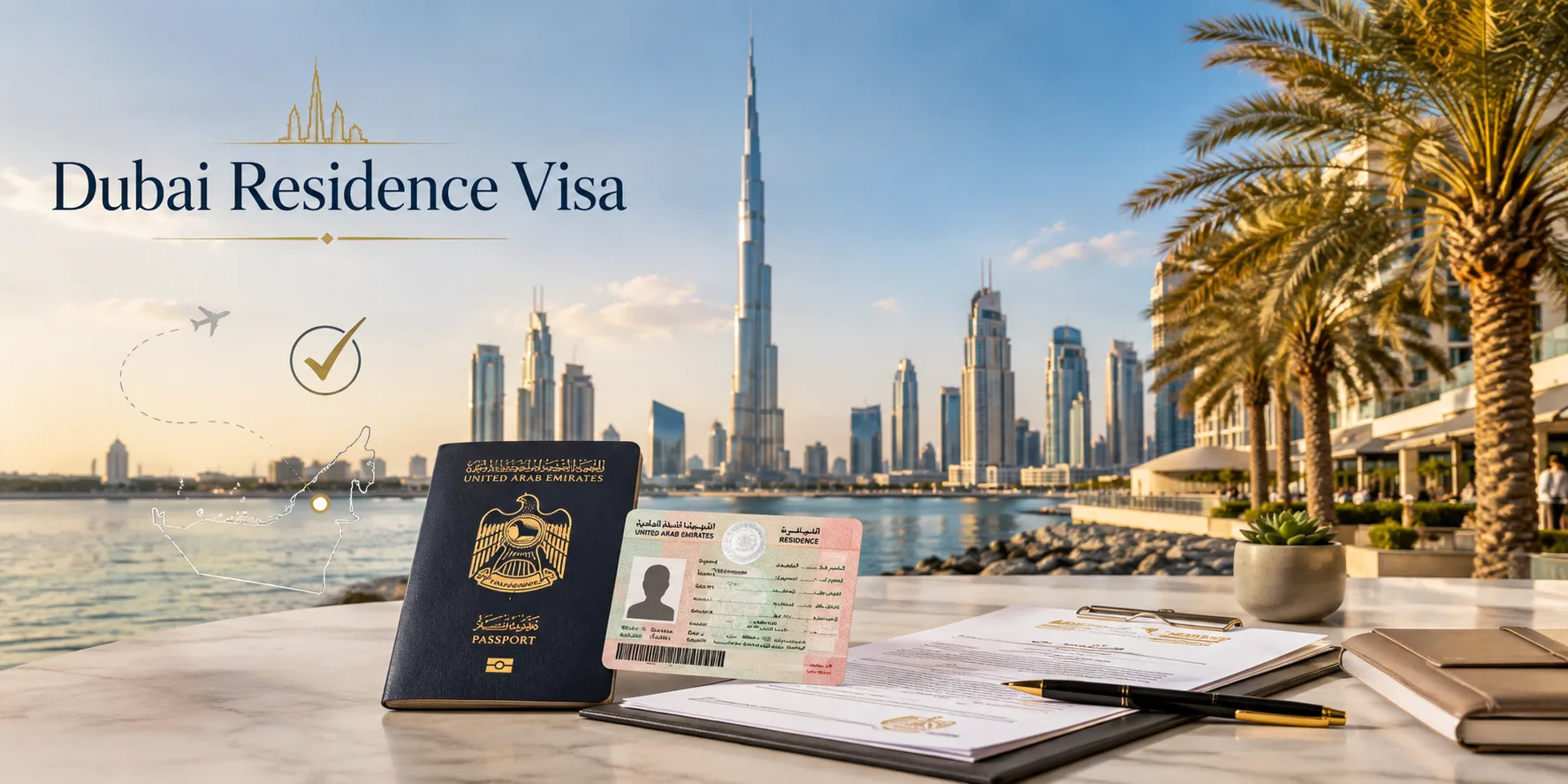
ICP stopped issuing the physical visa sticker from 11 April 2022. The Emirates ID now serves as proof of legal stay, and visa details are open through online systems.
This means the modern process is better described as permit issuance linked with Emirates ID, not passport stamp.
Do not wait for a passport sticker that is no longer part of the standard process.
Dubai Residence Visa Types at a Glance
| permit Route | Typical Now Term | Main Basis |
|---|---|---|
| Private sector work | 2 years. | UAE employer. |
| Family visa | Linked to sponsor and route. | Valid UAE visa holder sponsor. |
| Virtual work visa | 1 year, can be renewed. | Remote work for entity outside UAE. |
| Property visa | Route-specific. | valid fully owned UAE property. |
| Green Visa | 5 years, can be renewed. | Skilled worker, freelancer, self-employed, investor or partner. |
| Golden Visa | 5 or 10 years. | Investment, real estate, talent or other valid route. |
| Blue Residency | 10 years. | Special green or green work work. |
| Student visa | Depends on study route. | Valid educational route. |
| Retiree visa | 5-year route open. | Age/tool plus money rules. |
Do not choose a visa route only from the term period. Choose the route that matches your legal basis for living in the UAE.
How to Receive a Dubai Residence Visa
The exact path varies, but the modern process often follows this order:
- Choose the correct visa route.
- Obtain the needed entry or status route if your route needs one.
- Submit the permit-visa form.
- Complete the health test rule if it applies to you.
- Complete Emirates ID steps and biometrics where needed.
- Pay the UAE permit and ID fees.
- Receive notice of visa issue.
- Receive or activate the Emirates ID linked to the visa record.
The exact order can change by route. Work cases may also include work-permit steps. Family, property and no-sponsor route use their own paper path.
Entry Permit and permit Permit Are Not the Same
An entry visa or entry permit may allow you to enter the UAE so you can complete visa steps. The final permit is a separate legal status.
ICP states that a person entering for the purpose of completing visa issue must normally finish the needed visa steps within the permitted period.
Do not treat an entry permit as the final Dubai residence visa.
1. Work Dubai Residence Visa
The standard work visa route is for people employed by a UAE employer. The UAE now describes the standard work visa as a two-year can be renewed permit.
GDRFA's latest private sector visa tool also states that private sector workers can receive a two-year can be renewed permit.
GDRFA now lists these core visa papers for the private sector permit:
- Passport copy.
- Recent photo.
- Valid health test for people over 18.
The work-permit and work process can add other papers before the final visa stage.
See our Dubai Work Visa Guide for the work route in more detail.
2. Family Dubai Residence Visa
An valid UAE visa holder can sponsor certain family members. Now GDRFA guidance includes a spouse, children under 25, unmarried daughters, and children with special needs regardless of age under the relevant rules.
GDRFA's family visa tool also needs suitable housing and proof of family family link.
For the family entry route, GDRFA now states that the visa holder sponsor must earn at least AED 4,000 per month, or AED 3,000 plus housing.
The family visa is linked to the sponsor's own visa status. The dependant's term does not run beyond the sponsor's valid permit.
See our Dubai Family Visa Rules guide before preparing marriage, birth or housing papers.
3. Virtual Work permit Visa
The virtual work route is for a person living in the UAE while working online for an firm outside the UAE.
GDRFA now offers a one-year can be renewed virtual work visa without a UAE sponsor or host.
The core GDRFA rules include:
- Passport copy.
- Photo.
- Valid health cover.
- Health test result.
- Proof of remote work outside the UAE.
- Salary proof of at least USD 3,500 per month or equivalent.
- Emirates ID receipt.
I removed the old claim that six months of bank statements became a universal new rule in January 2026. The GDRFA service card clearly needs the USD 3,500 monthly income proof but does not present that six-month bank-statement claim as a universal rule on the tool page.
See our Dubai Virtual Work Visa Guide.
4. Property-Owner permit Permit
Dubai has a visa route for valid property owners. This should not be confused with the property-based Golden Visa.
GDRFA's latest property owner visa tool says the property must be:
- Fully constructed.
- Registered with the relevant real-estate UAE office.
- Fully owned by the person.
- Fit to live in.
The person must also show monthly income of at least AED 10,000 or prove proof of funds for the visa term.
The GDRFA service card does not list the old AED 750,000 property threshold used in many older articles. That does not mean each property automatically qualifies; the latest tool rules still have to be met.
See our Dubai Property Visa Guide.
5. Golden Visa
The Golden Visa is a long-term route without a sponsor. Now UAE guidance provides 5-year and 10-year routes depending on the person type.
For real-estate investors, the latest UAE guidance lists a minimum AED 2 million property value for the five-year Golden Visa route.
Other Golden Visa routes include public investors, entrepreneurs, special talent, outstanding students, humanitarian pioneers and frontline heroes, subject to rules for that route.
Do not assume each Golden Visa route uses the same investment threshold.
See our Dubai Golden Visa Guide.
6. Green Visa
The Green Visa is a five-year can be renewed no-sponsor route.
UAE guidance lists skilled workers, freelancers, self-employed people, investors and business partners among the valid groups.
This route can suit people who qualify independently rather than through a normal employer backed permit.
7. Blue Residency
The Blue Residency is a 10-year long-term permit for people with special work in environmental protection, sustainability and climate fields.
ICP now provides live Blue Residency tools, including the visa route and a separate entry visa used to complete Blue Residency steps.
Blue Residency is a real latest route, but it is not a broad investor or work visa. People need proof that they meet its special rules rules.
8. Student and Retiree Routes
Student visa depends on the valid study route and programme. The ICP visa tool ties the visa term to the study programme rather than using one universal one-year rule for each student.
The retiree visa also has its own money rules. Now ICP rules include age or tool criteria plus property, deposit or income options depending on the exact retiree route.
Do not reuse work or tourist visa rules for student or retiree permit.
Dubai Residence Visa Rules
There is no single paper list for each Dubai residence visa. The route decides the papers.
Common rules can include:
- Passport valid for at least six months.
- Recent photo.
- Health test clearance for people aged 18 or over where needed.
- ID card form or receipt.
- Health cover or health card where needed by the route.
- Sponsor, job, family, property, income or study papers depending on the route.
Prepare only the papers for your exact visa route. Extra papers do not fix a wrong route.
Health Fitness for UAE permit
People aged 18 and above often need a health test test for UAE permit.
UAE health guidance states that permit screening focuses on disease rules. Some worker routes have extra health-screening rules.
Do not use a generic list of diseases to predict an person result. Health test is decided through the valid UAE health process.
ID card and Dubai Residence Visa
ID card is central to the visa process. ICP now links visa issue with the ID card form.
After permit is issued, the ID card becomes the visa holder's main UAE ID card and proof of visa status.
If permit is ended, the linked ID card is also ended through the system.
Your ID card term is tied to your visa record.
Dubai Residence Visa Fees: Use Route-Specific Fees
The source article used broad “all-in” estimates such as AED 3,000–15,000+. I removed those because they mix UAE charges, health costs, cover, employer costs, typing fees and private tool fees across very other routes.
A safer method is to check the exact tool card for the visa route you need.
| Now GDRFA permit Tool | Published permit Fee |
|---|---|
| Private sector permit | AED 200 base visa fee, plus listed extra charges. |
| Virtual work visa | AED 200 base visa fee, plus listed extra charges. |
| Property owner permit | AED 200 base visa fee, plus listed extra charges. |
GDRFA also lists extra charges such as Knowledge Dirham, Innovation Dirham, delivery and an inside-country fee where relevant. Some longer visa terms add annual issuance charges.
These are not complete “all-in” costs. Health test, ID card, health cover, work-permit steps, property review and private tool charges can be separate.
Dubai Residence Visa review Time
There is no one reliable end-to-end time for each visa route.
Several GDRFA service cards list an expected completion time of 48 hours for the permit-visa service once the needed stage and papers are ready.
But the whole journey can take longer because work approval, entry status, health test, biometrics, missing papers or other steps may happen before the final visa tool.
Do not promise “2–3 weeks” or “5–8 days” as a universal permit timeline.
How to Check Dubai Residence Visa Status
Dubai visa cases are handled through GDRFA channels, while ICP provides federal ID and visa tools.
Keep your form or file reference when you submit. Use the same UAE channel that processed the permit case to check updates.
For broad visa guidance on the site, you can also review our Dubai Visitor Visa Guide when comparing short-stay and permit options.
Grace Period After permit Expiry or Cancel Process
There is no universal 60-day grace period for each UAE permit.
Now ICP renew and cancellation rules list other grace periods by visa route:
| Category | Now Grace Period |
|---|---|
| Golden, Green and Blue Residency holders and listed related routes | 180 days. |
| Skilled workers in levels 1–3 and property owners | 90 days. |
| permit with guarantor or host | 60 days. |
| Other routes | 30 days. |
The overstay fine is AED 50 per day after the relevant grace period ends.
You can verify the latest route rules on the UAE ICP visa renew tool.
Staying Outside the UAE for More Than Six Months
Many normal visa holders need to pay attention to long periods outside the UAE.
ICP provides a visa route for valid visa holders who stay outside the UAE for more than six months, but the tool does not apply to Dubai visa holders in the same way.
Golden, Green and Blue Residency holders are among the routes that can enter while their permit stays valid without using that six-month visa route.
Check your own visa route before a long stay abroad.
Renewing a Dubai Residence Visa
Renew should be based on the same legal route under which the permit was issued.
ICP says the rules used for visa issue must continue to be met at renew.
Health test, ID card and route based papers may need to be updated.
Do not wait until the grace period to start renew planning. The grace period is a legal buffer, not the ideal renew window.
Cancelling a Dubai Residence Visa
permit should be formally ended when the visa holder permanently leaves the UAE, changes sponsor, or moves to another status where cancellation is needed.
Employer- and family backed cases normally involve the sponsor in the cancellation process.
When the permit is ended, the linked ID card is also ended in the system.
Dubai Residence Visa: Simple Examples
Example 1: You have a UAE job. Your employer handles the work route. You complete the health test and ID steps. The final permit is linked to your job route.
Example 2: Your spouse lives in Dubai. Your spouse may sponsor you if the family rules are met. Housing and proof of the family link can be needed.
Example 3: You work online for a company abroad. The virtual work route may fit. You must prove the remote job and the USD 3,500 monthly income rule.
Example 4: You own a home in the UAE. Check the property-owner route first. Do not assume the Golden route is the same.
Example 5: You meet a long-term visa rule. Green, Golden or Blue Residency may fit. Each route has its own test.
Before You Start the Dubai Residence Visa Process
Write down why you need to live in Dubai. Keep the reason simple.
Do you have a job? Do you have a family sponsor? Do you own a home? Do you work for a firm abroad? Are you applying for a long-term route?
Your reason points to the visa route. It also tells you which papers to prepare.
Do not start with the fee. Do not start with the visa length. Start with the legal reason for your stay.
What to Keep in One File
- Passport copy.
- Photo.
- Entry or status paper, if your route needs one.
- Health-test result, if needed.
- ID receipt or ID details.
- Job, family, property or income proof for your route.
- Payment receipts.
- Visa file or request number.
Save these files on your phone and in a secure backup. Use clear scans. Check the name and passport number before you send anything.
What Happens After the Health Test?
The next step depends on your route. In many cases, the permit request and ID steps move forward once the health result is ready.
Keep the health result and ID receipt. Your sponsor, employer or visa channel may need them to finish the case.
Do not assume the health test alone gives you legal stay. The permit still has to be issued.
What Happens After the Permit Is Issued?
Check the visa details. Check the start date and end date. Check the sponsor or route.
Your ID card is the main proof of legal stay. Keep the online visa details too.
If any name or passport detail is wrong, use the proper update route. Do not wait until renew.
Can You Change From One permit Route to Another?
Yes, in many cases a person can move to a new legal route. For example, a worker may change employers. A family member may later move to a work route.
The old permit may need to be ended before the new one is finished. The exact steps depend on the old and new route.
Do not cancel too early without a plan. Check the next route and the grace period first.
When Should You Renew?
Start checking the renew rules before the permit ends. Do not use the grace period as your normal renew plan.
Make sure the sponsor, job, family link, property or income basis still meets the rules.
Update any paper that has expired. Keep your passport valid.
Dubai Residence Visa Travel Check
Before a long trip outside the UAE, check how your visa route treats time abroad.
Some long-term routes have more freedom. Other visa holders may need extra steps after a long stay outside the UAE.
Check before you leave, not after six months have passed.
Common Dubai Residence Visa Mistakes
- Using the old passport stamp process as if it is still latest.
- Assuming each visa has a 60-day grace period.
- Using guessed all-in fees instead of the exact tool card.
- Confusing a normal property owner permit with the property Golden Visa.
- Using an old property threshold without checking the latest route.
- Applying for virtual work without proving the USD 3,500 monthly income rule.
- Assuming each student permit lasts exactly one year.
- Using tourist visa rules for visa forms.
- Ignoring health test and ID card steps.
- Using a visa route that does not match the real reason to live in the UAE.
Most avoidable errors come from mixing two other visa routes.
Which Dubai Residence Visa Should You Choose?
| Your Situation | Route to Check |
|---|---|
| UAE job offer | Work visa. |
| Valid UAE visa holder family sponsor | Family visa. |
| Remote work for non-UAE company | Virtual work visa. |
| valid UAE property | Property visa. |
| AED 2 million valid real estate | Property Golden Visa. |
| Skilled worker / freelancer / investor | Green Visa if valid. |
| Special long-term route | Golden or Blue Residency if valid. |
| Study in UAE | Student visa. |
| Retiree | Retiree visa if rules are met. |
Need help understanding your Dubai visa route?
Compare the purpose of your stay first, then prepare the papers for the exact route.
Plain-English Dubai Residence Visa Summary
Start with your reason for living in Dubai. A job uses the work route. A spouse or parent may use the family route. Remote work uses its own visa. Home owners and long-term visa holders use other routes.
Next, check the papers for that route. Do not copy a paper list from a different visa.
If you are over 18, a health test is common. The ID card is also a key part of the process.
Once the visa is issued, read every detail. Keep the ID card and online visa details safe.
Before the visa ends, check the renew rules. If the visa is cancelled, check the grace period for your exact route.
Simple rule: right route, right papers, right dates.
Five Fast Checks Before You Apply
Check 1: Why will you live in Dubai? Pick the visa that matches that reason.
Check 2: Who will sponsor you, if anyone? It may be an employer, a family member or no sponsor at all.
Check 3: Is your passport valid? Keep at least six months where the route asks for it.
Check 4: Do you need a health test? Most adults do for the main visa routes.
Check 5: What is your grace period? Check it before the visa ends or is cancelled.
Do these five checks first. They can save time and stop many common errors.
Dubai Residence Visa Checklist
- Correct visa route selected.
- Passport valid for at least six months.
- Sponsor or no-sponsor basis confirmed.
- Health test rule checked.
- ID card steps prepared.
- Now UAE fees checked for the exact tool.
- Grace period checked for the exact visa route.
- No reliance on old passport stamp instructions.
- No guessed all-in cost table.
- Renew and cancellation plan understood.
Quick Final Check
Keep the last check simple.
Read your passport. Check the name. Check the number. Check the expiry date.
Read your visa route. Make sure it matches why you will live in Dubai.
Read your ID details. Make sure the same core data is correct.
Save your receipts. Keep the case number and any UAE notice sent to you.
Check the end date. Put a reminder in your phone well before it ends.
If you plan a long trip abroad, check the rules before you fly.
Good records make the next step much easier.
Receive Your Dubai Residence Visa With the Correct Process
A Dubai residence visa is not one product with one price, one grace period and one checklist. It is a group of visa routes with other legal bases.
The most important 2026 corrections are simple: visa stickers are no longer the standard proof, grace periods vary by route, and broad all-in fee estimates should not replace the UAE service card.
Choose the right route, follow the GDRFA or ICP rules, complete health and ID card steps where needed, and use the issued visa record as the final UAE office for your case.
Ready to plan your UAE visa correctly?
Check whether you need a visitor route first or whether your case already fits a visa route.
One last tip: Keep names, dates and file numbers in one short note. This makes each check fast and helps you spot a bad detail before you send the form.
Last reviewed: 25 August 2026. UAE permit rules, fees, grace periods and route rules can change.