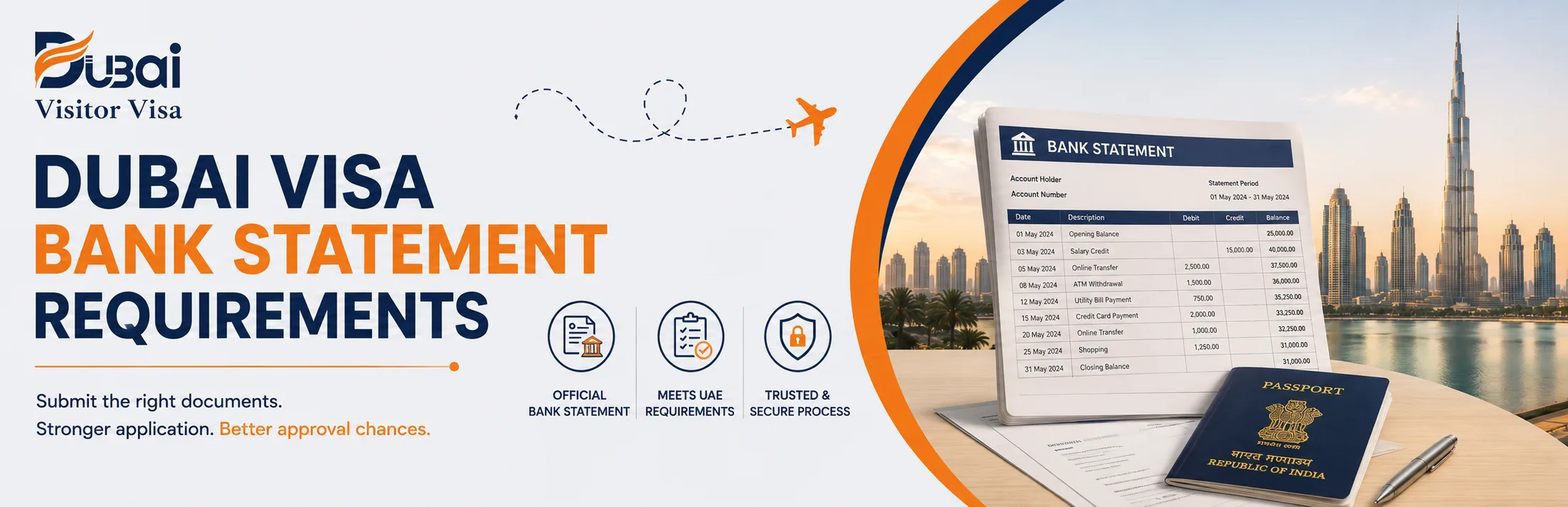
Dubai Visa Bank Statement Requirements 2026: Minimum Balance, Proof of Funds and Who Needs It
01-Aug-2026 0 Comments 1000 Views
Priyanshu Raghav
By Priyanshu Raghav, Dubai Visa Specialist · Last reviewed 1 August 2026 · Financial-rule review: 16 July 2026
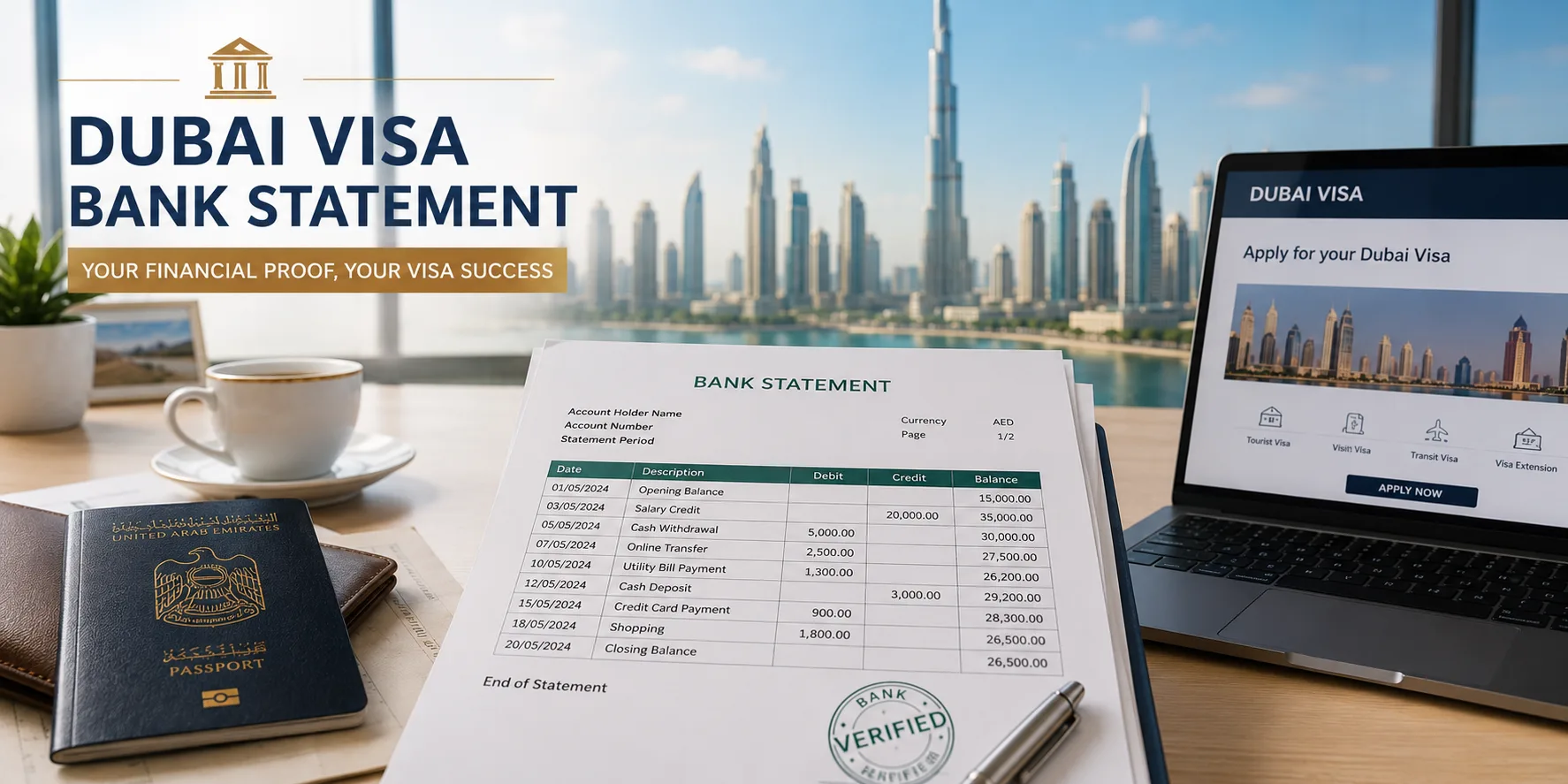
Searches for Dubai visa bank statement requirements usually turn up one confident number — AED 3,000, AED 5,000, INR 1 lakh — presented as if it applies to every applicant. It doesn't. There is no single official minimum bank balance that governs every Dubai tourist visa. Whether a bank statement for a Dubai visa is requested at all depends on the visa type, the application channel, the sponsor and the applicant's own profile. The one clear exception is the UAE five-year multiple-entry tourist visa, which carries its own separately published financial condition. Standard 30-day and 60-day applications are assessed on a different, less rigid basis, and reviewers can still ask for extra financial proof on a case-by-case basis. Employment status changes what an applicant needs to prepare, and even a strong bank balance never guarantees approval. This guide separates confirmed rules from common assumptions about the minimum bank balance for a Dubai visa, organised by visa type and by applicant profile.
Dubai Visa Bank Statement Requirements — Quick Answer
A bank statement is not subject to one universal minimum-balance rule for every Dubai tourist visa. Standard 30-day and 60-day visa applications may or may not require additional financial evidence depending on the applicant, nationality, sponsor and application channel. The UAE five-year multiple-entry tourist visa is different because it has a specifically published USD 4,000 (or equivalent) financial requirement covering the six months before application.
Meeting a financial-document requirement does not guarantee visa approval.
Dubai Visa Bank Statement Rules at a Glance
| Visa Category | Published Fixed Balance? | Financial Guidance |
|---|---|---|
| Standard 30-day tourist visa | No universal official figure identified | Additional evidence may depend on the application |
| Standard 60-day tourist visa | No universal official figure identified | Longer itinerary may lead to more supporting evidence being requested |
| 90-day visit category | Verify the exact issuing route | Do not treat any unverified fixed amount as official |
| Standard multiple-entry visa | Product- and channel-specific | Financial evidence may be requested case by case |
| Five-year multiple-entry tourist visa | Yes | USD 4,000 or equivalent during the previous six months |
| Family or friend-sponsored visit | Sponsor rules apply | Sponsor income, relationship and accommodation proof may be required instead |
| Business or investment visit | Category-specific | Financial-solvency or professional evidence may apply |
| Transit visa | Usually itinerary-led | Airline, onward travel and sponsorship conditions apply instead of a balance rule |
Reviewed against current published UAE immigration guidance as of 16 July 2026. Financial-document conditions can change; confirm current requirements before applying.
Is a Bank Statement Required for a Dubai Visa?
A bank statement may be required for some Dubai visa applications, but it is not accurate to describe it as universally compulsory for every short-term tourist visa applicant. Requirements depend on the visa category, nationality, sponsor, applicant profile and application route.
In practice, a financial document can sit in one of several positions in an application. A document that is truly mandatory means the application cannot move forward without it. A document that is conditionally required only applies to a specific applicant group or visa route. Some documents are only requested as an additional item after an applicant has already submitted their initial paperwork. Others count as supporting evidence — helpful for explaining how a trip is funded, but not formally listed as compulsory. Sponsor evidence is a separate category again, where the financial proof comes from a parent, spouse, company or host rather than the applicant.
| Document Position | Meaning |
|---|---|
| Mandatory | Application cannot proceed without it |
| Conditionally required | Needed for a specific applicant or visa route |
| Additional document | Requested after initial submission |
| Supporting evidence | Helps explain funding or travel ability |
| Sponsor evidence | Provided by a parent, spouse, company or host |
Confusing "mandatory" with "recommended" is one of the most common sources of anxiety among applicants preparing their documents. Where a bank statement is not listed as mandatory for a route, that does not mean financial evidence is irrelevant — it means the position of the document is different, and it can still be requested later in the review.
How Much Bank Balance Is Required for a Dubai Visa?
This is the single most searched question around Dubai visa bank balance requirement, and the honest answer is that there is no universal figure for every standard tourist visa. What reviewers generally look for — where financial evidence is requested at all — is reasonableness relative to the trip: whether the funds shown make sense for the travel duration, the number of travellers, existing flight and hotel bookings, and whether a sponsor is covering some or all of the cost.
Several factors shape how much evidence an applicant may need to prepare: the length of the trip, whether accommodation and flights are already paid for, whether a sponsor is contributing, the applicant's own income position, the number of dependants travelling on the same trip, and whether the reviewing authority has asked for an additional document. The five-year multiple-entry tourist visa is the one clear exception, because it has its own separately published figure covered later in this guide.
The financial evidence should be reasonable for the applicant's planned trip, but a specific unpublished amount should not be presented as an official guarantee. Dubai Visitor Visa does not operate an unofficial minimum-balance calculator, because doing so would imply a precision that does not exist for standard tourist visa routes.
Is There a Fixed Minimum Balance for Every Tourist Visa?
No Universal Amount for Standard Tourist Visas
There is no single balance figure that applies uniformly across the 30-day visa, the 60-day visa, the 90-day category, the multiple-entry visa, family visit routes and the transit visa. Each of these has its own eligibility structure, and financial evidence — where relevant — is assessed against that specific route rather than a shared threshold.
A Specific Published Requirement for the Five-Year Visa
The five-year multiple-entry tourist visa is genuinely different. Current published guidance ties it to a specific financial condition, covered in detail in the visa-type comparison below.
Category-Specific Financial Solvency
Investment visits, business exploration trips, self-sponsored long-term routes and family sponsorship each carry their own conditions, which are not the same as a standard tourist visa's requirements and should not be combined into one blanket rule. If you are applying under one of these categories, treat its requirements as belonging to that category alone rather than assuming a tourist-visa rule applies, or the reverse.
Bank Statement Rules by Visa Type
The table below summarises how financial-document expectations differ across Dubai's main visa products. Treat it as a starting point, not a final answer — always confirm the current position for your exact route before applying.
| Visa Type | Universal Fixed Balance? | Typical Statement Position | Main Action |
|---|---|---|---|
| 30-day tourist visa | No universal published figure | Channel- or applicant-dependent | Check exact requirements for your route |
| 60-day tourist visa | No universal published figure | Additional evidence may be requested | Match funds shown to the itinerary |
| 90-day visit visa | Route-specific | Verify the current service conditions | Do not rely on an unverified fixed-amount claim |
| Standard multiple-entry visa | Product-specific | May call for stronger travel and financial evidence | Confirm your entry plan and route |
| Five-year tourist visa | Published requirement | Six-month statement, USD 4,000 equivalent | Follow the published financial condition |
| Transit visa | No general tourist balance rule | Airline and itinerary documents are central | Check sponsor and onward-travel conditions |
30-Day Tourist Visa
For a standard bank statement for Dubai tourist visa applications lasting 30 days, there is no single universal official minimum that should be treated as a fixed rule. Whether a statement is requested at all can depend on the application route — direct government portal, airline, tourism establishment or authorised agency — and on the applicant's own profile and nationality. Strong travel bookings, a confirmed hotel and a return ticket can reduce ambiguity around a short trip, but they do not replace any document that is formally required for your specific route. Additional financial evidence can still be requested after the initial submission. For the full document checklist for this visa, see the 30-day Dubai tourist visa page.
60-Day Tourist Visa
A longer stay understandably invites a closer look at trip affordability, so a bank statement for 60-day Dubai visa applications is somewhat more likely to be requested or supplemented with additional evidence than for a 30-day trip. That does not mean a higher fixed minimum exists — it means reviewers may want to see that hotel costs, travel, insurance and day-to-day funding are logically covered for the extra time. Applicants travelling with dependants should expect the expected cost picture, and therefore the supporting evidence, to scale accordingly. See the 60-day Dubai tourist visa page for the current document list.
90-Day Tourist Visa
Some pages circulating online state that every bank balance for 90-day Dubai visa applicant must hold a specific fixed amount such as AED 5,000. That should not be treated as an official rule unless the exact issuing authority and application route currently publish that figure — and at review, no such published universal amount for the standard 90-day tourist visa was identified. What does vary for this category is the visa route itself (self-sponsored tourist visa versus a relative-or-friend visit visa), any sponsor or host conditions attached to that route, the affordability case for an extended trip, accommodation and insurance, and nationality-specific document requests. Full details are on the Dubai 90-day tourist visa page.
Multiple-Entry Tourist Visa
For a multiple-entry Dubai visa bank statement, reviewers are generally more interested in the travel plan itself — the regional itinerary, the purpose of re-entry, and whether repeat travel costs are logically covered — than in a single fixed balance. Because a multiple-entry visa implies more movement and potentially more spending, stronger itinerary evidence can support the financial picture. It is important not to confuse a standard 30- or 60-day multiple-entry product with the five-year multiple-entry visa; the financial condition attached to the five-year visa does not apply to shorter multiple-entry visas.
Five-Year Multiple-Entry Tourist Visa
This is the one Dubai visa category with a genuinely published financial rule. Current guidance ties the UAE 5-year tourist visa bank balance condition to a bank statement covering the six months before application, showing a balance of at least USD 4,000 or the equivalent in another currency, held consistently rather than deposited shortly before applying. Health insurance valid in the UAE, a confirmed round-trip ticket and a passport valid for at least six months are required alongside this financial evidence. Family members applying together should each expect their own financial evidence to be assessed on this basis unless the current service conditions state otherwise. For the complete eligibility picture, fees and stay rules, see the five-year multiple-entry tourist visa update and the Dubai visa types comparison.
Currency note: the UAE dirham is pegged to the US dollar at a fixed rate of approximately AED 3.6725, so USD 4,000 corresponds to roughly AED 14,690 — this dirham figure is stable because of the peg. In Indian rupees, USD 4,000 was approximately equivalent to INR 3,81,600 based on a mid-market rate of roughly INR 95.4 per US dollar on 31 July 2026 (source: Google Finance); the INR figure moves with the exchange rate and should be rechecked at the time of application rather than relied on from this page.
Transit Visa
A Dubai transit visa bank statement is generally not the central document for this category. Transit eligibility depends mainly on airline sponsorship and confirmed onward travel rather than a standalone balance requirement, and a transit visa is a distinct product from a normal short tourist visa — a longer Dubai stopover does not automatically qualify as transit. Financial evidence, where requested at all, tends to depend on the specific application channel rather than a published tourist-visa figure. See the Dubai transit visa guide for eligibility and documents.
Three-Month vs Six-Month Bank Statements
Whether reviewers want Dubai visa bank statement three months or Dubai visa bank statement six months is another area where a single blanket rule gets repeated online. In reality, the period may depend on the visa type, the application channel, the applicant's profile, whether a sponsor is involved, and any specific request from the reviewing authority. The clearest fixed rule is attached to the five-year visa, which specifically calls for six months of statements.
| Statement Period | When It May Be Used | Important Note |
|---|---|---|
| Latest one month | Basic current-balance support | May be insufficient alone |
| Three months | Common supporting period for shorter routes | Not universal |
| Six months | Stronger financial history | Specifically relevant to the five-year visa |
| Older statement | Usually considered weak | May not reflect current funds |
A three-month statement should not be assumed to be automatically accepted for every route, and six months should not be assumed to be compulsory outside the five-year visa. When in doubt, prepare the longer period, since a six-month statement can generally stand in for a shorter request but not the reverse. See how recent your statement should be in the FAQ section below.
What Information Should the Statement Show?
Regardless of which visa route applies, a bank statement is only useful if it is complete and verifiable. A statement worth submitting should show:
- The applicant's full name, matching the passport
- The issuing bank's name
- The account number, partially masked where the bank's format allows
- The exact statement period covered
- Opening and closing balance for that period
- The full transaction history, not a summary page only
- The currency of the account
- Salary or other regular income, where applicable
- Any large deposits, shown in context rather than cropped out
- Bank contact or verification details
- The issue date of the statement
- Official bank branding or a secure digital verification feature
The document should be complete, legible, internally consistent, unedited, reasonably recent, traceable back to the issuing bank, and clearly relevant to the applicant named on the visa application. Do not crop pages to hide transactions, and do not submit a statement that has been altered in any way — beyond being a poor strategy, this can create far bigger problems than a modest balance ever would.
Does the Bank Statement Need a Stamp?
Whether a Dubai visa bank statement needs a stamp is not governed by one rule that applies to every application channel. Some channels accept an official electronic PDF issued directly by the bank, while others specifically request a stamped or certified copy, particularly for routes with a formally published financial condition such as the five-year visa. Statements in a foreign language may need an official translation. Screenshots are consistently weaker evidence than a full bank-issued statement, and any downloaded PDF should retain its authenticity features — bank letterhead, verification codes and contact details — rather than being trimmed down to a single page.
| Statement Format | General Strength | Possible Issue |
|---|---|---|
| Bank-issued stamped statement | Strong | May require a branch visit to obtain |
| Official online PDF | Often strong | Must be verifiable and complete |
| Bank letter plus statements | Strong | Additional cost or time to arrange |
| Mobile-app screenshot | Weak | Usually incomplete information |
| Edited spreadsheet | Unacceptable | Not a bank-issued document |
| Cropped statement | Weak | Missing context |
Can You Submit an Online Bank Statement?
An online bank statement for a Dubai visa can generally be used where the application channel accepts digital documents, provided it is the official PDF issued through the bank's secure download or app, carries the bank's logo and the account-holder's name, covers the full statement period being requested, includes the transaction history rather than a summary only, and shows a verification code or digital signature where the bank provides one. If the file is password-protected, be ready to share the password through the correct channel so it can actually be opened and checked. Avoid submitting screenshots only, manually created statements, edited PDFs, photos of a partial screen, or any file that is missing the applicant's name — these consistently weaken an application regardless of the underlying balance.
Can You Apply for a Dubai Visa Without a Bank Statement?
Several scenarios can mean a Dubai visa without bank statement is genuinely possible: the standard route you are applying through simply does not list a bank statement among its documents, a sponsor is providing the financial evidence instead of the applicant, the tourism establishment or agency handling the application has its own document set, salary slips or an employment letter are used in place of a statement, or a parent or spouse is supporting the trip. Additional evidence can still be requested later even where it was not part of the initial checklist. The one route where this flexibility does not apply is the five-year visa, where the published financial evidence is a core requirement rather than optional support.
Applying without a bank statement may be possible for some standard tourist visa routes, but it does not mean financial evidence can never be requested. Treat "not initially listed" as different from "never relevant."
Bank Statement Rules for Unemployed Applicants
Unemployment does not automatically make someone ineligible for a Dubai visa, but a Dubai visa bank statement for an unemployed applicant does need to tell a clear story about where the trip's funding comes from. Reviewers are generally looking to understand the funding source rather than penalising the lack of a payslip. A parent, spouse or other family member's support can often be used where the route accepts sponsor-provided evidence, typically alongside a sponsorship letter and proof of the relationship. Personal savings can be sufficient on their own where the route accepts them. Travel purpose and clear ties back home — return bookings, ongoing commitments — also factor into how an unemployed applicant's file reads as a whole, alongside prior travel and immigration history where relevant.
Useful supporting evidence for this profile can include: a personal savings statement, a sponsor's bank statement, a sponsorship letter, proof of the relationship to the sponsor, accommodation confirmation, a return booking, and asset or investment evidence where relevant. None of this guarantees approval — it simply gives the application a coherent financial picture.
Bank Statement Rules for Housewives and Homemakers
For a homemaker applying for a Dubai visa, spouse-funded travel is a common and generally workable path. This typically means a marriage certificate, a sponsor letter from the spouse, evidence of the spouse's employment, the spouse's bank statement, a joint travel booking where the couple is travelling together, accommodation confirmation and a return ticket. Where the homemaker holds a personal account, that can be included alongside the spouse's documents rather than instead of them. There is nothing in current guidance that requires a homemaker to show independent salary income to qualify.
Bank Statement Rules for Students
Students applying for a Dubai visa are generally expected to rely on parent or guardian funding rather than personal income. A typical file for this profile includes a Dubai visa bank statement for a student's parent, a student ID, an enrolment letter from the current institution, a sponsorship letter, proof of the relationship (often a birth certificate), evidence that the student intends to return to their studies, and — for minors — appropriate travel consent documentation and accommodation details. There is no requirement for a student to demonstrate salary income; the funding is expected to come from a parent or guardian, clearly documented.
Bank Statement Rules for Retired Travellers
Retired applicants are not expected to produce salary slips, since that income source no longer applies to their situation. Instead, a Dubai visa bank statement for a retired person is typically supported by pension statements, a retirement letter, savings or fixed-deposit evidence, investment or property income where relevant, and — where a family member is travelling together or contributing — sponsor support documents. Insurance and clear return ties can also strengthen this profile, particularly for longer trips.
Bank Statement Rules for Self-Employed Applicants
Self-employed and business-owner applicants often have both a personal account and a business account for a Dubai visa application, and the two are not automatically interchangeable. A business account may not by itself replace the applicant's personal financial evidence — reviewers are typically trying to confirm that the applicant personally has access to funds, not just that a company does. Useful supporting documents include company registration papers, tax documents, invoices demonstrating regular business income, proof of business ownership, and evidence of personal drawings from the business where relevant. Additional documents may be requested to show the link between company funds and the applicant's personal access to them.
Can a Parent or Spouse Provide the Bank Statement?
Sponsor funding is one of the most common ways applicants without independent income support their Dubai visa application. A Dubai visa parent bank statement or Dubai visa spouse bank statement is generally paired with proof of the relationship, a sponsorship letter, and — depending on the route — the sponsor's passport copy, residence status and employment evidence. Where the applicant is a minor, additional rules around consent and guardianship typically apply. Adult applicants relying on a sponsor should expect their file to be reviewed as a whole, including the shared itinerary and the applicant's own dependency on the sponsor.
| Sponsor Type | Possible Supporting Documents |
|---|---|
| Parent | Bank statement, relationship proof and sponsor letter |
| Spouse | Bank statement, marriage proof and sponsor letter |
| Adult child | Relationship proof and a financial undertaking |
| Employer | Employment letter and approved business documents |
| UAE host | Host identity, residence status and relationship documents |
| Friend | Acceptance may be limited and needs case-by-case clarification |
Not every relationship type is treated the same way, and "can another person sponsor my Dubai trip" does not have a single yes-or-no answer — it depends on the relationship and the route being used.
Can You Use a Joint Bank Account?
A joint bank account for a Dubai visa application can be workable where the applicant's own name clearly appears on the account and the joint ownership is easy to understand from the statement itself. Some routes may want the relationship between account holders explained, and in principle both holders' consent for the funds to be referenced supports the credibility of the document. One point worth keeping in mind: the same funds should not be presented as available evidence for more than one applicant's separate visa application at the same time. A joint account with a spouse or parent is generally viewed as stronger evidence than an account belonging entirely to an unrelated third party, though acceptance ultimately remains specific to the application and route.
Salary Slips, Employment Letters and Other Financial Evidence
Beyond a bank statement, several other documents can support a Dubai visa application, and a Dubai visa salary slip requirement is not universal — plenty of applicants apply successfully with a Dubai visa without a salary slip by relying on alternative evidence instead.
| Document | What It Helps Prove |
|---|---|
| Salary slip | Current employment income |
| Employment letter | Job status and approved leave |
| Tax return | Declared income |
| Pension statement | Retirement income |
| Fixed deposit certificate | Available savings |
| Sponsor letter | Third-party funding |
| Business documents | Self-employment income |
| Student enrolment letter | Ongoing studies and return ties |
No single document on this list guarantees approval on its own. The strongest applications tend to combine two or three complementary documents that together tell a consistent story about who is funding the trip and how.
Are Sudden Large Deposits a Problem?
A large deposit appearing in a sudden deposit in bank statement for a Dubai visa is not automatically a rejection trigger, but an unexplained one can raise questions that a well-documented deposit would not. What generally matters is whether the source of funds is traceable — salary credits, a fixed-deposit maturity, an investment redemption, a property sale, a business payment or a family transfer are all easier to explain than an unexplained cash deposit. Borrowed funds should never be misrepresented as personal savings, and creating a balance at the last minute, right before applying, tends to weaken rather than strengthen an application's credibility. A stable pattern of account activity over time is generally easier for reviewers to assess than a single recent spike.
Source-of-funds checklist for unusual transactions: salary credit, fixed-deposit maturity, investment redemption, property sale, business payment, family transfer, loan, cash deposit. Where any of these appear as a large or unusual entry, include supporting evidence — a sale agreement, a maturity certificate, a transfer reference — rather than leaving the reviewer to guess.
Common Bank Statement Mistakes
- Submitting an incomplete statement period
- Missing the applicant's name on the document
- Assuming the wrong currency applies
- Cropped or partial pages
- Missing transaction history
- Relying on mobile screenshots only
- Submitting an edited PDF
- Sending a password-protected file without sharing access instructions
- Using an outdated statement
- Leaving a large deposit unexplained
- Showing a negative or inconsistent balance
- Using another person's account without sponsorship evidence
- Using a business account without ownership proof
- Assuming one statement can cover an entire family's application
- Applying the five-year visa's USD 4,000 rule to a standard tourist visa
- Relying on an unverified fixed-balance claim for the 90-day visa
- Missing a required translation
- A name mismatch between the statement and the passport
- A passport-number mismatch across documents
- Hiding overdrafts or existing loans rather than disclosing them
What to Do If You Have Insufficient Financial Evidence
If your current documents feel thin, there are safer options than rushing an application or manufacturing a stronger-looking balance:
- Confirm whether a statement is actually required for your specific route.
- Double-check you have selected the correct visa category.
- Wait for a stronger statement period to build up naturally, where time allows.
- Add salary or employment evidence alongside the statement.
- Add sponsor documents where the route accepts them.
- Explain any unusual transactions with supporting evidence.
- Provide accommodation and return-travel bookings.
- Lean on personal savings evidence where applicable.
- Consider a shorter visa duration where that better matches your situation.
- Request a pre-submission document review before applying.
- Avoid fake, borrowed or manipulated statements entirely.
- Never submit an altered document.
| Applicant Problem | Better Action |
|---|---|
| No personal income | Review sponsor-supported document options |
| Short statement history | Confirm the minimum period needed, or wait |
| Sudden deposit | Explain the source with supporting evidence |
| Low current balance | Review the trip budget and visa choice |
| Business funds only | Add business-ownership and personal-access proof |
| Previous rejection | Review the complete file before reapplying |
| Applying for the five-year visa | Meet the published USD 4,000 condition in full |
Falsifying documents or temporarily manipulating a balance is never advisable — beyond the ethical issue, it tends to create bigger, harder-to-fix problems than a modest balance ever would.
What If a Previous Dubai Visa Was Rejected?
A Dubai visa rejected due to bank statement concerns is only one of several possible causes, and it is worth resisting the urge to assume the balance was the sole issue. Application data, passport validity, prior UAE immigration records, sponsor or agency information, and the financial evidence itself can all play a role. Before reapplying, review your previous submission for mismatches, correct anything that was wrong, and avoid submitting an identical duplicate application immediately — a short review period, ideally with clarification from the channel you applied through, generally improves the odds of a corrected reapplication. For a fuller breakdown of common causes and how to approach a reapplication, see the Dubai visa rejection reasons guide, the visa status check page and the UAE visa fine check page if an unpaid fine may be a factor.
Dubai Visa Financial-Document Checklist
Statement quality
- Correct account holder named
- Correct statement period shown
- All pages included
- Transactions clearly visible
- Currency clearly visible
- Bank details visible
- Document unedited
- Recent issue date
- Clear, legible PDF
Financial logic
- Funds match the trip length
- Dependants factored in
- Accommodation factored in
- Flights factored in
- Sponsor support explained
- Large deposits explained
- Business funds properly documented
Applicant profile
- Employment evidence, where relevant
- Student evidence, where relevant
- Pension evidence, where relevant
- Sponsor letter, where relevant
- Relationship proof, where relevant
- Business ownership proof, where relevant
- Return ties demonstrated
Application accuracy
- Name matches the passport exactly
- Passport number matches across documents
- Visa type is correct for the trip
- Any currency conversion is dated and labelled as approximate
- Additional requested documents are included
- Contact details are correct
Conclusion
Dubai visa bank statement requirements are genuinely more varied than a single quoted figure suggests. Most standard 30-day and 60-day tourist visa applications are not tied to one published minimum balance, financial evidence expectations shift with visa type, sponsor and applicant profile, and the five-year multiple-entry tourist visa remains the one route with a clearly published USD 4,000 condition. Whatever route you are applying through, prioritise a complete, accurate and traceable set of documents over chasing an unverified number — and remember that even the strongest financial evidence supports an application without guaranteeing its outcome. For document review help specific to your visa type and profile, see the Dubai visa requirements guide or get in touch with our team.
- Dubai Visa
- UAE Visa
- Dubai Tourist Visa
- Dubai Visitor Visa
- Bank Statement
- Proof of Funds
- Visa Requirements
- Dubai Visa Documents
- Visa Application
- Dubai Travel
- UAE Travel
- Financial Documents
- Tourist Visa Requirements
- Dubai Visa Guide
- UAE Tourist Visa
Frequently Ask Questions
Not for every visa category. A bank statement can be mandatory, conditionally required, requested as an additional document, or simply useful supporting evidence, depending on the visa type, application channel and applicant profile. The five-year multiple-entry tourist visa has a clearly published financial requirement; most standard 30-day and 60-day tourist visas do not have one universal published rule, though additional evidence can still be requested.
Yes. Retired applicants are not expected to produce salary slips, since that income source generally no longer applies to their situation. Pension statements, savings evidence, fixed deposits, or investment and property income can all support this profile instead, alongside valid insurance and clear return ties for longer trips.
There is no universal published bank-statement requirement specifically for the 30-day tourist visa. Whether one is requested can depend on the application channel, your nationality and your applicant profile. Additional financial evidence can still be requested after you submit your initial application, so it is worth having supporting documents ready even if they are not listed upfront.
As with the 30-day visa, there is no universal fixed requirement, though a 60-day stay can prompt reviewers to look more closely at how the extra time and cost are being funded. Preparing evidence that logically supports a two-month trip — accommodation, funds and any sponsor contribution — is a sensible precaution even where a statement is not formally listed as mandatory.
A joint bank account can generally be used where the applicant's own name clearly appears on the statement and the joint ownership is easy to identify. Some routes may want the relationship between account holders explained. The same funds should not be presented as evidence for more than one applicant's separate application at the same time, and acceptance ultimately depends on the specific route.
No. Amounts such as AED 3,000, AED 5,000 or a fixed INR figure are sometimes presented online as universal rules, but no single published minimum currently applies to every standard Dubai tourist visa. The five-year multiple-entry tourist visa is the clear exception, with its own separately published USD 4,000 condition.
No. AED 5,000 is not a confirmed universal requirement for the standard 90-day tourist visa, and this figure should not be treated as an official rule unless the exact issuing authority and application route currently publish it. Verify the current requirement for your specific 90-day route rather than relying on an unverified fixed amount.
There is no universal balance figure for standard tourist visas. What matters is that the funds shown are reasonable for the trip — its length, the number of travellers, existing bookings and any sponsor support. The exception is the five-year multiple-entry tourist visa, which has a published requirement of USD 4,000 or equivalent held over the previous six months.
Not automatically, but an unexplained large deposit can raise questions that a well-documented one would not. Funds that can be traced to a clear source — salary, a property sale, an investment maturity or a family transfer — are generally easier to assess than an unexplained cash deposit. Creating a balance shortly before applying tends to weaken rather than strengthen an application.
Not universally. Some application channels accept an official electronic PDF issued directly by the bank, while others specifically request a stamped or certified copy — this is more common for routes with a formally published financial condition, such as the five-year visa. Screenshots and cropped statements are consistently weaker than a full, verifiable bank-issued document, stamped or not.
Applying without a bank statement may be possible for some standard tourist visa routes — where a route simply does not list one, or where a sponsor, employer or agency provides alternative financial evidence instead. This does not mean financial evidence can never be requested; additional documents can still be asked for later in the review. The five-year visa is the exception, where the financial evidence is a core, non-optional requirement.
Yes, in most cases. Students are generally expected to rely on parent or guardian funding rather than personal income, supported by an enrolment letter, a sponsorship letter and proof of the relationship. There is no requirement for a student to demonstrate their own salary, since the funding is expected to come from a parent or guardian.
There is no single fixed rule for every visa, but a statement that is several months old by the time you apply is generally considered weak evidence, since it may not reflect your current financial position. Aim for a statement issued as close to your application date as your route allows, and confirm the accepted period for your specific visa type.
Yes, in principle, provided it is the official PDF downloaded through your bank's secure channel or app, shows your name and the bank's branding, covers the full period requested, includes the full transaction history rather than a summary, and carries a verification code or digital signature where your bank provides one. A partial screenshot is not a substitute for this.
Unemployment does not automatically disqualify an applicant. What generally matters is showing a clear, credible source of funding for the trip — personal savings, a sponsoring parent or spouse with supporting documents, or another form of documented support. Travel purpose and clear return ties also form part of how the overall application is assessed.
The five-year multiple-entry tourist visa has a specifically published financial condition: a bank balance of at least USD 4,000, or the equivalent in another currency, maintained during the six months before the application, alongside valid health insurance and a confirmed round-trip ticket. This figure is specific to the five-year visa and should not be applied to shorter tourist visas.
It depends on the route. Three months of statements is a commonly used supporting period for some standard applications, but it is not universal, and six months is not automatically required outside the five-year visa, which specifically calls for a six-month statement. Where you are unsure which period your route needs, preparing six months of statements is generally the safer option.
In many cases, yes — a spouse's bank statement, alongside a marriage certificate and a sponsor letter, is a commonly used and generally workable path for a homemaker applicant. Where the applicant also holds a personal account, that can be included alongside the spouse's documents. There is no requirement for a homemaker to show independent salary income.
Start by confirming whether a statement is genuinely required for your route, then consider adding salary, employment or sponsor evidence, explaining any unusual transactions, and matching your documents to your actual trip length and travel companions. A pre-submission document review can help identify gaps. Avoid manufacturing a stronger-looking balance or submitting altered documents under any circumstances.
Yes, weak or unclear financial evidence can contribute to a rejection, but it is rarely the only possible cause. Document quality, passport validity, prior immigration records and application accuracy can all play a role as well. If a previous application was rejected, review the full file rather than assuming the balance alone was responsible before reapplying.
Write Your Comment
Your email address will not be published. Required fields are marked *