PRESS
PRESS 


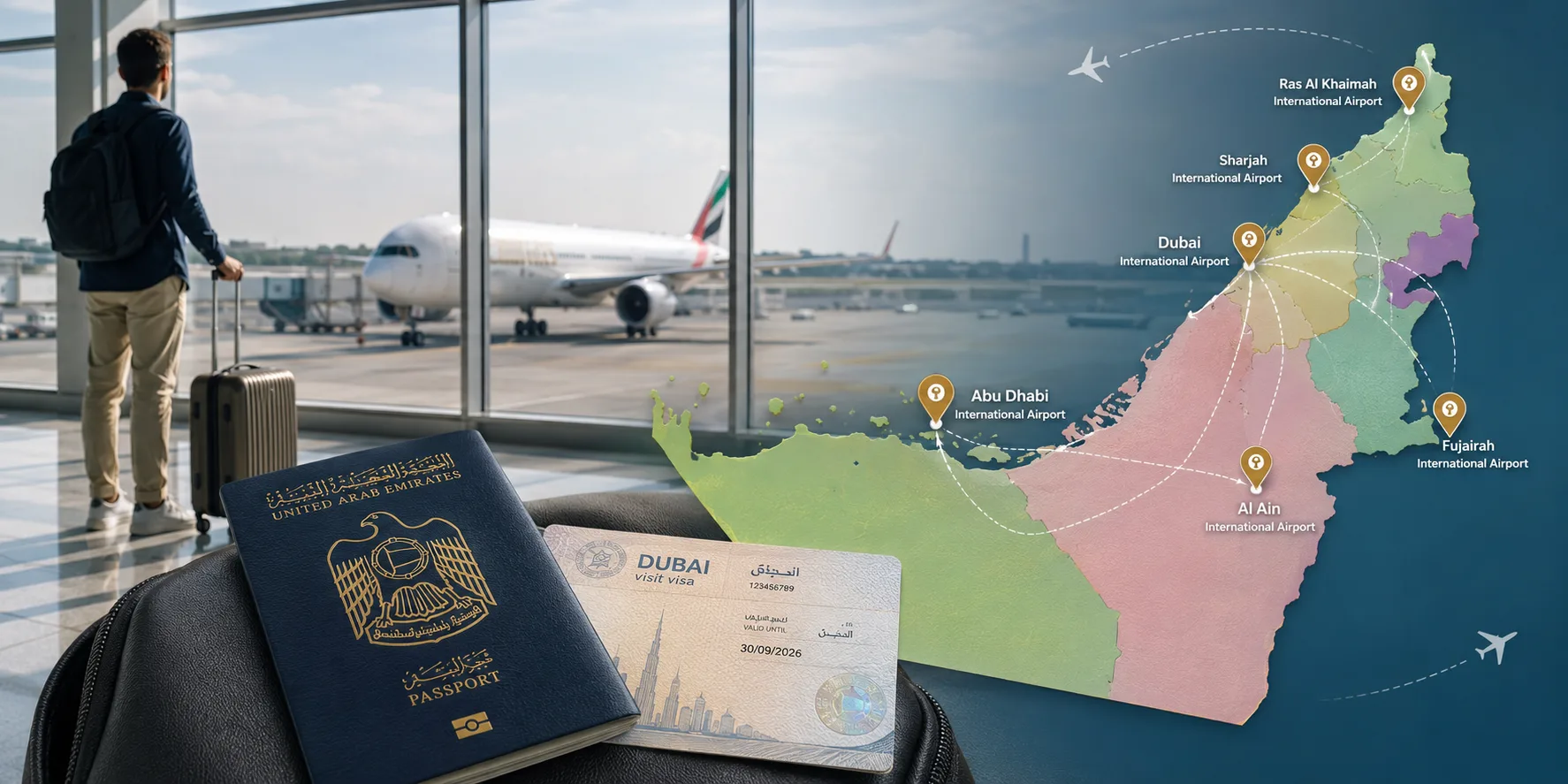
For most standard tourist, visit and residence cases, Dubai visa airport entry is not limited to Dubai International Airport. A valid UAE visa processed through Dubai can often be used for arrival at Abu Dhabi, Sharjah or another UAE airport. The important exceptions are transit visas and visas arranged under an airline's own booking rules.
Do not treat “any UAE airport” as an untermal promise. Check the visa category, issuing or sponsoring channel, passport details, visa dates and airline terms before changing your arrival airport.
Travellers often ask if a visa linked to Dubai forces them to land in Dubai. In many normal cases, it does not. The phrase “Dubai visa” often describes the authority or sponsor that handled the file, not a city-only travel permit. Still, Dubai visa airport entry must be checked against the exact visa and booking. A transit permit or airline-sponsored visa can carry tighter route terms than a standard tourist visa.
There is also an administrative split to understand. Dubai-issued visa records are handled through GDRFA Dubai, while Abu Dhabi, Sharjah, Ajman, Umm Al Quwain, Ras Al Khaimah and Fujairah use the federal ICP system for their visa files. That does not mean a standard visitor must stay in one emirate. It does mean you should check the file through the correct authority when something on the visa is unclear.
Dubai Visa Airport Entry: What the Rule Means
A standard UAE tourist or visit visa gives permission to enter and stay in the UAE for the approved purpose and period. It is not normally a pass that limits your trip to Dubai city after entry. This is why travellers can visit Dubai, Abu Dhabi, Sharjah and the other emirates during a lawful stay without applying for a second local tourist visa.
Airport entry is a separate question. For ordinary visas, another UAE airport is often acceptable. Yet the visa must still be valid on the travel date. A single-entry visa must also be unused before the first entry. Your passport details must match the visa record, and any sponsor terms still apply.
The safest rule is simple: do not decide from the word “Dubai” alone. Read the visa type and sponsor details first. Then check the airline terms for the ticket you plan to use.
| Visa or Entry Type | Another UAE Airport? | What to Check |
|---|---|---|
| Regular tourist visa | Often yes | Valid dates, passport match and sponsor terms |
| Regular visit visa | Often yes | Validity and any host or sponsor terms |
| UAE residence visa | Generally yes | Active residence status and re-entry rules |
| Single-entry visa | Usually for the one permitted entry | It must not have been used already |
| Multiple-entry visa | Usually yes before expiry | Stay limits still apply on each trip |
| Transit visa | May be airport or airline specific | Sponsor, airport and onward itinerary |
| Airline-arranged visa | Depends on the airline's service terms | Required carrier, ticket and routing |
Dubai Visa Airport Entry at Abu Dhabi
Can you land in Abu Dhabi with a Dubai-issued tourist or visit visa? In a normal case, often yes. Zayed International Airport is a UAE port of entry. A standard visa processed through Dubai is not automatically invalid because the flight lands in Abu Dhabi.
However, check the exact permit before you book. If an airline sponsored or arranged the visa, the airline may have its own travel terms. If it is a transit visa, the airport can matter much more. Etihad currently states that transit visas requested through its website can only be used to enter through Zayed International Airport. Etihad also states that other visa types can be used to enter through any UAE airport. That distinction is important.
Before an Abu Dhabi arrival, confirm the visa is still valid and the passport number is correct. If it is single entry, confirm it has not been used. Residence holders should check that their residence status remains active, especially after a long absence.
Abu Dhabi check: Dubai visa airport entry is usually a visa-status question first and a sponsor-term question second.
If your permit is a transit visa or was issued through an airline package, confirm the exact routing before you change flights.
Dubai Visa Airport Entry at Sharjah
A standard Dubai-processed UAE tourist or visit visa can also often be used at Sharjah International Airport. The same core checks apply: the visa must be active, the passport must match and the permitted entry must still be available.
Do not assume the rule is identical for every airline-arranged application. A ticket, sponsor or visa package can include terms that sit alongside the immigration permission. If an airline arranged the visa, read that airline's current terms before changing the carrier or arrival point.
Sharjah arrival does not create a second UAE visa requirement simply because the visa file was processed in Dubai. Once you have entered the UAE lawfully, travel between Sharjah and Dubai is domestic travel, not a second international entry.
Can an Abu Dhabi or Sharjah Visa Be Used to Enter Dubai?
The same idea works in the other direction for many standard visa types. A valid tourist or visit visa processed through the federal ICP system is not normally a city-only permit. It can often support arrival at Dubai International Airport, subject to the visa's own terms and the airline's checks.
Still, do not confuse an ordinary visitor visa with an airline transit product. A transit visa may be tied to a specific hub, carrier or onward journey. Visa category matters more than the emirate name printed in your booking history.
If your file was issued outside Dubai, check it through ICP. If it was issued in Dubai, use GDRFA. Our Dubai visa status guide can help you identify the right checking route.
Dubai Visa Airport Entry Rules by Visa Type
Tourist visas
For a standard tourist visa, Dubai visa airport entry is usually flexible enough for another UAE airport. Current GDRFA services include 30-day and 60-day tourist visas in single-entry and multiple-entry forms. The key questions are whether the visa is valid, whether the permitted entry is available and whether the sponsor has added any travel term.
If you still need to compare the main visitor options, use the Dubai visitor visa guide. It explains the common visa routes without assuming that one document list applies to every applicant.
Visit visas
A visit visa can be sponsored or supported in different ways. The airport is not automatically fixed by the emirate that handled the file. However, the host, sponsor or issuing channel may ask for booking details. Keep those details available when you travel.
Do not treat sponsor information as an airport code. Instead, check the visa document, your ticket and any written sponsor terms together.
Residence visas
Valid UAE residents can generally return through other UAE airports. A Dubai residence holder is not normally forced to use DXB every time. The residence status must still be valid, and special re-entry rules can apply after long periods outside the UAE.
For residence cases, the main risk is often not the airport. It is an expired, cancelled or otherwise inactive residence record. Check the live status before a long-distance flight if you have been outside the UAE for an extended period.
Visa on arrival
Visa-on-arrival rules depend on nationality and qualifying documents. They are not “Dubai-issued” in the same way as a prearranged Dubai visa. Eligible travellers use the entry process at the relevant UAE border point. Nationality rules can change, so check the current category before departure.
For nationality-based eligibility, see our Dubai visa on arrival guide.
Transit visas
Transit visas are the clearest exception to broad airport flexibility. The UAE Government says 48-hour and 96-hour transit visas are sponsored by UAE-based airlines and must be approved before entry. It also states that they are single entry and cannot be extended. See the official UAE Government transit visa guidance for the live framework.
A transit visa is built around a connection. That means the sponsor, airline and onward flight matter. Changing the airport or carrier can break the terms even when a normal tourist visa would have allowed more flexibility.
For the detailed 48-hour and 96-hour options, use our Dubai transit visa guide.
Dubai Visa Airport Entry and Airline-Sponsored Visas
This section needs more care than the old page gave it. An airline may help arrange a visa, but that does not mean all airline-issued visas have the same freedom. The immigration permission and the airline service terms must both be respected.
For example, Emirates currently states that passengers using its prearranged visa service must travel to and from Dubai on Emirates or eligible codeshare flights. Its online visa service also requires a confirmed Emirates booking and an itinerary that includes Dubai. So a traveller should not obtain an Emirates-arranged visa and then assume a different carrier or airport is automatically acceptable.
flydubai also lists booking terms for visas it facilitates. Its current guidance says a confirmed and paid round-trip booking with flydubai is required to collect the visa. The practical lesson is clear: do not change the airline after visa issuance without checking the sponsor's rules.
Etihad makes the transit distinction explicit. A transit visa requested through Etihad is limited to entry through Zayed International Airport. Etihad says other visa types can enter through any UAE airport. This shows why a broad statement such as “all airline visas are airport-restricted” would also be wrong.
| Channel | Current Point to Check | Safe Traveller Action |
|---|---|---|
| Emirates visa service | Emirates/codeshare travel to and from Dubai is part of its published terms | Do not switch carrier or routing without confirmation |
| flydubai visa service | A confirmed paid round trip with flydubai is part of its current criteria | Check booking terms before ticket changes |
| Etihad transit visa | Entry is limited to Zayed International Airport | Keep the Abu Dhabi transit routing |
| Other airline or agency | Terms vary by sponsor and visa product | Get the exact term in writing |
Not sure which visa type you hold?
Check the visa category and status before you change the airport, airline or route.
Single-Entry and Multiple-Entry Airport Rules
Single entry describes the number of entries, not the name of one airport. In a normal visitor case, the one permitted entry can often take place through a UAE airport other than Dubai. After you use that entry and later leave the UAE, the same single-entry visa cannot normally be reused for another trip.
Multiple entry allows more than one entry while the visa remains valid, subject to its stay rules. Different trips can often use other UAE airports. The visa's expiry date and permitted stay still matter on every visit.
Do not confuse airport choice with entry count. A single-entry visa does not mean “single airport,” and a multiple-entry visa does not mean “unlimited stay.”
Can You Enter at One UAE Airport and Exit at Another?
For standard tourist, visit and residence cases, travellers can generally arrive through one UAE airport and depart through another. A trip might begin at DXB and end at AUH, or begin at SHJ and end at DXB. The departure airport does not normally need to match the arrival airport.
Again, transit and airline-sponsored products need more care. A sponsor may require a specific ticket or routing. Open-jaw travel is not a reason to ignore sponsor terms.
Plan the road transfer to the departure airport early. Dubai, Abu Dhabi and Sharjah are separate cities, and road time can change with traffic. The immigration rule may be simple while the ground journey is not.
Major UAE Airports Relevant to This Question
You do not need a list of every airport to answer this search intent. These are the main passenger airports most travellers mean when asking about Dubai visa airport entry.
| Airport | Code | Emirate | Traveller Note |
|---|---|---|---|
| Dubai International Airport | DXB | Dubai | Main international gateway for Dubai |
| Al Maktoum International Airport | DWC | Dubai | Check the airport code because DXB and DWC are different airports |
| Zayed International Airport | AUH | Abu Dhabi | Main Abu Dhabi international gateway |
| Sharjah International Airport | SHJ | Sharjah | Common alternative for Dubai and Sharjah trips |
| Ras Al Khaimah International Airport | RKT | Ras Al Khaimah | Check the current airline route and visa terms before booking |
Dubai Visa Airport Entry Checklist Before Flying
Use this short sequence before you pay to change a flight. It is faster than relying on forum comments or an old screenshot.
- Identify the visa category. Confirm tourist, visit, residence, visa on arrival or transit.
- Check the issuing channel. Know whether the file is Dubai/GDRFA, federal/ICP or airline sponsored.
- Confirm visa dates. Check the entry window and the permitted stay.
- Check single or multiple entry. A used single-entry permit cannot normally be used again.
- Match passport details. Name, passport number, nationality and date of birth should match the visa record.
- Review airline terms. Look for required carrier, airport, PNR or onward-flight terms.
- Confirm the airport code. DXB, DWC, AUH and SHJ are not interchangeable on a ticket.
- Keep written proof. Save the visa copy, booking confirmation and any sponsor guidance.
If one of these checks is unclear, resolve it before departure. Airline staff can refuse boarding when their own visa-service terms are not met, even if the traveller believes the underlying UAE visa should be valid.
Dubai Visa Airport Entry: Three Common Flight Changes
These examples show how the rule works in real trips. They are not approval promises. Use them to see which fact needs a check before you fly.
Case 1: Your Dubai flight changes to Abu Dhabi
You hold a normal UAE tourist visa issued through Dubai. Your airline moves the flight from DXB to AUH. The visa is still in date. It has not been used. The passport number also matches.
In this case, Dubai visa airport entry at Abu Dhabi may still work. First check who issued or backed the visa. If no airline visa deal ties you to Dubai, the airport change is often not a visa problem. Ask the airline to check the new route before you accept the change.
Case 2: You used an Emirates visa service
You booked with Emirates and used its visa service. You then find a cheaper flight to Sharjah on another airline. This is not the same as Case 1. Emirates has its own travel terms for visas arranged through its service.
Do not switch the flight first and ask later. Check the visa service terms before you buy the new ticket. A UAE visa can be valid as a visa while the sponsor's travel terms still block the new plan. The airline may also check those terms at the airport.
Case 3: You hold an Etihad transit visa
Your Etihad transit visa was set up for Abu Dhabi. You later want to land in Dubai. This change is high risk. Etihad says a transit visa requested through its site can only be used to enter through Zayed International Airport.
That rule is about the transit visa product. It should not be copied to all Etihad visas. If your permit is not a transit visa, check the exact visa type. If it is a transit visa, keep the route that meets the sponsor's terms.
What these cases show: the airport name is only one part of the check.
The visa type, sponsor and ticket can all matter. Read the visa and booking as one travel file.
Documents to Carry for a Different UAE Arrival Airport
Carry documents that help the airline and immigration officer check the same facts. Not every item is mandatory for every visa route, so avoid treating this as one universal application checklist.
- Valid passport used for the visa or residence record.
- Visa or entry permit copy, digital or printed.
- Confirmed flight booking showing the intended arrival and onward or return journey.
- Accommodation or host details when relevant to your visa or trip.
- Sponsor contact details for sponsored visit cases.
- Residence proof for UAE residence holders when requested.
- Insurance evidence when required for your visa route; see our UAE visit visa insurance guide.
- Onward itinerary for transit cases.
Many prearranged visitor-visa channels expect a passport with at least six months left before expiry, but requirements can differ by visa class and traveller status. Do not turn one sponsor's passport rule into a universal claim for every resident or visitor.
Common Dubai Visa Airport Entry Mistakes
Most avoidable problems come from assuming the visa name tells the whole story. The following mistakes are more important than memorising a long list of airports.
- Assuming every Dubai-linked visa can use every airport with no terms.
- Treating a transit visa like a normal tourist visa.
- Changing from the sponsoring airline without reading its visa-service terms.
- Trying to reuse a single-entry visa after an earlier UAE trip.
- Booking AUH while assuming it is another name for a Dubai airport.
- Ignoring an expired or inactive residence record.
- Using a renewed passport without checking how the existing visa is linked.
- Relying on an old forum answer instead of a current visa or airline check.
- Assuming the departure airport must match the airport used for entry.
A correct visa can still create a travel problem if the ticket breaks the sponsor's published terms. That is why this page separates visa dates from airline terms.
Travel Between Emirates After You Enter
Once you have lawfully entered the UAE, normal travel between Dubai, Abu Dhabi, Sharjah and the other emirates does not require a new tourist visa each time you cross an emirate boundary. A road trip from Dubai to Abu Dhabi is domestic travel inside the UAE.
This is different from first entry at an international airport. The first-entry question is about your visa, passport and sponsor terms. The later road trip is about remaining lawfully in the UAE within your permitted stay.
For that separate planning intent, see our Dubai visitor visa for Abu Dhabi guide.
When Dubai Visa Airport Entry Needs Direct Confirmation
Most standard cases are simple, but some should be confirmed before travel. Direct confirmation is especially important when the visa or itinerary has changed after issuance.
- The visa is a transit permit.
- An airline arranged or sponsored the visa.
- The arrival airport changed after visa approval.
- The operating airline changed.
- The itinerary moved to separate tickets or a new PNR.
- The passport was renewed after the visa was issued.
- A single-entry visa may already have been used.
- A residence holder has been outside the UAE for a long period.
- The visa record is cancelled, expired or difficult to check.
For Dubai-issued files, check through GDRFA. For files issued in the other six emirates, check through ICP. If an airline arranged the visa, confirm the airline terms too. Visa status and airline boarding rules are related, but they are not the same check.
Planning a UAE trip but still need the correct visa?
Compare the main Dubai visitor visa options before you book a route that depends on a specific visa type.
Final Answer on Dubai Visa Airport Entry
In many standard tourist, visit and residence cases, Dubai visa airport entry can take place through another UAE airport. That can include Abu Dhabi or Sharjah. The visa must be valid, the passport must match and any entry limit must still be available.
The main caution is sponsorship. Transit visas and airline-arranged visas can include route, carrier or airport terms. Emirates, flydubai and Etihad do not all publish the same service rules. So the correct answer is not “always yes” and not “always no.” It is generally possible for standard visas, subject to the exact visa and sponsor terms.
Check the live visa record and the current airline terms before changing your flight. That is the safest way to avoid a preventable boarding problem.