PRESS
PRESS 


Quick answer: A UAE visa fine check starts by identifying which authority owns the visa file. Use GDRFA Dubai for a Dubai-issued visa or residence file. Use ICP for files issued in Abu Dhabi, Sharjah, Ajman, Umm Al Quwain, Ras Al Khaimah or Fujairah. The current federal overstay rate is AED 50 per chargeable day after the authorised stay and any applicable grace period end.
The exact fine start date is not the same for every visitor or resident. Entry permits use their permitted stay and route-specific rules. Residence permits can have 30, 60, 90 or 180-day grace periods after expiry or cancellation, depending on the residence category. The official GDRFA or ICP record is the amount you should rely on.
Visa Fine Check — Quick Facts
- Current overstay rate: AED 50 for each chargeable day.
- Dubai-issued file: check through GDRFA Dubai.
- Other emirates: check through ICP.
- Residence grace periods: can be 30, 60, 90 or 180 days by category.
- Tourist and visit files: use the permitted stay and any route-specific grace period shown on the file.
- Payment: paying the fine does not by itself create a new legal visa status.
- Final amount: use the official authority result, not a third-party calculator.
Not Sure Whether Your Visa Has Expired?
Check the visa status and permitted stay date before you calculate an overstay. The expiry shown on an entry document is not always the same as the last legal stay day.
Check Dubai Visa StatusUAE Visa Fine Check: Which Authority Should You Use?
The first step in a UAE visa fine check is identifying the authority that owns the immigration file.
- Dubai-issued visa, entry permit or residence file: use GDRFA Dubai.
- Abu Dhabi, Sharjah, Ajman, Umm Al Quwain, Ras Al Khaimah or Fujairah file: use ICP.
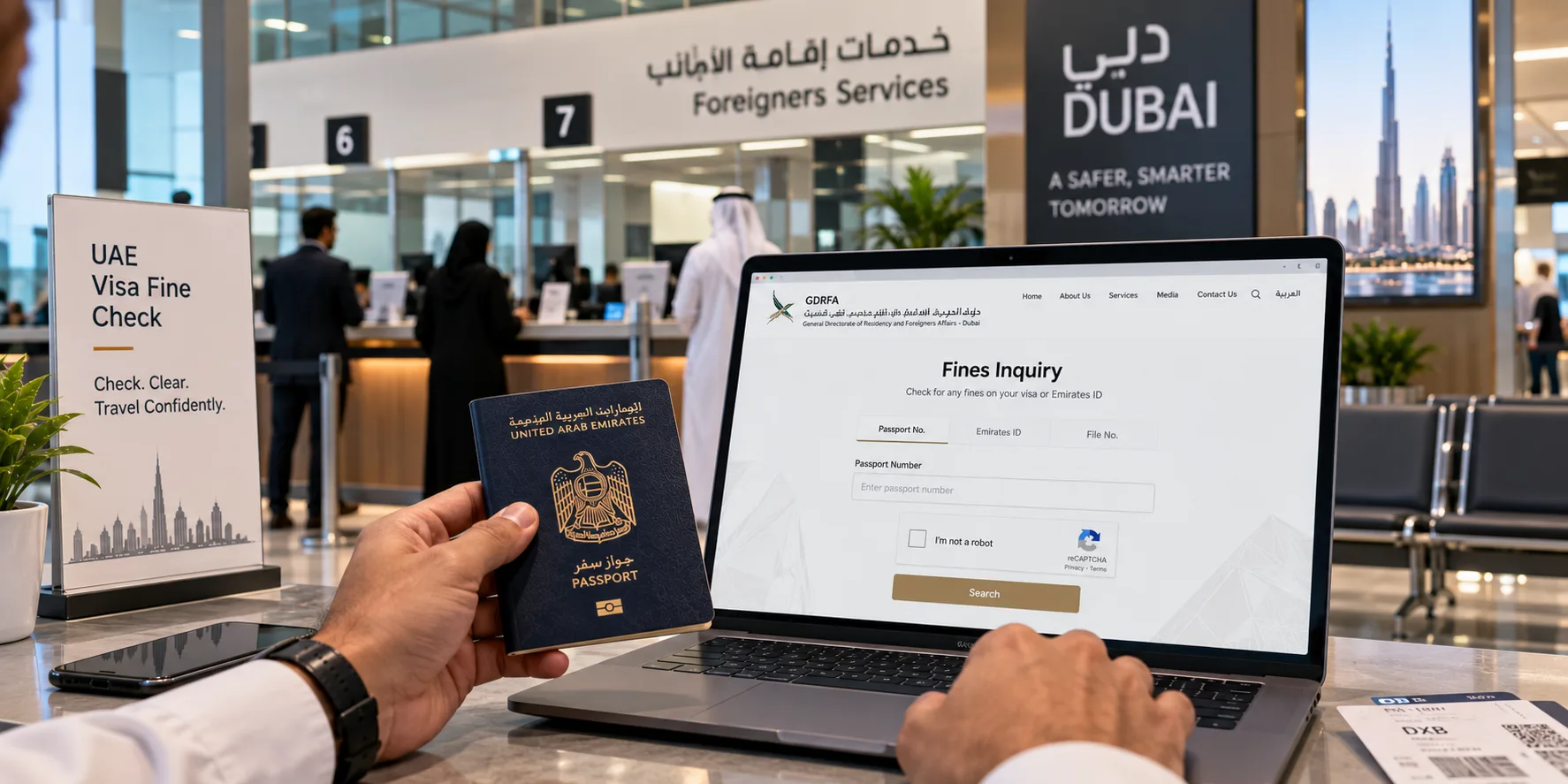
For a Dubai-issued file, use the official GDRFA Dubai Fines Inquiry Service. It supports searches using a file number, UDB number, Emirates ID or passport number. Depending on the search method, the form can also request nationality, file type, place of issue, date of birth and gender.
For a federal file, use the official ICP visa or residence violation fine service.
A “no record” result from one authority does not automatically prove that there is no fine. First confirm the issuing emirate and the identity details linked to the original immigration file.
What Details Should You Keep Ready?
Before opening a fine service, keep the visa copy or residence record nearby. A Dubai file may be searchable by file number, UDB number, Emirates ID or passport number. The live service decides which extra fields you need.
Use the identity details exactly as they appear on the immigration record. If your passport was renewed, keep both the old and new passport details available. If a sponsor filed the original visa, ask for the file reference rather than guessing from the visa type.
A clean UAE visa fine check matters because a spelling error, wrong date of birth or wrong issuing emirate can produce a no-record result. That result does not prove the file is clear. It may only mean the search details were wrong.
UAE Visa Fine Check by Passport Number
A visa fine check by passport number is useful, but the passport number is rarely the only field. The authority can also ask for nationality, date of birth, file details or another identity number.
If you renewed your passport after the visa was issued, the immigration record may still use the old passport number. In that situation, try the file number, UDB number or Emirates ID when the live service offers those options.
Do not enter passport or Emirates ID details into an unknown “fine checker” site. Use the authority that owns the file. If you are unsure whether a separate Emirates ID penalty is involved, the Emirates ID Fine Check guide explains the difference between ID renewal delays and visa overstays.
UAE Visa Fine Check: Current AED 50 Daily Overstay Rate
The current standard UAE overstay fine is AED 50 for each chargeable day. Current ICP services apply the AED 50 daily amount to visa and residence violations, and UAE Government guidance states that visit, tourist and residence overstay fines are standardised at AED 50 per day.
The fine does not necessarily begin on the same calendar date for every traveller. It starts after the authorised stay and any grace period that applies to the specific immigration record have ended. Residence permits can have category-based grace periods, while entry permits follow the rules attached to the relevant visa or permit type.
This is why a simple “visa expiry date + number of days” calculation can be wrong. Before estimating a fine, confirm the permitted stay, the relevant grace period and the authority that owns the file.
Simple Overstay Estimate
For an educational estimate:
Chargeable overstay days × AED 50 = estimated daily overstay amount
| Chargeable Days | Daily Fine Estimate |
|---|---|
| 1 day | AED 50 |
| 5 days | AED 250 |
| 10 days | AED 500 |
| 30 days | AED 1,500 |
| 60 days | AED 3,000 |
| 90 days | AED 4,500 |
This estimate covers only the AED 50 daily component. Separate smart-service, departure-permit, status-change or other government charges can apply depending on the case. Always compare the estimate with the official ICP or GDRFA record.
When Does a Dubai Visa Overstay Fine Start?
The Dubai visa overstay rules depend on the actual permitted stay, not only the visa issue date. Entry validity, permitted stay and residence expiry are different concepts.
For a tourist or visit visa, check the authorised stay shown on the file and any specific grace rule that applies to that route. Do not copy a residence grace period onto a tourist visa. These Dubai visa overstay rules are file-specific.
For residence permits, the current ICP rules give category-based grace periods after expiry or cancellation. Once that grace period ends, the AED 50 daily fine can begin.
If your visit visa is still valid and the category allows more time, act before overstay starts. Check the permitted stay, extension eligibility and the issuing authority before you pay for another service.
Visa Still Valid?
Check extension options before the legal stay ends. Fixing the stay while the visa is valid is usually simpler than resolving an overstay later.
Review Dubai Visa Extension OptionsTourist and Visit Visa Overstay Rules
Do not assume that every tourist or visit visa has the same grace period. Current ICP service cards state that the AED 50 daily fine begins after the permitted stay and the grace period applicable to that specific type of entry permit have ended.
That means the correct starting point is the immigration record for the visa you actually hold, not an old rule copied from another visa category. Check the permitted stay, any extension or status-change transaction, and the authority's live record before calculating chargeable overstay days.
If an extension or status-change request is pending, keep the submission receipt but do not assume the request has stopped the fine until the immigration record shows the updated legal status.
If your visa is still valid and your category allows an extension, review the Dubai visitor visa extension options before the permitted stay ends.
ICP service cards state that AED 50 per day applies after the entry permit has expired or been cancelled, starting after any grace period that applies to that permit type. Some special routes publish their own stay and extension rules.
A pending extension request should not be treated as proof that the overstay has stopped. Wait for the immigration record to show the new legal status. A cancelled flight also does not automatically rewrite the visa record unless an official relief measure covers the case.
Residence Visa Grace Periods After Expiry or Cancellation
For ICP-managed residence files, current guidance publishes category-based grace periods after residence expiry or cancellation:
| Residence Category | Current ICP Grace Period |
|---|---|
| Golden, Green and Blue Residence holders and eligible family members; widows/divorcees of residents; students after study; and qualifying relatives of UAE citizens | 180 days |
| Skilled workers in professional levels 1–3 and property owners | 90 days |
| Residence permits issued with a guarantor or host | 60 days |
| Other residence categories | 30 days |
These grace periods apply to the relevant ICP-managed residence categories. Do not automatically apply the same table to every Dubai-issued residence file. For a Dubai residence, confirm the grace period shown by GDRFA or the rule that applies to your specific residence category.
Expiry and Cancellation Are Not the Same Event
A residence permit can end because it expires or because it is formally cancelled. The date recorded by the immigration authority matters when determining when a grace period begins. Do not calculate the grace period from an employer's last working day, resignation date or the date you stopped using your Emirates ID.
If a sponsor cancels your residence, keep the official cancellation confirmation and check the cancellation date shown on the immigration record. If you are unsure whether the residence has actually been cancelled, confirm its live status before calculating the grace period or any possible overstay fine.
For help confirming whether a previous residence file has been formally closed, see the UAE visa cancellation status check guide.
How to Pay a Dubai or UAE Visa Fine
First check the fine through the correct authority. Then review the person, file number, dates and every charge shown before you pay.
- Confirm the issuing authority. Use GDRFA for Dubai or ICP for the other emirates.
- Open the matching fine service. Use the official portal or an authorised centre.
- Check the file details. Make sure the fine belongs to the correct person and visa.
- Review the full amount. Do not look only at the daily AED 50 component.
- Complete payment. Use the payment method offered by the authority.
- Save the official receipt. Keep it until the file shows the updated status.
- Recheck the immigration record. Confirm the balance has cleared.
- Complete the next legal step. Paying a fine does not itself create a new visa.
ICP's current violation-fine service says the person must leave the UAE or adjust status after paying the fine. That point is important: payment settles the monetary violation, but the immigration status still needs a legal resolution.
What Can Be Added to the AED 50 Daily Fine?
The AED 50 figure is the daily violation amount, not always the full amount shown at payment. ICP's current violation-fine service also lists a smart-service fee. A departure permit, status change or other service can create separate charges.
This is why two people with the same number of chargeable days can see different totals. One person may only need to settle the daily fine. Another may also need a departure permit, service transaction or other status step.
Read the payment screen line by line. Do not call every item an “overstay fine.” Keep the daily fine, government service fee and any private handling fee separate when you compare totals.
Departure Permit and Leaving the UAE After an Overstay
A departure permit should not be described as automatically required after a fixed number of overstay days. ICP's current departure-permit service does not publish a universal “30-day overstay” trigger.
Where a departure permit is required, ICP states that outstanding fines must be paid before a regular permit is issued. The traveller must leave the UAE within 7 days from the permit's issuance date.
Current ICP departure-permit fees
- Application fee: AED 200
- Smart Services fee: AED 100
Dubai cases can follow GDRFA procedures instead of the ICP federal route. If your case involves an unresolved residence cancellation, lost passport, status issue or another immigration block, confirm the required departure procedure with the authority that owns the file before travelling.
Can a Dubai Overstay Fine Be Reduced or Waived?
For Dubai files, GDRFA provides an official service that allows a person to submit a request to waive or reduce a financial penalty arising from violations of the UAE entry and residence law.
GDRFA currently lists the following requirements for this request:
- a copy of the violator's passport;
- a letter explaining the reasons for the violations and the person's inability to pay the fine; and
- any additional documents requested by the Fines Committee.
Submitting a request does not guarantee approval. The authority reviews the application and supporting documents.
For a non-Dubai file, contact ICP through its official channels to confirm which relief, exemption or status-resolution process is available for the specific case rather than assuming the Dubai procedure applies.
Temporary Overstay-Fine Relief and Amnesty Claims
Temporary relief measures should be treated separately from the normal overstay rules. For example, ICP announced an exceptional measure on 4 March 2026 for travellers who could not leave because of regional airspace closures and flight suspensions. The announcement applied to qualifying fines incurred from 28 February 2026.
That was a targeted emergency measure for affected travellers, not a permanent general exemption from UAE overstay fines.
Do not rely on an old social-media post, expired initiative or unofficial claim that a new amnesty is available. Before delaying payment or status correction, check current ICP or GDRFA announcements and confirm whether a relief measure specifically covers your case.
Fine Not Showing or Fine Paid but Still Showing
A missing result does not always mean the file has no fine. Common causes include the wrong authority, an old passport number, a data mismatch or a delay before the fine posts.
| Problem | What to Check |
|---|---|
| No record found | Confirm issuing emirate and search the matching authority. |
| Passport search fails | Try file number, UDB number or Emirates ID when available. |
| Old passport used for visa | Search with the identity details linked to the original file. |
| Fine still shows after payment | Keep the receipt and allow time for the transaction to post. |
| Balance looks wrong | Check the chargeable dates, grace period and any extra service items. |
Do not pay twice because the portal still shows the old result. Repeat the UAE visa fine check with the same authority after the payment has had time to post. Contact official support if the record remains blocked.
Can a Sponsor Check or Pay a Dependant's Fine?
A sponsor may be able to check a dependant's Dubai fine when the service allows access to the sponsored file. GDRFA's fines inquiry page explicitly refers to checking fines on your own file or files under your sponsorship.
The exact search details still depend on the record. Keep the dependant's passport, Emirates ID or file number available when the service asks for them. Employer-sponsored and family-sponsored records may not use the same access path.
Do not share a dependant's identity details in public chat or comments. Use the official service or an authorised centre when the file contains sensitive personal information.
Does an Overstay Affect a Future Dubai Visa?
A past overstay can form part of the immigration history. Unpaid fines, an unresolved exit issue or an open residence record can complicate a new application.
Paying a fine does not guarantee approval of a later visa. At the same time, a resolved overstay does not automatically mean permanent ineligibility. The authority reviews the new application on its own facts.
Before you apply again, clear the old file and understand the actual issue. The Dubai Visa Rejection Reasons guide explains how previous UAE records can interact with a new visa application.
What to Keep After You Resolve the Case
Keep the fine-payment receipt, cancellation or departure record, and any status-change approval. These records can help if an old fine still appears later or if a new visa application needs clarification.
If you left the UAE after resolving an overstay, confirm that the departure was recorded. If you changed status inside the UAE, keep the new visa or residence approval with the old payment receipt.
Do not submit a new tourist application while the old file still shows an unresolved balance or unclear status. First make sure the previous immigration record has reached the legal end state that applies to your case.
Common Dubai Overstay Fine Check Mistakes
- Checking ICP for a Dubai-issued file or GDRFA for a federal file.
- Confusing visa issue validity with the permitted stay.
- Assuming every tourist visa has the same grace period.
- Applying a residence grace period to a visit visa.
- Calculating fines from an old AED 100 or AED 200 daily rate.
- Treating 11 February 2026 as the start date of the AED 50 rate.
- Searching only with a new passport when the old one is linked to the file.
- Paying a second time before the first payment posts.
- Waiting until the airport to investigate a complicated overstay.
- Assuming fine payment alone creates valid visa status.
- Assuming an amnesty or waiver is automatic.
- Sharing passport or Emirates ID details on an unverified site.
A reliable Dubai overstay fine check uses the authority's actual record, not a social-media calculator or an old fee table.
Protect Your Passport and Emirates ID Data
Fine checks can require sensitive identity details. Enter them only on the official authority service or at an authorised centre. Do not send passport numbers, Emirates ID numbers, UDB numbers or visa-file details to public social-media accounts.
Resolved the Old Visa File?
If the overstay, fine and exit or status issue are fully resolved, check the current visitor-visa route before starting a new UAE application.
Review Dubai Visitor Visa OptionsFinal Overstay and Fine Checklist
- Confirm the issuing emirate.
- Use GDRFA for Dubai or ICP for other emirates.
- Check the real permitted stay or residence expiry date.
- Confirm the grace period that applies to the exact file.
- Use AED 50 per chargeable day only as an estimate.
- Compare the estimate with the official fine result.
- Review any service or departure-permit charges separately.
- Save the payment receipt.
- Recheck the status after payment posts.
- Leave the UAE or complete a legal status change when required.
The safest UAE visa fine check is the one tied to the correct immigration file. Identify GDRFA or ICP first, confirm the chargeable dates, then pay or fix the status through the route that applies to that visa.