PRESS
PRESS 

UAE visa restrictions are much narrower than most viral posts suggest. As of 13 October 2026, the only published rule against whole nationalities covers the Democratic Republic of the Congo (DRC) and South Sudan. It exists because of Ebola. Uganda was under the same rule until the UAE eased it on 26 September 2026. Most other passports can still apply, including those of Pakistan, Bangladesh, Egypt and Nigeria. Some simply face tougher checks and more refusals.
So the real question is rarely "Is my country banned?" It is usually "Will my application pass?" Here, we separate confirmed UAE visa restrictions from rumours, country by country. We also show you how to check your own case with official sources before you pay for a visa.
UAE Visa Restrictions 2026: Current Status
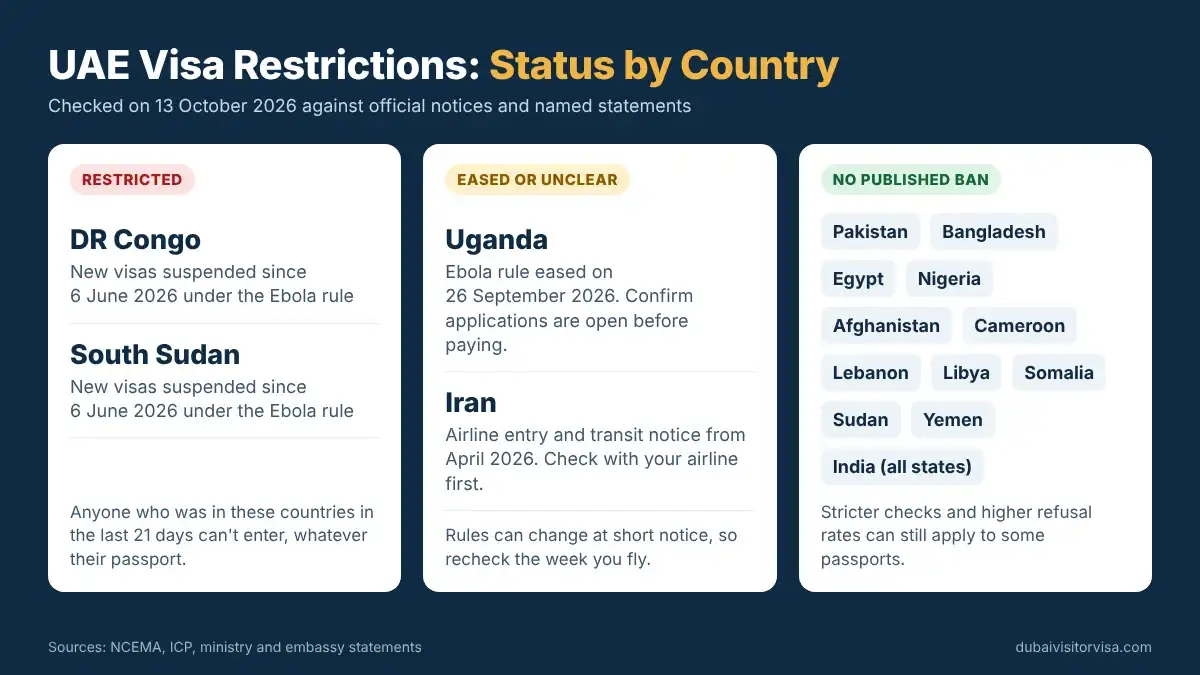
This table shows what is actually in force for the countries people ask about most. We checked every row against official notices and named news reports on 13 October 2026.
| Country or claim | Status today | What it means for you |
|---|---|---|
| DRC | Restricted (health rule) | New visas stay suspended. Anyone in the DRC during the past 21 days can't enter. |
| South Sudan | Restricted (health rule) | Same rule as the DRC. |
| Uganda | Eased on 26 September 2026 | Confirm that applications are being accepted before you pay. |
| Pakistan | No published ban | Visit visas moving again through registered agents. Solo applicants see more refusals. |
| Bangladesh | No published ban | Approvals have been very limited since 2024. |
| Iran | Unclear | Airlines barred most Iranian passports in April 2026. Check with your airline. |
| Nigeria | No published ban | Agents apply extra conditions that were never published officially. |
| Egypt | No ban | Egypt's foreign ministry says visas are issued normally. |
| Afghanistan, Cameroon, Lebanon, Libya, Somalia, Sudan, Yemen | No published ban | Named in a viral list that no UAE authority confirmed. Expect strict checks. |
| India (UP or any other state) | No ban | No UAE rule treats applicants by home state. |
Two points stand out about UAE visa restrictions today. First, the only active nationality rules are health measures with a clear start date and a named authority. Second, every other "ban" being shared either never existed or describes slower, stricter checks for some passports. That difference matters, because good documents can overcome a strict check, while nothing overcomes a real ban.
If you're not sure where your passport stands, the Dubai visa eligibility checker is a quick first step. Then read the country notes that follow, since each one explains what has actually changed.
Which Countries Face a Real UAE Visa Ban Right Now?
The answer is short. Two countries, the DRC and South Sudan, face a suspension of new visas, and both measures are tied to the Ebola outbreak in central and east Africa. No other passport is covered by published UAE visa restrictions as of mid-October 2026.
DRC and South Sudan: Ebola Entry Rules Still Apply
These are the strictest UAE visa restrictions in force today. On 5 June 2026, the UAE's emergency authority, NCEMA, and its federal immigration authority, the ICP, announced two measures. First, travellers arriving from the DRC, Uganda or South Sudan can't enter the UAE, even through a third country, unless they have spent more than 21 days outside those countries. Second, the UAE stopped issuing all new visas, including visit visas, to nationals of the three countries from 1:00 pm on 6 June 2026.
Notice that the rule works in two ways. The 21-day part depends on where you have been, so it can apply to any passport holder, for example a British engineer flying in from Juba. The visa part depends on your passport. Meanwhile, cargo and transit flights kept running.
On 26 September 2026, the authorities confirmed that the measures for the DRC and South Sudan remain in force while the outbreak continues. They also said they would keep the rules under review. So if you hold one of these passports, wait for an official notice before you spend money on a visa. No provider can get around the suspension.
Uganda: Restrictions Eased on 26 September
Uganda declared its Ebola outbreak over on 28 July 2026. Two months later, NCEMA, the health ministry and the ICP said they were easing the June measures for Ugandan nationals. That makes Uganda the first country to come off the Ebola-related UAE visa restrictions.
However, the change did not switch everything back on overnight. Uganda's foreign minister, Adonia Ayebare, said one step was still left. A UAE team first had to visit Uganda's aviation authority and other bodies to check they were ready. He expected that visit within seven days. We have not seen a published result of the visit yet. For now, ask your provider to confirm that the system accepts Ugandan applications before you pay.
Ugandans also faced a separate rumour in September 2025, when a viral post claimed a full ban from 2026. The UAE's ambassador to Uganda called that claim false. Even so, a Ugandan foreign affairs minister said at the time that the UAE had suspended long-term visas for some groups of Ugandans. Our Dubai visa guide for Ugandan citizens covers documents and routes now that the health rule has eased.
Is There an Official UAE Visa Ban List?
No. The UAE does not publish a list of banned countries, and no federal body has confirmed the lists shared online. Genuine UAE visa restrictions come through official channels such as NCEMA, the ICP or the official news agency WAM. Each notice carries a start date and a reason, as the Ebola measures did.
The most shared list appeared in September 2025. It named nine countries: Afghanistan, Bangladesh, Cameroon, Lebanon, Libya, Somalia, Sudan, Uganda and Yemen. Some versions added Nigeria. The claim started on UAEVisaOnline, a private visa agency site. It quoted an "immigration circular" that nobody has ever shown. Within days, news sites in India and abroad repeated it.
Then the denials came. Bangladesh's ambassador to the UAE, Tareq Ahmed, said neither the embassy nor the consulate had received any notice from the UAE government. Later, the Bangladesh Embassy in Abu Dhabi said UAE officials had confirmed that no such order was announced. In addition, The Business Standard in Dhaka published a note saying its own report on the ban had been incorrect.
Notice how the lists keep changing, too. If one government order existed, every copy would name the same countries. Instead, each repost adds or drops a few names. That pattern usually means people are copying each other rather than quoting a source.
Why Bangladeshi Applicants Still Struggle
Bangladesh shows the gap between formal UAE visa restrictions and day-to-day approvals. There is no published UAE visa ban on Bangladeshi nationals. Even so, approvals have been scarce since August 2024. In May 2025, the UAE ambassador in Dhaka said the embassy was issuing 30 to 50 visit visas a day. He added that skilled work visas were back online, and that visas for security guards and business groups were moving.
By October 2025, though, Bangladeshi tour operators told The Business Standard that tourist and transit visas were "almost zero". We have found no official UAE notice in 2026 that either reopens or closes Bangladeshi visit visas. Work permits follow a separate track through the labour ministry, MOHRE. There, skilled roles have fared better than low-skilled jobs.
If you are planning a trip, apply early and keep every document consistent. Then check the latest position in our Dubai visa guide for Bangladeshi citizens.
Pakistan Visa Ban and the "Banned Cities" Lists
Pakistan isn't covered by any published UAE visa restrictions. The confusion began in late 2025. On 27 November 2025, a senior Pakistani interior official, Salman Chaudhry, briefed a Senate committee. He said only holders of diplomatic and official (blue) passports were getting visas. Officials in Islamabad and Abu Dhabi, however, have said there is no official ban.
The position improved in summer 2026. In early August, Arab News reported that Pakistani families were getting visit visas again through registered travel agents. A UAE embassy official said visas were open for ordinary passports through agents. Travel agents added that individual applicants still faced more refusals than families. Daily passengers to Dubai had climbed to about 400, still well short of the roughly 1,000 a day of two years earlier.
What about the lists of banned Pakistani cities? We have not found any UAE document that bans applicants from named cities. The lists on social media name different cities each time, which points to rumour rather than policy. The real hurdles are more ordinary. For example, the GDRFA asks Pakistani applicants for a copy of their national ID card, and every detail must match the passport. The Pakistan to Dubai visa requirements list the documents that help a file pass.
Egyptian Visa Ban Claims
There is no UAE visa ban on Egyptians. In August 2026, social media posts claimed mass layoffs and visa cancellations for Egyptian workers in the UAE. On 20 August, Egypt's assistant foreign minister for consular affairs, Haddad Al Gohary, gave a clear answer. He said the embassy and consulate had found no mass dismissals or visa cancellations. In his words, "Visas are issued on a regular basis."
He did accept that some people had lost their residence permits, mostly for breaking residency rules or overstaying. The same rules apply to everyone. Anwar Gargash, an adviser to the UAE President, also denied reports that work residencies were being cancelled in bulk. So Egyptians can apply for visit visas in the usual way, and our Dubai visa guide for Egyptians covers costs and documents.
Iranian Passport Holders After the April Airline Notice
Iran is the one case where the honest answer is "check before you book". On 1 April 2026, amid the war involving Iran, Emirates, flydubai and Etihad posted notices. They said Iranian passport holders could not enter or transit the UAE. The notices listed some exceptions, such as Golden Visa holders and some family members of UAE nationals.
The UAE lifted all air traffic restrictions on 3 May 2026, and Emirates later updated its travel notices. However, we have not seen a public statement confirming that the April rule for Iranian nationals has ended. So Iranian passport holders should confirm with their airline and visa provider before paying. Our notes on Iranian passport rules for Dubai set out the extra checks.
Nigeria's Agent-Reported Conditions
The UAE lifted its long suspension of visas for Nigerians in July 2024. A year later, Nigerian travel agents shared a notice they said came from Dubai immigration. It said transit visas would no longer be processed for Nigerians. It also said applicants aged 18 to 45 travelling alone could not get a tourist visa, and older applicants needed bank statements for the last six months with at least USD 10,000 at each month end.
Nigeria's presidency said it had received no formal notice of a new policy, and that the UAE was still issuing visas. No UAE authority has published those conditions, so treat them as provider practice rather than law. Still, they shape outcomes. Before you apply, ask your provider which conditions apply to Nigerian passports, and read our Nigerian citizens' Dubai visa guide.
Is There a UAE Visa Ban for UP or Other Indian States?
No. There is no UAE visa ban for Uttar Pradesh (UP), Karnataka, Punjab or any other Indian state. UAE visa restrictions apply by nationality or travel history, never by Indian state. A Dubai visa decision depends on your passport, your documents and your own history. Indian passports are not on any restriction list.
The rumour has a real background, though. From late 2024, Dubai began asking visit visa applicants to upload a confirmed return ticket and a hotel booking. Those staying with relatives had to show where they would live. Indian travel agents then reported a sharp rise in rejections. When many applicants from one region get refused in the same month, it can look like a regional ban. In reality, the cause is usually missing bookings, mismatched details or a thin travel history.
Many Indians don't need to apply in advance at all. If you hold certain US, UK, EU or other approved visas or residence permits, you may qualify for a visa on arrival instead. The Dubai visa rules for Indians explain both routes.
Visa Refusal, Restriction or Personal Ban: Which One Do You Face?
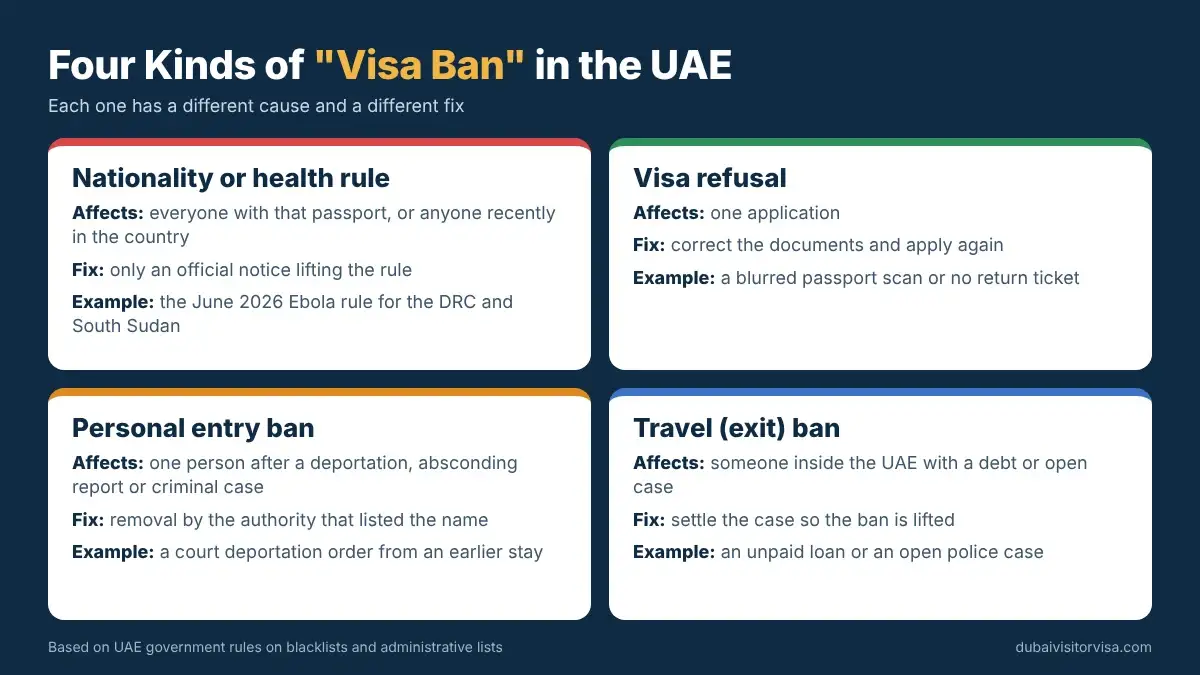
People use the word "ban" for very different problems, and not every problem is one of the UAE visa restrictions in the news. Getting the label right tells you what to do next, so it helps to separate four situations:
- Nationality or health restriction: a public, dated rule from a named authority, such as the Ebola measures. Nobody can get around it until the authority lifts it.
- Visa refusal: one decision on one file. It doesn't stop you from applying again with better documents.
- Personal entry ban: a block linked to one person's record, usually after a deportation, an absconding report or a criminal case.
- Exit or travel ban: a block that stops someone already in the UAE from leaving, usually because of an unpaid debt or an open court case.
Personal Entry Bans and the UAE Blacklist
The UAE keeps two kinds of lists for individuals. The Federal Department of Criminal Police runs the blacklist. It covers people deported by a court after a crime, and people the Interior Ministry deported under Article 23 of the residency law. It also lists people reported by the UAE's international police cooperation department. People deported from another Gulf state for a crime are on it too, as are people with diseases the health ministry treats as a public danger.
The residency departments (GDRFA) keep a separate list for residency cases. It mainly covers domestic workers who cancelled their residence early and workers reported for absconding. People under a deportation order from the residency office are on it as well. Names go on or come off either list only by a letter from the authority concerned. You can read the categories in the official UAE government blacklist rules.
A personal ban is not something a visa agent can fix by trying again. If you lived in the UAE before, a past case, an unpaid fine or an absconding report may still affect you. In that case, resolve it first, usually through a UAE lawyer or your former sponsor, before you pay for a new visa.
Labour Bans, Travel Bans and Advice for Residents
A labour ban from MOHRE usually affects new work permits rather than visit visas, and our UAE labor ban rules explain how the one-year ban works. A travel ban works the other way round, because it keeps a person inside the country until a debt or legal case is settled. Dubai Police offers an online travel ban enquiry for Dubai cases, which needs an Emirates ID and UAE PASS. Abu Dhabi's Judicial Department runs its own enquiry service.
There is also the travel advice the UAE gives its own people. On 30 May 2026, the foreign ministry urged UAE nationals and residents not to travel to the DRC, Uganda and South Sudan. That advice concerns people leaving the UAE. It doesn't decide who can visit.
How to Check UAE Visa Restrictions Officially
You can check UAE visa restrictions yourself. You don't need to trust a forwarded message, or even us, when official channels can answer the question. Work through these checks in order:
- Look for an official notice. Real nationality measures appear on WAM and come from bodies such as NCEMA, the ICP or the Ministry of Foreign Affairs. Each one has a date, a reason and a list of countries.
- Find out if you need a visa at all. Many passports get a free entry stamp, so read about the Dubai visa on arrival before paying for anything.
- Confirm with your airline. Airlines check entry rules before boarding, and the decision at check-in is final. Emirates, flydubai, Etihad and Air Arabia all publish travel updates.
- Ask your visa provider in writing. A licensed Dubai tourism company files tourist visas with the GDRFA, so it sees at once if the system blocks a passport.
- Check your own record if you lived in the UAE. Former residents can check their file status through ICP or GDRFA services, using their unified number (UID) where asked.
- Track your application. After you apply, the Dubai visa status checker shows each stage up to the decision.
One more tip: save a screenshot of any official notice you rely on, with the date visible. If an airline agent or provider tells you something different, you can show them exactly what you read.
What About Transit Passengers?
Changing planes without passing immigration doesn't need a UAE visa for most travellers. Even so, airlines apply UAE entry and transit rules at check-in, which is how the April notice stopped Iranian transit passengers. If you want to see the city between flights, you need a transit visa, such as the 96-hour transit visa. Nigerians should keep in mind the 2025 agent reports that transit visas were not being processed for their passports, and confirm before booking.
If You See a UAE Visa Ban Post Online
Most ban posts share the same warning signs. Before you cancel a trip or pay an "approval guarantee" fee, look for these:
- No named authority, only phrases such as "sources say" or "immigration circular".
- No date, or a date that has already passed and was never updated.
- A country list that differs from other versions of the same story.
- Links to a private visa website instead of WAM or a government portal.
- A sales pitch at the end, such as a "special route" for banned nationalities at an extra fee.
The last sign deserves extra caution. Nobody can sell you a way around a real suspension. If a seller promises guaranteed approval for a restricted passport, walk away and keep your money.
On the other hand, real UAE visa restrictions come with an official notice that is easy to recognise. The notice names the issuing body, gives a start date and time, explains who is covered and lists any exceptions. The June 2026 Ebola notice did all four, which is why we treat it as fact while treating the viral lists as rumour.
What to Do After a UAE Visa Rejection
A rejection is frustrating, but it is rarely permanent. Most refusals come from fixable problems rather than hidden UAE visa restrictions. Take these steps before you reapply:
- Find out the reason, if you can. The system often gives no clear reason. Still, your provider can usually tell you if the issue was documents, the photo, the passport or a security check. Compare your file with the common Dubai visa rejection reasons too.
- Fix the details. Names must match the passport exactly. A blurred scan, a passport that expires within six months or a photo that breaks the rules can each cause a refusal, so compare your photo with the Dubai visa photo size rules before uploading.
- Strengthen the file. Add a confirmed return ticket, a hotel booking or your host's details, plus proof of funds where your provider asks for it.
- Don't rush a copy. Reapplying the same day with the same file usually brings the same result, so fix the cause first.
- Try another route. A family visit with a sponsor, a business visa with a host company or a visa on arrival may suit your case better.
Fees are another common worry. Once your file reaches immigration, the government fee is usually spent, so a refusal rarely brings a refund. Our Dubai visitor visa cost breakdown explains which parts of the price go to the government.
Overstays Can Create Your Own Restriction
Some travellers create their own problem. Staying past your visa costs AED 50 a day in fines. A serious overstay can also end in deportation, and deportation puts your name on the blacklist. So book your exit flight in time, or request a 30-day inside-country visa extension before the visa runs out.
Before You Apply for a UAE Visa
Run through this short checklist first. It catches most of the problems that people later mistake for UAE visa restrictions:
- Your passport stays valid for six months or more from your arrival date.
- Your passport is not under a current suspension. As of 13 October 2026, that means the DRC and South Sudan only.
- You haven't been in the DRC or South Sudan during the past 21 days.
- Your names, dates and passport number match exactly across every document.
- You have a return or onward ticket and a confirmed place to stay.
- Your health insurance is valid in the UAE, as explained in our notes on UAE visit visa insurance.
- You have chosen a visa that matches your dates, for example the 30-day single-entry visa for a short holiday.
- You have no open case, unpaid fine or absconding report from an earlier stay.
For the full document list, including photo and passport scan rules, read the Dubai visitor visa requirements.
Not sure where your passport stands? Ask us before you pay, and we'll tell you if applications for your nationality are going through. Apply now if your documents are ready, or contact us with your nationality and travel dates.
How We Check UAE Visa Ban Rumours
We track UAE visa restrictions with a simple rule. A claim goes into our status table as a restriction only when it passes three tests. A named UAE authority must have issued it. It must have a clear start date. And we must be able to read the original notice or a report that quotes it directly. Embassy statements, named officials and well-known newspapers help us judge rumours. Anonymous posts and agency websites don't count as evidence.
We recheck the table whenever a UAE authority announces a change, and the date at the top shows the last full review. If you spot a new notice, send it to us and we'll verify it.
In short, UAE visa restrictions today come down to one health rule for two countries, a recent easing for Uganda, and a lot of noise about everyone else. Check the official sources, prepare a clean application, and don't let a forwarded list cancel a trip you can still make.