PRESS
PRESS 

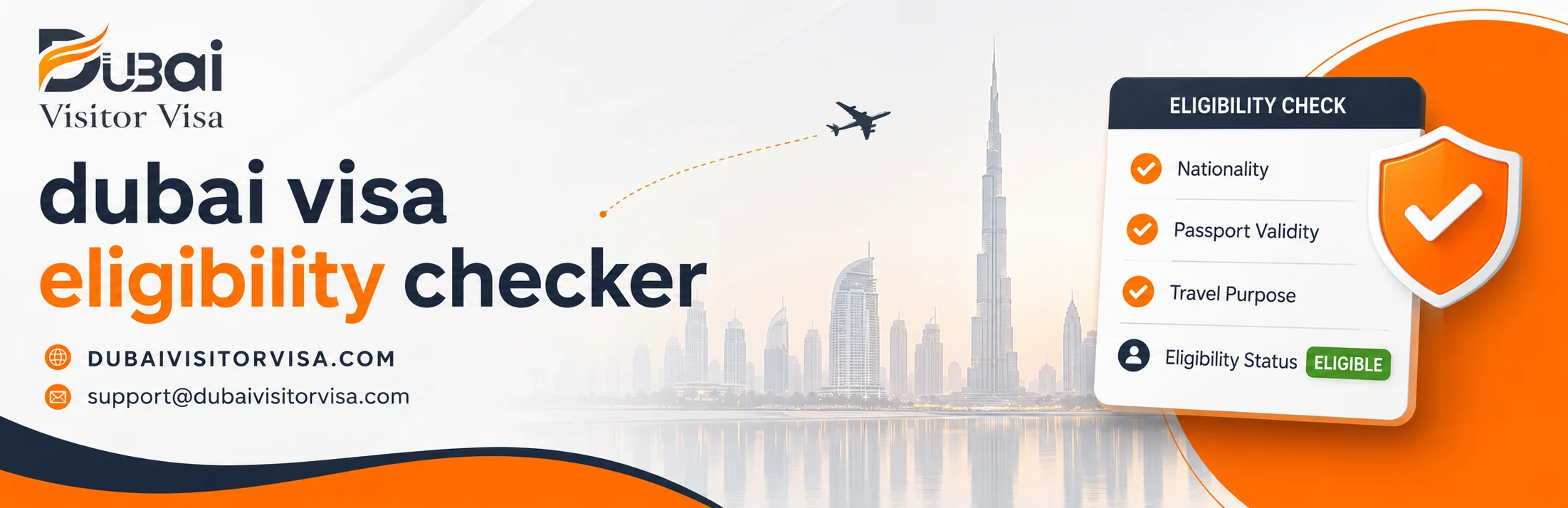
Use this Dubai visa eligibility checker to find the UAE entry route that is most likely to apply to your passport in 2026. Your passport nationality is the main starting point. Some travellers can enter without an advance tourist visa. Many get a visa on arrival. A small group may use a special 14-day or 60-day route with the right foreign visa or residence card. Other travellers need an approved UAE visa before departure. If you already know you need an advance visa, see our Dubai visitor visa application guide.
Quick answer: do not decide UAE visa eligibility from your country of residence alone. Check the passport you will actually use for travel. Then check whether that passport qualifies for a normal visa-on-arrival route, a special conditional route, or an advance tourist visa.
This checker is a first-stage travel tool, not an immigration decision. Rules can change and border officers make the final entry decision. Recheck shortly before you fly, especially if your trip is months away.
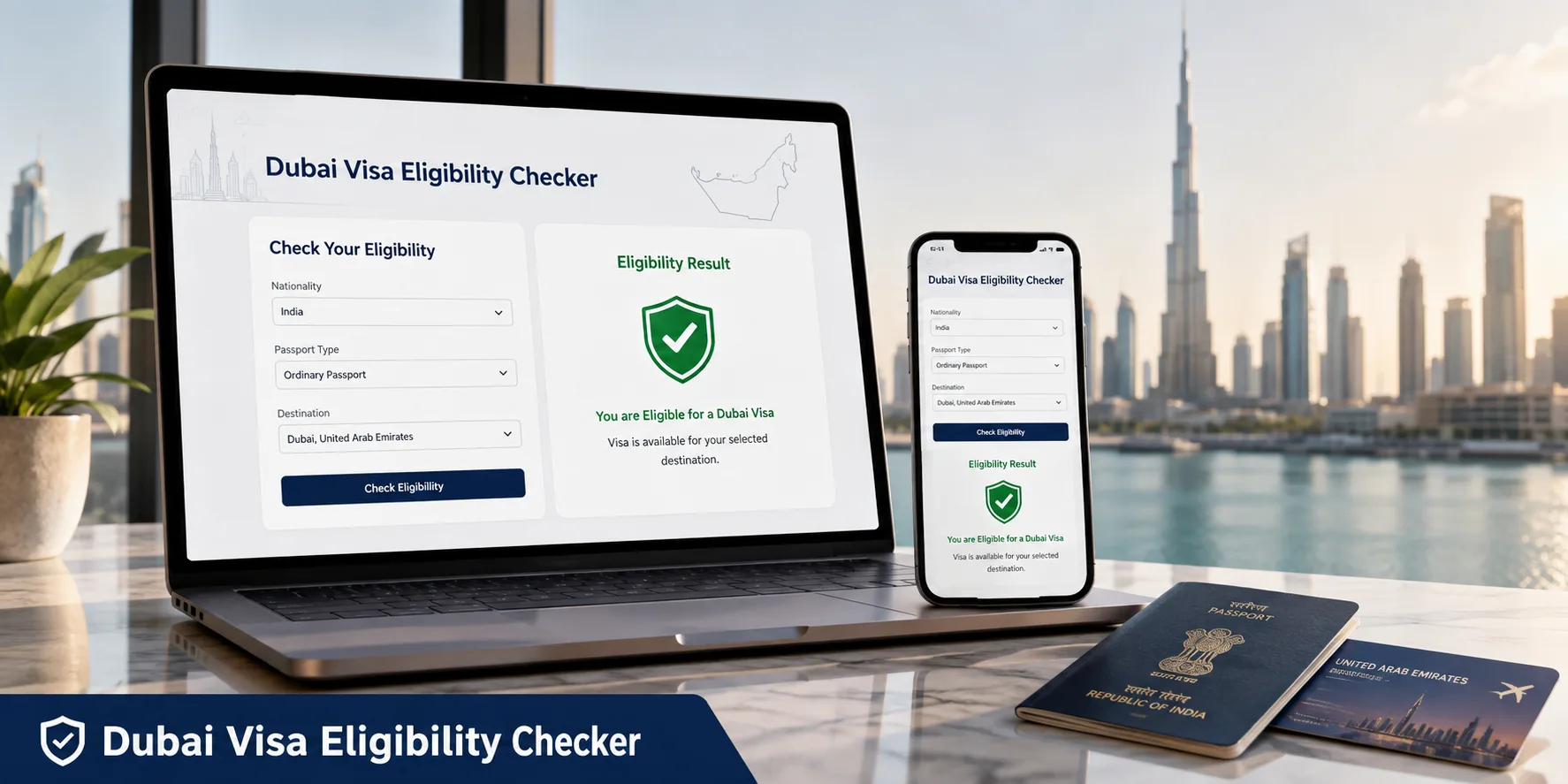
Dubai Visa Eligibility Checker: Check Your Passport
Select the passport you will use. Add your travel purpose and any qualifying foreign visa or residence document. The tool does not ask for a passport number, visa number or Emirates ID.
Passport nationalitySelect nationality
Purpose of travelTourism or family visitBusiness meeting or conferenceTransit / stopoverMore than one UAE entry
Do you hold one of these valid foreign documents?None of theseValid US visa, US residence permit or Green CardValid UK visa or residence permitValid EU visa or residence permitValid Australian residence permitValid Canadian residence permitValid Japanese residence permitValid New Zealand residence permitValid South Korean residence permitValid Singapore residence permit
If transiting, will you stay airside?Not a transit tripYes, I plan to stay in the international transit areaNo, I plan to pass immigration / leave the airport
Check Dubai Visa RequirementChecker scope: ordinary passports and common short-visit routes. Refugee documents, emergency passports, diplomatic passports and unusual immigration cases need a manual check.
| Result Type | What It Usually Means | Next Step |
|---|---|---|
| GCC citizen | No UAE visa is normally needed | Travel with the required valid identity or passport document |
| Visa on arrival | No advance tourist visa normally needs to be arranged before travel | Confirm the permitted stay and passport rule before travel |
| Conditional 14/60-day route | Passport plus an accepted foreign visa or residence document may qualify | Check the current ICP service terms |
| Advance visa likely required | Your passport is not in the normal arrival groups used by this checker | Arrange the correct tourist or visit visa before departure |
| Manual review | Non-standard passport or unusual travel case | Confirm with the airline and UAE authority before booking |
How the Checker Works
This checker uses four short questions. First, it looks at the passport you will use. Second, it checks whether that passport appears in a standard UAE arrival group. Third, it checks whether one of the special 14-day or 60-day routes may apply. Finally, it adjusts the next step for transit or repeat-entry travel.
This order matters. A person can live in the United Kingdom, Canada or Germany and still travel under the rules of a different passport. Residence can matter in a special visa route, but it does not simply replace passport nationality.
The checker does not predict approval. It only identifies the likely route. An advance visa can still be refused. A person who qualifies for visa on arrival can still face normal border checks.
Do I Need a Visa for Dubai?
The answer falls into a few broad groups. GCC citizens do not normally need a UAE visa. Many other passports receive a visa on arrival. Some passports can use a special conditional entry route when paired with a qualifying foreign visa or residence document. Everyone else usually needs to arrange a visa before travel.
Dubai is part of the United Arab Emirates. A “Dubai visa” is therefore a UAE entry permission. Once you are lawfully inside the country, a trip from Dubai to Abu Dhabi or Sharjah is domestic travel and does not use another international entry.
If you are unsure whether your passport belongs to an arrival group, use the checker above as a first step. Then recheck the current rule shortly before departure.
GCC Citizens: No UAE Visa Normally Required
Citizens of Bahrain, Kuwait, Oman, Qatar and Saudi Arabia do not need a UAE visa for normal entry. This is different from being a foreign resident of a GCC country.
GCC citizenship and GCC residence are not the same. A Pakistani, Indian, Filipino or Egyptian passport holder living in a GCC state should not choose “GCC citizen” unless they actually hold that nationality.
GCC residents who are not GCC citizens can have a separate eVisa route. Residence validity and other conditions can apply.
30-Day UAE Visa on Arrival Group
Published airline and UAE visa-on-arrival guidance lists a 30-day visa-on-arrival group. These travellers do not normally arrange a standard tourist visa before flying to Dubai.
The group currently includes Andorra, Brunei, Hong Kong, Kazakhstan, Macau, Malaysia, Mauritius, Monaco, Mongolia, Republic of Ireland, Ukraine, Uzbekistan and Vatican City.
The 30-day allowance is not a universal rule for every visa-on-arrival passport. Other passport groups have different stay structures.
90-Day UAE Visa on Arrival Group
A larger group receives a multiple-entry 90-day visit visa on arrival. Current guidance says this visa is valid for six months from issue and permits 90 days of stay in total during that period.
The current 90-day group is large. It covers many passports from Europe, the Americas, Asia and Oceania. Examples include Australia, Canada, China, Fiji, France, Germany, Japan, New Zealand, Singapore, South Korea, the United Kingdom and the United States. Use the checker above for the full passport-by-passport result.
The 90 days are cumulative. Leaving the UAE and coming back does not start a fresh 90-day allowance under that same six-month arrival visa.
Mexico: 180-Day Visa on Arrival
Mexico is a separate case in current guidance. Mexican passport holders are listed for a multiple-entry 180-day visit visa that is valid for six months and allows 180 days of stay in total.
Mexico does not sit inside the normal 90-day group. The stay rule is different.
Dubai Visa Eligibility Checker: Conditional 14-Day and 60-Day Route
The most significant 2026 change on this page is the expansion of the conditional entry route. On 25 June 2026, ICP expanded it beyond India to six more nationalities: Indonesia, Vietnam, Thailand, the Philippines, Kenya and South Africa.
The current ICP service cards cover India, Kenya, Indonesia, Vietnam, Thailand, the Philippines and South Africa. Ordinary passport holders from these countries may qualify when they also hold an accepted foreign visa, residence permit or Green Card under the service terms.
The supporting document is not identical for all seven nationalities. The six nationalities added in June 2026 are described by ICP as needing a valid residence permit from an approved country. The existing India route is described in terms of a valid qualifying visa or residence document. Read your own service card before assuming a short-stay foreign visitor visa is enough.
The current ICP service pages list a valid US, EU or UK visa, residence permit or US Green Card among the accepted documents. They also accept valid residence permits from Japan, South Korea, Australia, Canada, Singapore and New Zealand.
For the official announcement and current 2026 expansion, see the ICP entry-visa eligibility update.
| Special Route | Stay | Extendable? | ICP Issuance Fee |
|---|---|---|---|
| 14-day visa | 14 days from entry | Once for the same period | AED 100 issuance fee + AED 100 smart-service fee |
| 60-day visa | 60 days from entry | No | AED 250 issuance fee + AED 100 smart-service fee |
AED 100 and AED 250 are the issuance fees, not the complete amount paid. Current ICP service cards show a separate AED 100 smart-service fee for both routes. Check the live service total at the time of application.
Current ICP service cards require a passport valid for at least six months. The foreign visa or residence document is described as needing to be valid, without a separate six-month rule of its own. Check the validity your own service card asks for rather than assuming a blanket six-month requirement on both documents.
What If You Do Not Qualify for Visa on Arrival?
If your passport is outside the normal arrival groups, check the special seven-country route. If that route does not fit, you will usually need an approved tourist or visit visa before departure.
Current Dubai tourist visa services include 30-day and 60-day options in single-entry and multiple-entry forms. The visa route should match the real trip.
See our Dubai visitor visa requirements guide before submitting documents.
30-Day vs 60-Day Tourist Visa
If the checker points you to an advance tourist visa, the next choice is usually stay length and entry count.
| Visa Type | Best For | Current GDRFA Base Fee |
|---|---|---|
| 30-day single entry | One short UAE trip | AED 252 + 5% VAT |
| 60-day single entry | One longer UAE trip | AED 352 + 5% VAT |
| 30-day multiple entry | Short trip with UAE exit and return | AED 300 + 5% VAT |
| 60-day multiple entry | Longer trip with UAE exit and return | AED 500 + 5% VAT |
The final amount can differ because a provider may add service charges and other applicable costs. Government fee and provider price are not the same thing.
For a separate cost breakdown, use our Dubai visa cost guide.
Checker result says advance visa?
Compare the current 30-day and 60-day options before paying. Choose the visa that matches your actual stay and entry plan.
Check Tourist Visa Options Compare Visa Costs
What Documents Do Advance Tourist Visa Applicants Need?
Current GDRFA tourist services list a short core set. You need a personal photo and a passport copy. You also need a ticket to continue the trip or leave the UAE. Medical insurance must be valid in the UAE.
The passport or travel document should normally be valid for at least six months. GDRFA also lists a national identity card for some passport holders, including Iraq, Pakistan, Iran and Afghanistan.
Hotel proof, two blank passport pages and bank statements are not universal requirements for every standard 30-day or 60-day tourist visa. They can be requested in a particular route or by a provider, but they are not part of the same universal core list.
Five-Year Multiple-Entry Tourist Visa
The UAE also has a five-year multiple-entry tourist visa. This is a separate self-sponsored route and can be issued to all nationalities subject to its conditions.
The current UAE Government description says the visa allows repeated visits of up to 90 days and can be extended for a further 90 days. The total stay should not exceed the permitted annual limit.
The route needs a bank balance of at least USD 4,000, or its equivalent, held during the last six months. You also need valid health insurance and the other travel papers.
Current ICP material describes a passport valid for more than six months for this visa. There is no two-year passport validity requirement.
Current GDRFA service information for the five-year tourist visa lists an AED 3,000 guarantee and a displayed total of AED 3,713.50 for that Dubai service route. GDRFA also notes that the final amount can vary with the case. That fee sits outside the normal 30-day and 60-day tourist visa table above.
Passport Nationality vs Country of Residence
Passport nationality is normally the first eligibility factor. Country of residence can matter for a special route, but it does not automatically give you the entry rights of that country.
For example, a Filipino passport holder living in the UK still travels on a Philippine passport. However, a valid UK residence permit may become relevant because the Philippines is now one of the seven countries in the conditional ICP route.
Residence can add a route. It does not rewrite your passport nationality.
Using the Checker for Dual Nationals
If you hold two passports, run the checker for the passport you intend to use. Eligibility can be different for each passport.
Use the same passport consistently for the relevant visa application, airline check-in and UAE entry. Switching documents halfway through the process can create a mismatch.
If you choose the passport with the easier entry route, make sure it is valid and legally usable for the full journey.
What If You Hold a Refugee or Emergency Travel Document?
A refugee document or emergency passport may follow a different rule. The same is true for stateless and other special travel papers. Do not treat them like a normal passport.
Use manual verification. Confirm with the airline and the relevant UAE authority before paying for a non-refundable trip.
The checker intentionally does not give a firm automated result for these cases.
Transit: Do You Need a UAE Visa to Leave the Airport?
Transit is not only about layover length. The key question is whether you need to pass UAE immigration.
If you remain airside and your airline transfers you to the next flight without immigration, a UAE entry visa may not be needed. If you must collect bags, change to a separate ticket or leave the airport, you may need entry permission.
Travellers who are not eligible for a normal arrival route may be able to use a 48-hour or 96-hour transit visa when the airline and itinerary qualify. See our Dubai transit visa guide.
Do You Need Multiple Entry for Dubai and Abu Dhabi?
No. Dubai and Abu Dhabi are both inside the UAE. Travelling between emirates does not mean you have left the country.
A multiple-entry visa matters when you leave the UAE and then return. A Dubai–Oman–Dubai plan is a real example. Dubai–Abu Dhabi–Dubai is not.
Entry count and stay length are separate decisions.
How Long Does a Tourist Visa Take?
Current GDRFA service cards list an expected completion time of 48 hours for standard 30-day and 60-day tourist visa services.
This is not a guaranteed personal approval time. A provider can need time to review files before submission. The authority may also request more information. That is why the displayed processing time on a provider visa card is usually longer than the government service time.
Do not book around a guaranteed two-day result. Leave time for one correction or extra review.
Overstay Rules After Entry
The checker tells you how you may enter. It does not change the stay limit after you arrive.
Current UAE service information sets an overstay fine of AED 50 per chargeable day. Since the unified fine structure introduced in February 2026, pre-arranged tourist and visit visas carry no grace period. The fine starts from the first day after your permitted stay ends.
Grace periods still exist in some other categories, most commonly after a residence permit is cancelled. Those rules belong to residence cases and should not be assumed on a normal tourist visit.
Read our Dubai overstay rules guide before relying on any extra time.
How to Apply After You Check Eligibility
- Use the passport you will actually travel with.
- Check whether you are GCC, normal visa on arrival, conditional route or advance-visa required.
- If an advance visa is required, choose the correct stay length.
- Choose single or multiple entry from the real itinerary.
- Prepare a clear passport copy and photo.
- Add onward or return travel and UAE-valid insurance where required.
- Review the full price before payment.
- Keep the application reference.
- Check the issued visa before travel.
After submission, you can use our Dubai visa status page where that service applies.
Common Eligibility Mistakes
- Choosing country of residence instead of passport nationality.
- Calling every arrival route “visa-free.” Many current airline pages describe them as visa on arrival.
- Assuming every arrival passport gets 90 days.
- Assuming a foreign residence permit helps every nationality.
- Using the special seven-nationality route without the required supporting document.
- Assuming Dubai and Abu Dhabi need two entries.
- Treating a transit visa as a cheap tourist visa.
- Using a refugee document as if it were an ordinary passport.
- Believing an online eligibility result guarantees entry.
Why This Checker Does Not Promise Approval
Eligibility and approval are different. A passport may qualify for a route, but the traveller still has to meet the route’s conditions.
An approved advance visa also does not guarantee entry. Border officers can still perform normal checks.
No private visa website can guarantee boarding, visa approval or UAE admission. A useful checker should show the likely route and the next verification step.
Still unsure after checking?
Use a manual review for non-standard passports, mixed travel documents or unusual residence cases.
Ask for a Manual Check Review Visa-on-Arrival Rules
Dubai Visa Eligibility Checker: Final Travel Check
Run the checker again if your passport, travel purpose or supporting foreign document changes before the trip.
- Your passport is the same one you plan to use at check-in.
- Your passport has enough validity for the route.
- Your arrival category still matches the latest published rule.
- Any supporting visa or residence permit is valid.
- Your stay length fits the permission you will receive.
- Your entry count matches the real itinerary.
- You understand that visa eligibility does not guarantee border entry.
What to Check Before You Start
Before you use this checker, get the passport you will use for the trip. Do not use an old passport. Do not use the passport of a family member. The result must match your own travel document.
Check the passport expiry date first. Most UAE visitor routes need a passport with at least six months left. If your passport is close to expiry, renew it before you rely on any result.
Next, think about your real trip. Are you going once? Will you leave the UAE and come back? Are you only changing planes? These simple facts can change the visa type you need.
Keep the travel plan simple. A one-week holiday does not need a 60-day visa just because that visa gives more time. A trip from Dubai to Abu Dhabi does not need multiple entry. Both cities are in the UAE.
If you hold a foreign visa or residence card, have it with you. The special 14-day and 60-day route only helps certain passports. It does not help every traveller who lives abroad.
Finally, check the date of the rule. UAE entry rules can change. A result from last year may no longer be safe to use today. Run the check again before you fly.
How to Read Your Checker Result
A Dubai visa eligibility checker result should answer one clear question: what should you do next? It should not make a promise about approval.
If the result says GCC citizen, you normally do not need a UAE visa. Make sure you are a citizen of a GCC state. A GCC residence card alone is not the same thing.
If the result says visa on arrival, you normally do not need to buy a standard tourist visa before the trip. Check the stay period. Some passports get 30 days. Many get 90 days in total. Mexico has a separate 180-day rule.
If the result says special 14-day or 60-day route, check your foreign visa or residence card. The route only works when both parts match: the right passport and the right supporting document.
If the result says advance visa likely required, do not wait until airport check-in to solve it. Pick the right tourist or visit visa before travel.
If the result says manual review, the checker has reached its safe limit. This can happen with refugee documents, emergency passports or other unusual cases. A manual check is safer than a false yes or no.
Current Dubai Visitor Visa Prices After the Eligibility Check
If you need an advance tourist visa, keep government fees and private service prices separate. They are not the same.
We currently show the following service prices on our main visa cards. These are provider prices, not GDRFA government fees.
| Visa Option | Current Site Price | Displayed Processing Time |
|---|---|---|
| 30-day single entry | USD 160 | 3–4 days |
| 60-day single entry | USD 450 | 3–4 days |
| 30-day multiple entry | USD 375 | 1–2 days |
| 60-day multiple entry | USD 800 | 3–4 days |
These prices can change. Use the price shown on the live visa card at the time you apply.
Checking Visa Rules for Families
For families, the eligibility check must be run with each traveller’s own passport.
This matters when family members have different nationalities. One parent may get visa on arrival. Another parent may need an advance visa. A child may hold a third passport.
Do not assume one visa covers the whole family. Each person must have the right entry status for the passport used on the trip.
Keep a short family list. Write each traveller’s name, passport country, passport expiry date and visa route. This makes it easy to spot a missing step.
If one person uses the special conditional route, check that person’s supporting document too. Do not assume the same foreign residence card rule will cover every family member.
For children, make sure the name and passport data match all travel records. Carry any family documents that your route or airline asks for.
What to Do If Your Passport Is Not in the Checker
First, check the country name again. Some places have a formal name and a common name. A spelling difference can hide the right option.
Next, check the document type. A normal passport is not the same as a refugee travel document, emergency passport or stateless-person document.
If your passport is still missing from the checker, do not guess. Use a manual check. Tell the reviewer the exact passport type and the country that issued it.
Do not choose a nearby country just to get a result. Visa rules are tied to the real passport. A wrong country gives a wrong answer.
If your country has changed name or status, use the name printed on the current passport and ask for a manual review if the checker still cannot match it.
Before You Pay for Any Dubai Visa
Read the visa name. Check the stay length. Check the entry count. Then check the price.
A cheap visa is not useful if it does not fit your trip. A long visa is not better if you only need a short stay.
Match the visa to the trip before you pay. If you leave the UAE and return, you may need multiple entry. If you stay inside the UAE, you do not.
Check the passport scan before upload. The photo page should be clear. The name and passport number should be easy to read.
Check your photo too. Use a recent, clear photo. Do not use filters. Do not send a dark or blurred image.
Check the flight plan. If the route asks for onward or return travel, use a real booking that matches your trip.
Check the insurance rule. Standard GDRFA tourist visa services require medical insurance that is valid in the UAE.
Save a copy of what you submit. It helps if a provider asks for a new file later.
Last-Minute Travel
This checker can show the likely route. It cannot make a late trip safe.
If the result says you need an advance visa, allow time for review. GDRFA lists 48 hours as an expected service time for standard tourist visas. That is not a promise that every file will finish in two days.
A provider may need a new passport scan. A photo may fail a quality check. The authority may ask for more details.
Do not buy a non-refundable flight based only on an estimated visa time. Keep room for one correction.
If you qualify for visa on arrival, you still need to check your passport and stay rule. The airline can ask for proof that you meet the entry rule.
If the trip is tomorrow and your case is not clear, use a manual check. A fast answer is only useful when it is also the right answer.
Three Worked Examples
One Trip, One Passport
Imagine a traveller with a French passport. The current 90-day arrival group covers France. That traveller normally does not arrange a standard tourist visa before the trip.
Now imagine the same traveller also lives in India. The home address does not change the passport rule. The French passport remains the key entry document.
Now change the passport to India. The result changes. An Indian passport does not enter the normal 90-day group. A special route may apply if the traveller also holds one of the accepted foreign visas or residence documents.
If the Indian traveller does not meet that special route, an advance visa is the safer next step.
This is why the checker asks for the passport first. The same flight can contain people with very different UAE entry routes.
Dubai, Oman and Dubai Again
Imagine a traveller enters Dubai, stays three days, goes to Oman, then comes back to Dubai.
That traveller leaves the UAE when going to Oman. The return to Dubai is a new UAE entry.
If the traveller needs an advance visa, a multiple-entry option may fit the trip better than a single-entry visa.
Now change Oman to Abu Dhabi. The answer changes. Abu Dhabi is inside the UAE. No new UAE entry happens.
This is the simplest way to think about entry count: leaving the UAE matters. Moving between emirates does not.
Airport Transit
A traveller lands in Dubai and has a short connection. The bags are checked through. The next flight leaves from the same airside route. The traveller does not pass immigration.
In that case, UAE entry permission may not be needed because the traveller does not enter the country.
Now change one fact. The bags must be collected and checked in again. The traveller may need to pass immigration.
That can create a visa need. The airline and ticket setup matter.
Do not judge a transit case only by the number of hours. Ask whether you must cross the UAE border.
Final Takeaway
The safest way to answer “Do I need a visa for Dubai?” is to start with your passport. GCC citizens normally do not need a visa. Many passports qualify for 30-day, 90-day or 180-day visa on arrival. Seven nationalities also have a special conditional 14-day or 60-day route when they hold an accepted foreign document.
If none of those routes apply, an advance tourist visa is usually the next step. Current standard Dubai tourist options include 30-day and 60-day single-entry and multiple-entry visas.
The Dubai visa eligibility checker is designed to identify that first route clearly. It does not replace a final check with the airline or UAE authority before travel.
Updated 27 August 2026. UAE entry rules, government fees and service prices can change. Verify your own case with ICP or GDRFA before booking non-refundable travel.