PRESS
PRESS 

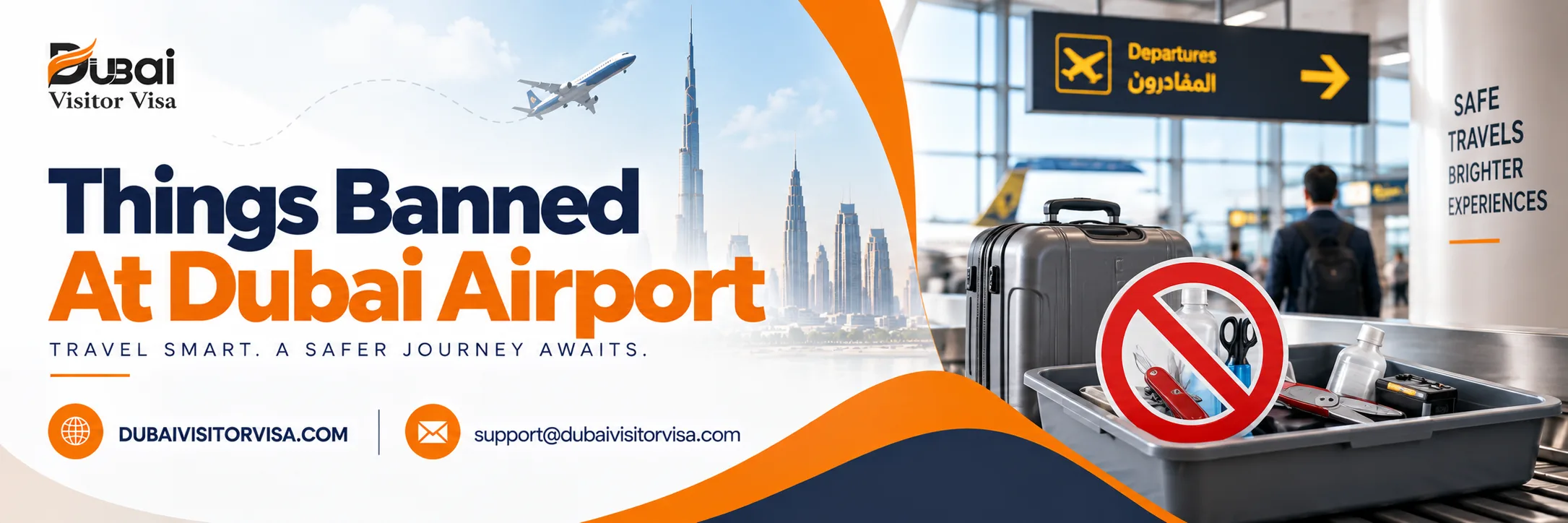
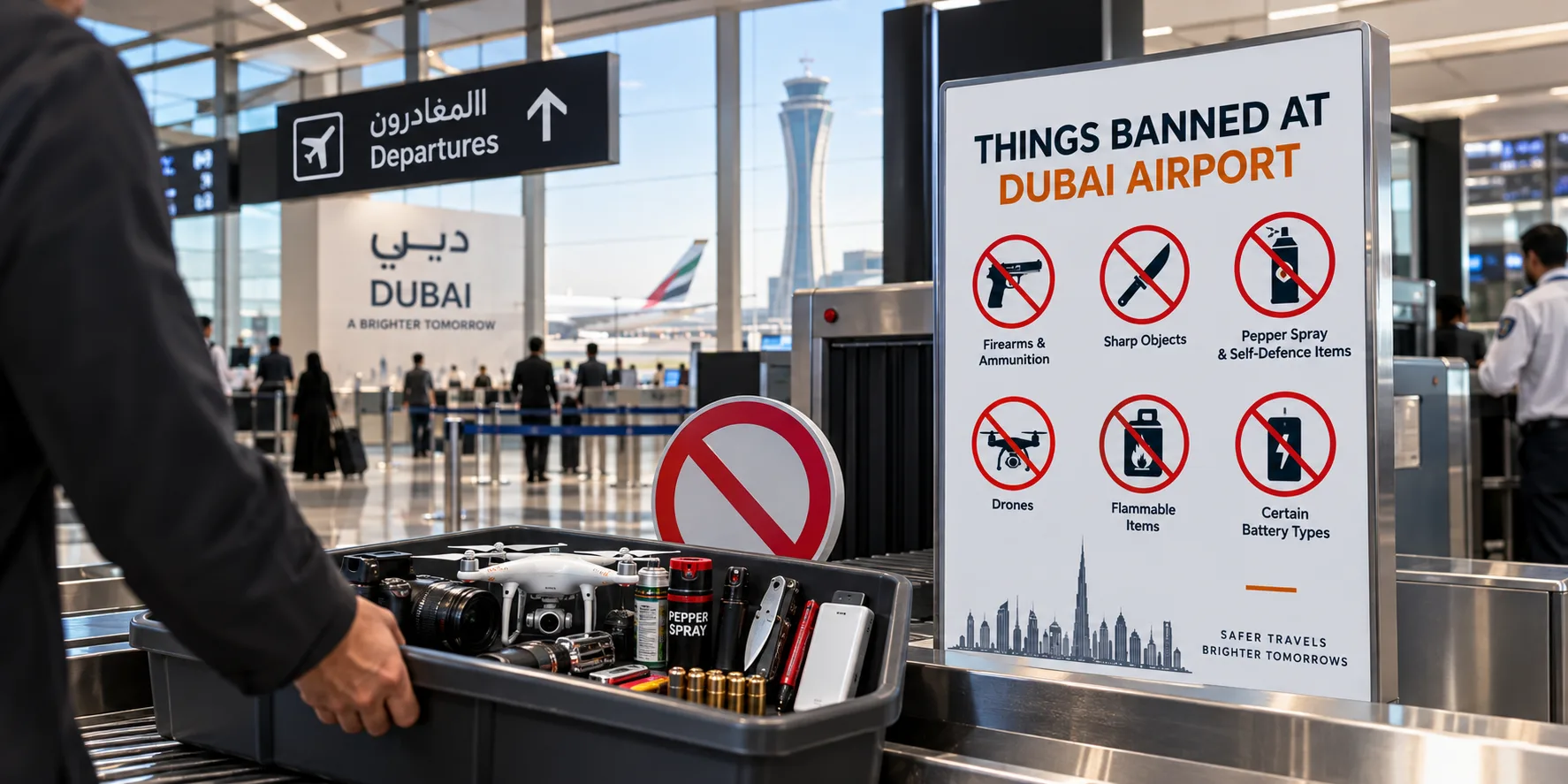
Quick answer: The things banned at Dubai Airport fall into three different groups: goods that Dubai Customs prohibits, goods that need approval or declaration, and items that airlines or airport security restrict in cabin or checked baggage. Mixing those categories is what makes many packing guides inaccurate.
Dubai Customs currently bans several passenger goods. Examples include narcotics, gambling tools, paan and betel leaves, counterfeit currency, and used or reconditioned tyres. These are core Dubai Airport prohibited items. Medicines, drones, plants, animals, weapons and commercial goods may instead need approval or declaration.
Leaving the terminal during a layover needs a visa — for most passports a 48-hour transit visa arranged before you fly.
Dubai Airport Customs — Quick Guide
- Prohibited: narcotics, paan/betel leaves, gambling equipment, counterfeit currency and other banned goods.
- Restricted: medicines, drones, weapons, some plants/animals and regulated communication equipment.
- Cabin baggage: liquids are normally limited to containers of 100 ml or less inside one resealable 1-litre bag.
- Power banks: airline rules apply; Emirates currently permits one under 100 Wh in cabin baggage but bans onboard use or charging.
- Alcohol: Dubai Customs currently lists up to 4 litres of alcoholic beverages or 2 cartons of beer within the duty-free passenger allowance for travellers aged 18+.
- Cash declaration: Dubai Customs updated its passenger cash procedure on 4 September 2026 to require declaration above AED 100,000.
- If unsure: declare the item and ask Customs rather than hiding it.
Flying Through DXB for the First Time?
Review the airport layout, terminals, arrival process and transfer basics before you travel. Customs is only one part of the DXB arrival journey.
Read the Dubai Airport GuideThings Banned at Dubai Airport: Prohibited vs Restricted
The first rule is simple: prohibited does not mean the same thing as restricted. Do not carry a prohibited item. A restricted item may be allowed when you meet its approval, quantity or declaration rule.
The current Dubai Customs prohibited and restricted goods guidance identifies the competent authorities for categories such as medicines, weapons, plants, radio equipment, alcohol and foodstuffs. Customs may need that authority's approval before release.
A third category comes from aviation security. An item may be legal to import but still be forbidden in hand baggage. Large liquids, many sharp tools and certain dangerous goods fall into this airport-security category.
Dubai Customs Prohibited Items You Should Not Pack
The main Dubai Customs prohibited items and Dubai Airport prohibited items listed in current passenger guidance include:
- Narcotic drugs and prohibited controlled substances.
- Gambling tools, machines and devices.
- Paan and betel leaves. Dubai Customs' passenger guide also highlights naswar.
- Poppy seeds under the narcotics-related prohibited list.
- Counterfeit or forged currency.
- Counterfeit goods and fake branded merchandise.
- Used, reconditioned and inlaid tyres.
- Radiation or nuclear-fallout contaminated substances.
- Three-layer / prohibited nylon fishing nets.
- Materials that contradict applicable public-morals or media rules.
- Cooked and home-made foods where listed under Dubai Customs passenger restrictions.
The source article also labelled all pork products as fully banned. That claim is too broad. Current Dubai Customs guidance specifically names live swine as prohibited, while meats and animal products are handled under food, veterinary and declaration controls. Do not convert “live swine prohibited” into “all pork products prohibited.”
It also included a blanket Israel-origin goods warning. Old customs pages and modern UAE trade practice conflict on that point. Do not present it as a simple current passenger rule without an item-specific customs classification.
Customs rules do not decide whether you can enter the UAE. If your passport needs an advance visa, the Dubai Visitor Visa Requirements guide explains the separate entry-document checklist.
Things Banned at Dubai Airport: Medicines Need Extra Care
Medicine needs extra care. A lawful prescription at home does not make the drug unrestricted in the UAE. For medicines allowed in Dubai Airport, check the active ingredient and the current MoHAP rules. The source's four-category system was too simple and is not the current official traveller framework.
Current MoHAP guidance separates ordinary prescriptions from narcotic, psychotropic and other controlled medicines. For visiting travellers, the electronic personal-use approval service is currently optional. Without prior electronic approval, declare narcotic or controlled medicines on arrival. Carry the required prescription and medical report.
Controlled Medicines
MoHAP currently allows up to a three-month personal supply of narcotic or controlled medicine, subject to its document rules. For prescription-only medicines that are not controlled, MoHAP currently states a maximum personal-use supply of six months.
Do not rely on a drug brand name alone. Check the active ingredient. Some narcotic or psychotropic medicines need medical documents. Substances on prohibited schedules cannot be carried.
Prescription and Medical Documents
For controlled medicine, keep the prescription and medical report ready. MoHAP says the supporting documents should come from the treating health authority or healthcare provider. If you obtained electronic approval, keep the approval accessible during travel.
A useful rule is: do not guess with controlled medicine. The safest list of medicines allowed in Dubai Airport is the current MoHAP record for the exact active ingredient, not a travel-blog brand list.
Food Rules: What the Source Got Wrong
The source made the food rules too broad. Current Customs material does not say all pork or all non-halal meat is automatically banned passenger baggage. At the same time, Dubai Customs does list cooked and home-made food among passenger items that should not be brought in.
Food, meat, plants, seeds, live animals and animal products can also need another authority's approval. If you carry fresh produce, seeds, meat, animal products or biological material, check the approval rules first.
For South Asian travellers, the safer high-priority warning is specific: do not pack paan, betel leaves, naswar or poppy seeds. These appear in current Customs passenger material.
If you are still preparing entry documents as well as luggage, check the passport, visa and travel-document rules separately from customs. Customs clearance does not replace immigration approval.
Alcohol, Tobacco and Duty-Free Passenger Limits
Alcohol is not simply “banned at Dubai Airport.” Dubai Customs currently lists a duty-free passenger allowance of up to 4 litres of alcoholic beverages or 2 cartons of beer, with 24 cans per carton and a maximum of 355 ml per can or equivalent.
The current Customs passenger page states that travellers must be at least 18 years old for the alcohol and tobacco exemptions. The source article added a blanket “non-Muslim only” customs condition that is not how the current Dubai Customs passenger allowance is written, so that wording has been removed.
Tobacco allowances also use quantity limits. Dubai Customs currently lists up to 400 cigarettes, 50 cigars or 500 grams of specified tobacco products within the exemption. Excess quantities can attract customs duty or other handling.
These customs allowances do not override airline dangerous-goods rules or local possession laws.
Cash, Jewellery and Goods You May Need to Declare
Cash rules changed on 4 September 2026. Dubai Customs updated its mobile passenger cash-declaration procedure on 4 September 2026. That current procedure says passengers must declare cash or other bearer monetary instruments when the aggregate amount exceeds AED 100,000 or the foreign-currency equivalent.
Some older Dubai Customs and federal pages still display the previous AED 60,000 figure. Because the change is recent, check the live Dubai Customs service on your travel date if you are near either threshold.
Dubai Customs also accepts declarations for commercial goods, valuable jewellery, precious metals, restricted medicines, drones, plants, animals and other controlled items. The iDeclare system helps arriving passengers declare goods before or after arrival.
If you are eligible to enter Dubai without an advance visa, customs rules still apply normally. The Dubai Visa on Arrival guide explains which travellers can use an arrival-based immigration route.
Dubai Airport Baggage Rules for Liquids and Sharp Items
The Dubai Airport baggage rules for hand luggage are airport-security rules, not customs import rules. Dubai Airports says hand-baggage liquids, aerosols and gels must go inside one transparent resealable bag. Each container must be no more than 100 ml and the total bag capacity must not exceed one litre.
Dubai Airports also publishes cabin restrictions for sharp objects and tools. Examples include flick knives, blades, scissors longer than 6 cm, drills, saws and other dangerous tools.
Security exceptions can apply to medical liquids, baby milk or food, and special dietary needs. Keep supporting information ready.
Checked Baggage Is Different
Moving an item into checked baggage does not make it legal. Customs prohibitions still apply, and airlines can impose their own dangerous-goods rules. Always check the operating airline's baggage policy for batteries, aerosols, sports gear and unusual equipment.
Power Banks, Batteries and Personal Electronics
Phones, laptops, tablets and cameras are normally personal effects. Power banks need more care because airline safety rules are stricter.
For Emirates flights, the current rule allows one power bank under 100 Wh in cabin baggage. It cannot go in checked baggage. From 1 October 2025, Emirates also prohibits using the power bank onboard or charging it from the aircraft power supply. The capacity rating must be visible. Emirates also says not to store the power bank in the overhead locker.
Do not apply the Emirates rule automatically to every airline. Check the carrier operating your flight because battery limits and storage rules can differ.
Personal electronics are different from regulated communication equipment. Drones, transmitters, some radio equipment and satellite phones can require declaration or competent-authority approval.
Drones, Radio Equipment and Other Restricted Items at Dubai Airport
The phrase restricted items at Dubai Airport is more accurate than “banned” for many technical devices. Dubai Customs lists drones and some communications equipment among goods that can require declaration or approval.
A drone can involve several rules. Customs entry, aviation registration and permission to fly are separate questions. Bringing a drone does not automatically give you permission to fly it in Dubai.
Weapons, ammunition, explosives and fireworks also fall under competent-authority controls. Travellers should not carry them without the exact approvals required by the responsible UAE authority and airline.
If your Dubai stop is only a connection, immigration and customs exposure depend on whether you remain airside or enter the UAE. The Dubai Transit Visa guide explains when a traveller may need to clear immigration and enter Dubai during a layover.
What to Do at Dubai Customs on Arrival
After immigration and baggage collection, follow the Customs signs. If you carry ordinary personal effects and nothing declarable, use the no-declaration channel. If you carry a restricted or uncertain item, use the declaration route.
Do not hide an item because you are unsure. Customs can inspect baggage, request supporting documents, assess duty, hold an item or refer a matter to another authority depending on what they find.
Keep prescriptions, permits, invoices and approvals easy to reach. Do not bury the only copy of an approval inside a checked bag.
Green Channel, Red Channel and iDeclare
Use the no-declaration channel only for ordinary personal baggage with nothing to declare. Use the declaration route when you carry a controlled, taxable, commercial or uncertain item.
Dubai Customs also offers iDeclare for arriving passengers. The service covers categories such as commercial goods, valuables, cash, medicines, drones, plants and animals. Check the live list before travel because thresholds and categories can change.
Do not treat the green channel as a shortcut when you are unsure. Choosing the wrong channel can create an avoidable customs problem.
What Happens If Customs Finds a Prohibited or Restricted Item?
The outcome depends on the item, quantity, documents and applicable law. Customs may hold goods, assess duty, issue a penalty or refer the case to another authority.
A missing device permit is not the same as carrying a prohibited narcotic. The legal consequence can vary greatly. Do not publish one fixed fine for every banned or undeclared item.
If Customs keeps an item, ask for the official receipt or case number. If another authority must approve release, follow that authority's process rather than paying an unofficial intermediary.
Visa Already Approved?
Check the visa record before departure and keep the approval with your passport. Airport customs and immigration are separate checks.
Check Dubai Visa StatusPre-Travel Entry and Customs Check
Before you leave home, review the things banned at Dubai Airport and confirm three separate points. Your passport must be valid. Your UAE entry route must be correct. Your baggage must meet customs and airline rules.
If you need an advance visitor visa, check its document list before you finish packing. If you qualify for visa on arrival, keep the documents needed for that entry route. If you are only transiting airside, confirm that your connection does not require you to clear immigration.
Keep digital and printed copies of key travel documents. Save medicine permits, customs declarations and equipment approvals where you can reach them without your checked bag.
How to Handle an Item You Are Unsure About
Start with the exact item. Check the product name, ingredients, quantity and purpose. One ingredient or technical detail can turn an ordinary item into a restricted one.
Next, check the correct authority. Customs controls import and declaration. MoHAP handles medicine rules. Dubai Airports and the airline control aviation security and dangerous goods. Drones and radio equipment can involve other regulators.
If the official pages disagree, use the newest service page and contact the authority before travel. The cash threshold shows why this matters. Dubai Customs published a new passenger procedure on 4 September 2026, while older pages still show the previous figure.
Use screenshots or PDFs only as backup. The live official record on your travel date matters more than an old saved guide.
Things Banned at Dubai Airport: Pre-Travel Packing Checklist
- Remove narcotics and any prohibited controlled substance.
- Do not pack paan, betel leaves, naswar or poppy seeds.
- Do not pack counterfeit currency or fake branded goods.
- Check every controlled medicine against current MoHAP guidance.
- Carry the prescription and medical report when the medicine rules require them.
- Do not pack cooked or home-made food where Customs passenger guidance prohibits it.
- Keep alcohol and tobacco within current passenger allowance rules.
- Check the live cash-declaration threshold if carrying a large amount of cash or bearer instruments.
- Keep cabin liquids within the 100 ml / 1-litre security rule.
- Check your airline's battery and power-bank policy.
- Declare drones, restricted devices, commercial goods, plants, animals or other controlled items when required.
- Keep permits and approvals accessible.
If you already have a visa application in progress, check its final status before departure. An application receipt is not the same as an issued visa.
Final Airport and Visa Check Before You Fly
Airport compliance has two parts. Can you legally carry the item? Can you legally enter Dubai? Check both before you leave home.
If your passport does not qualify for visa-free entry or visa on arrival, compare the correct visitor route before booking around an unapproved application. The Dubai Visitor Visa Cost guide explains the current government-fee and service-cost structure.
Keep a Simple Travel Document Folder
Before the airport, keep the passport, visa or entry proof, onward ticket and accommodation details together. Add any medicine prescription, customs declaration, equipment permit or airline approval that applies to your baggage.
Use file names that make sense on your phone. Do not rely on a message buried inside a long chat. If airport Wi-Fi or mobile data is slow, an offline copy can save time.
For controlled medicine, keep the prescription and medical report with the traveller who uses the medicine. For regulated equipment, keep the permit with the person carrying the item. This makes it easier to answer a Customs or airline question without searching through another traveller's bag.
Do Not Confuse Customs Approval With Visa Approval
Customs decides whether goods can enter. Immigration decides whether the traveller can enter. The airline can also refuse carriage when its rules are not met.
A medicine permit does not grant entry to Dubai. A Dubai visa does not make a prohibited item legal. Keep each approval tied to the purpose it actually covers.
For a family trip, check each traveller separately. Children can have different document needs, while adult baggage allowances and cash-declaration rules can depend on age. Do not assume one family member's allowance automatically covers everyone.
Allow extra time for controlled medicine, declared valuables or regulated equipment. Even when everything is legal, the inspection can take longer than an ordinary green-channel arrival.
Dubai Visitor Visa is a private visa-assistance service. It does not issue customs approvals, medicine permits, drone permissions or airport-security exemptions. Those decisions belong to the relevant UAE authority or airline.
Need a Pre-Arranged Dubai Visitor Visa?
If your passport requires advance approval, choose the visitor-visa route that matches your stay and entry needs before you fly.
Review Dubai Visitor Visa OptionsThe safest way to handle the things banned at Dubai Airport is to separate customs law from airline baggage rules. Verify medicines and regulated goods before packing. Declare anything uncertain when you arrive.