PRESS
PRESS 


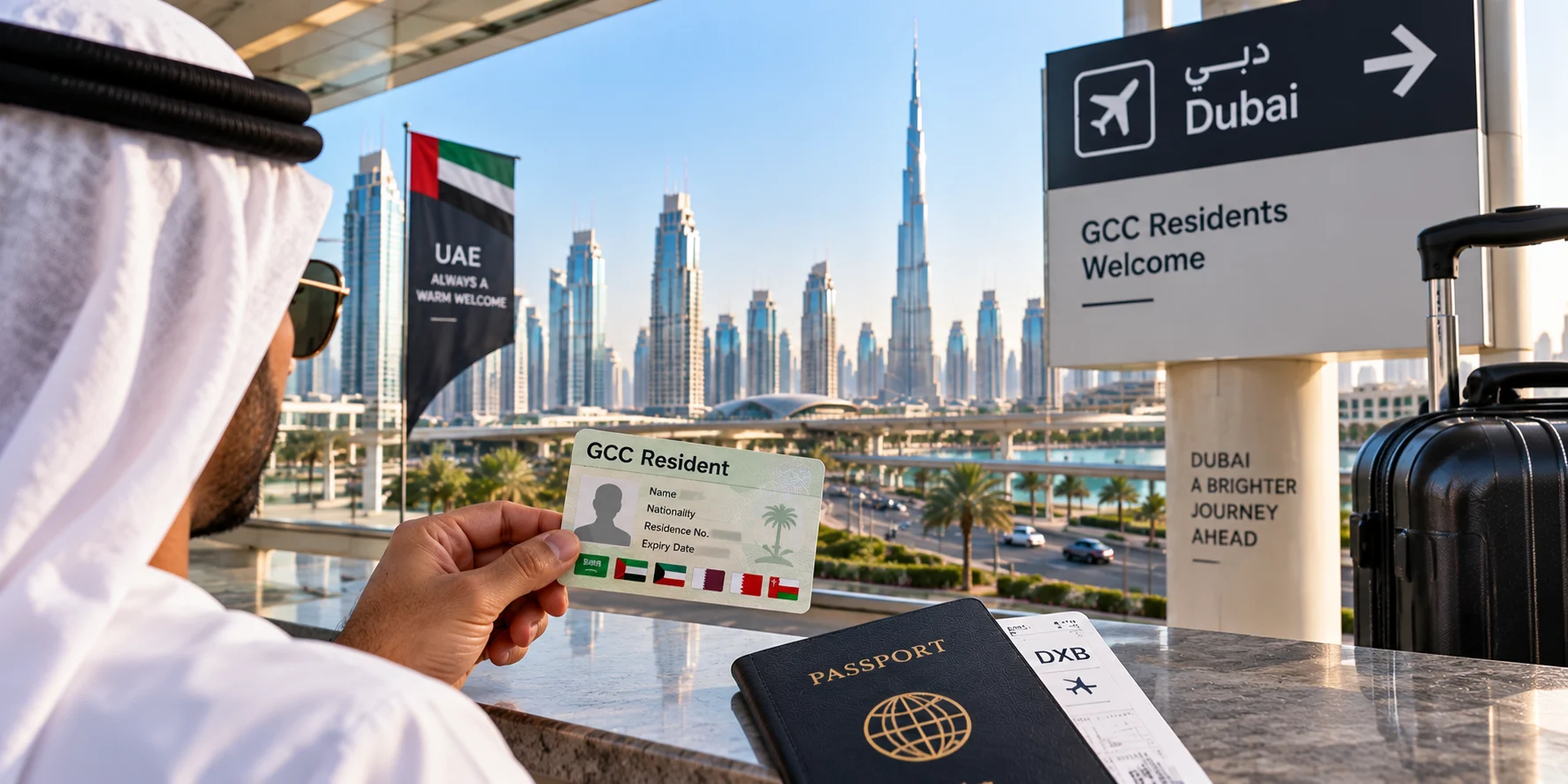
Quick answer: The current GCC residents Dubai visa route is a pre-arranged online entry visa for foreign nationals who legally reside in Saudi Arabia, Kuwait, Qatar, Bahrain or Oman. UAE government guidance says eligible GCC residents must obtain the eVisa before arriving. Tourists who are not GCC residents apply for the standard Dubai e-visa instead. The entry permit is valid for 30 days from issue, allows a 30-day stay from entry and can be extended once for another 30 days.
GCC citizenship and GCC residence are different. Citizens of Saudi Arabia, Kuwait, Qatar, Bahrain and Oman normally do not need a UAE visa. Foreign residents of those countries use the GCC-resident entry route only when they meet the current residence, passport and profession conditions.
GCC Resident eVisa — 2026 Quick Guide
- Who it is for: eligible foreign residents of Saudi Arabia, Kuwait, Qatar, Bahrain and Oman.
- Application: online before arrival.
- Entry-permit validity: 30 days from issue.
- Permitted stay: 30 days from entry.
- Extension: once for another 30 days.
- GCC residence validity: at least 1 year from UAE arrival.
- Passport validity: at least 6 months from arrival.
- Profession: must fall within the approved list, subject to authority assessment.
- Current GDRFA service total: AED 252.50, commonly rounded to AED 253.
- Expected GDRFA service time: 48 hours after the requirements are complete.
Not Sure Whether You Need the GCC-Resident Route?
Check your passport, GCC residence status and visa-on-arrival eligibility before starting a paid application.
Check Dubai Visa EligibilityGCC Residents Dubai Visa: Who This eVisa Is For
The official GDRFA GCC-resident entry visa service is for foreign nationals who reside in a GCC member state. It also covers eligible family members and accompanying domestic workers who reside with them.
This is not the same as a standard 30-day tourist visa sponsored by a tourism establishment. The GCC resident eVisa is a specific residence-based UAE entry route. Your GCC residence status and profession are part of the eligibility test.
GCC citizens should not use this route merely because they live in the Gulf. Saudi, Kuwaiti, Qatari, Bahraini and Omani citizens normally enter under the GCC-national rule. The residence-based route is for foreign passport holders living in those countries.
GCC Citizens vs Foreign GCC Residents
| Traveller | UAE Entry Route to Check |
|---|---|
| Saudi, Kuwaiti, Qatari, Bahraini or Omani citizen | GCC-national entry; no advance UAE visa normally required. |
| Foreign national legally resident in a GCC country | GCC-resident eVisa if the current conditions are met. |
| Foreign GCC resident whose passport has a separate visa-on-arrival route | Check the passport-based route before paying for the GCC-resident eVisa. |
| GCC resident who does not meet the residence/profession conditions | Check another lawful UAE visitor route that matches the passport and travel purpose. |
Holding a Saudi Iqama, Kuwait Civil ID, Qatar residence card, Bahrain CPR or Oman resident card does not by itself create automatic UAE entry. The residence permit must meet the current validity rule, and the occupation shown in the residence record must pass the profession assessment.
The correct route also depends on the passport itself. A foreign GCC resident can sometimes qualify for a separate arrival-based UAE route because of nationality or another valid residence document. In that situation, the UAE visa for GCC residents route may not be the only lawful option.
If a passport may qualify for an arrival-based route independently of GCC residence, compare that first. The Dubai Visa on Arrival guide explains the main passport-based and conditional arrival routes.
GCC Resident eVisa Validity, Stay and Extension
Current UAE government guidance gives three separate time rules for the UAE visa for GCC residents:
- Entry permit: valid for 30 days from the date of issue.
- Stay: up to 30 days from the date of entry.
- Extension: one extension for another 30 days.
Do not treat “valid for 30 days” and “stay for 30 days” as the same clock. The first tells you how long the issued permit remains usable for entry. The second controls the allowed stay after you enter.
This corrects the source's broad visa table that mixed GCC-resident entry with standard 30-day, 60-day, transit and business products. Those are separate services. A person should use another route only when the GCC-resident eVisa does not fit and another legal visa type genuinely applies.
GCC Resident Visa Requirements
The current GCC resident visa requirements are much narrower than the source's original full travel checklist.
GDRFA currently publishes:
- a recent colour photograph with a white background;
- a copy of the passport or travel document, including the outer cover, with at least six months of validity;
- a copy of the GCC residence permit or electronic extract showing the profession and residence validity.
UAE government guidance also states that the GCC residence must remain valid for at least one year from the UAE arrival date. The passport must remain valid for at least six months from arrival.
The source labelled confirmed flights, hotel proof, three months of bank statements and travel insurance as universal application documents. The current GDRFA Dubai service does not publish those as universal core documents for this exact eVisa route. A provider or authority can still request more information in an individual case.
For the broader difference between official tourist documents and provider-requested paperwork, use the Dubai Visitor Visa Requirements guide.
Profession Rule: What It Means in 2026
Profession still matters. GDRFA says the applicant's profession must fall within the approved list for visa issuance, subject to assessment by the competent authority.
The source published a “54 approved profession categories” section and then used that to suggest possible on-arrival processing. The current UAE government guidance instead tells GCC residents to apply online and obtain the visa before arriving. The profession rule is therefore an eligibility test for the eVisa, not a reason to rely on airport issuance.
Do not assume a broad title such as “engineer,” “manager” or “sales executive” guarantees approval. The profession recorded on the GCC residence permit or electronic extract must be assessed by the authority.
If your occupation recently changed, the residence record should reflect the current occupation before you rely on it for eligibility. A private provider cannot override a profession result made by UAE immigration.
Dubai Visa for GCC Residents: Current GDRFA Fee
The current Dubai visa for GCC residents service lists three fee components:
| GDRFA Fee Component | Amount |
|---|---|
| Service fee | AED 52.50 |
| Application fee | AED 100 |
| Issuance fee | AED 100 |
| Total listed government amount | AED 252.50 |
You may see the total described as AED 253 after rounding. A visa-assistance company can add its own document-review or service charge, so compare an all-in provider package with the government amount separately.
Do not mix this AED 252.50 GCC-resident eVisa fee with the 30-day or 60-day tourism-establishment visa fees. They are different services with different eligibility rules.
How Long Does the GCC-Resident eVisa Take?
GDRFA currently lists an expected completion time of 48 hours once the service requirements are complete. The service is available online 24/7.
The source claimed 2–3 working days and an express 24–48-hour route. Those can be provider processing claims, but they are not the current GDRFA service benchmark. The official service target is 48 hours and is not an approval guarantee.
Apply with travel buffer. A residence-validity question, profession assessment, document problem or immigration review can delay the result.
Need to Compare the GCC-Resident Route With Other Visa Types?
Check tourist, transit, visa-on-arrival, GCC-resident, family and long-term visitor options before choosing the wrong service.
Compare Dubai Visitor Visa TypesCountry Guide for GCC Residents
The core UAE conditions do not change simply because the residence card comes from a different GCC country. The practical difference is the name and format of the residence document you use.
Saudi Arabia Residents
A Dubai visa for Saudi residents uses the GCC-resident eVisa route when the applicant is a foreign national living in Saudi Arabia and meets the current conditions. The Saudi Iqama or electronic residence record must support the required one-year residence validity and show the occupation used for assessment.
Saudi citizens themselves normally do not need this eVisa. This route is for expatriate Saudi residents. A Dubai visa for Saudi residents should therefore be assessed from the applicant's foreign passport, Iqama validity and recorded profession.
Kuwait Residents
Foreign residents of Kuwait use their valid Kuwait residence record or Civil ID evidence as the GCC residence basis. Kuwaiti citizens use the GCC-national entry rule instead.
Do not rely on a fixed “Kuwait applicants take 2–3 working days” statement. GDRFA's published expected service time is 48 hours once the requirements are complete.
Qatar Residents
Foreign residents of Qatar use the same GCC-resident conditions: qualifying residence status, at least one year of residence validity from arrival, six months of passport validity and an acceptable profession.
The source linked processing speed to restored UAE-Qatar diplomatic relations. That historical context is not needed for a current visa checklist and has been removed.
Oman Residents
Foreign residents of Oman can use the GCC-resident eVisa when eligible. If you plan to drive into the UAE, confirm the border and transport requirements separately from the visa itself.
An electronically issued UAE entry visa is not automatically an assurance that every vehicle, insurance or road-border condition is satisfied. Keep visa eligibility and land-travel requirements separate.
Bahrain Residents
Foreign residents of Bahrain follow the same UAE eVisa rules. Use the current Bahrain residence record that proves legal residence, validity and profession.
Bahraini citizens normally enter under the GCC-national rule and do not use the expatriate-resident eVisa.
GCC Residents Dubai Visa: Online Application Steps
- Confirm you are using the correct route. Check whether your passport has another UAE entry option first.
- Check GCC residence validity. The residence should remain valid for at least one year from UAE arrival.
- Check passport validity. Keep at least six months from arrival.
- Check the profession record. The authority assesses whether the listed occupation qualifies.
- Prepare the published documents. Photo, passport/travel document copy and GCC residence proof.
- Use the official online service or an authorised assistance channel.
- Enter details exactly. Passport, residence and profession data should match the documents.
- Pay the applicable fee. Separate the government amount from any private service charge.
- Save the reference. Track the existing application rather than creating duplicates.
- Wait for the issued eVisa before travelling. Submission or payment is not approval.
The key point is simple: current UAE guidance says GCC residents need to obtain this eVisa before arrival. Do not plan around airport issuance based on profession.
Extension Rule for GCC Residents
The GCC-resident eVisa has its own clear extension rule: the 30-day stay can be extended once for another 30 days.
This is different from the standard GDRFA tourist-extension service, which follows its own same-period rules. Do not copy the generic tourist-extension limits onto the GCC-resident eVisa.
Apply before the authorised stay ends. The broader Dubai Visitor Visa Extension guide explains authority routing and why different visitor categories should not be treated as one extension product.
How the One-Time 30-Day Extension Changes Your Stay
The original eVisa gives a 30-day stay from entry. If the authority approves the one-time extension, the traveller receives another 30 days under the GCC-resident route. Do not calculate the new departure deadline from the visa issue date. Use the actual immigration record after extension approval.
An extension application and an approved extension are also different. A payment receipt or submission reference does not by itself add legal stay. Do not remain beyond the authorised date merely because an extension request is pending.
If your GCC residence permit will expire during the proposed extra stay, check the file before assuming the extension remains available. The residence basis is central to this visa category, so a changing GCC residence status can affect what immigration allows next.
If the one-time 30-day extension is not enough, the next step may require a different lawful visa or status route. Do not create a second “GCC extension” by copying standard tourist-extension rules. The current government guidance specifically describes this residence-based eVisa as extendable once for another 30 days.
Overstay and Expired GCC-Resident eVisas
Once the authorised stay and any applicable grace period end, the current UAE standard overstay fine is generally AED 50 per chargeable day. Do not assume the 30-day permit validity from issue gives you extra stay after entry.
Also do not rely on an old rule saying a departure permit automatically becomes necessary after a fixed number of overstay days. The immigration file decides what must happen next.
Before paying a private company to “clear” an expired file, check the actual visa status and fine record. The legal solution can differ depending on whether the traveller still has an extension option, has already used the one-time extension, has left the UAE, or has another immigration issue on the record.
Keep the original eVisa, any approved extension and payment receipts together. Those documents make it easier to compare the expected dates with the official immigration record if a discrepancy appears.
If the stay has already ended, use the Dubai Visa Overstay Rules guide to separate the fine check, departure-permit issue and status-resolution steps.
Common GCC-Resident eVisa Problems
- GCC residence has less than one year of validity from UAE arrival.
- Passport has less than six months of validity.
- Profession on the residence record does not meet the approved-category assessment.
- Residence record does not clearly show the occupation or validity.
- Passport or residence details do not match the application.
- Traveller assumes GCC residence means automatic UAE entry.
- Applicant plans to obtain the visa at the airport instead of applying online first.
- Applicant mixes the GCC-resident eVisa with a standard tourist visa or transit visa.
- Multiple applications are submitted before the first file is resolved.
- An old UAE immigration issue or unpaid fine remains on the record.
If an application is refused, identify the actual problem before submitting another file. Correct the residence, passport, profession or data issue first instead of sending the same file again through another channel.
GCC Residents Dubai Visa: Final 2026 Checklist
- Confirm that you are a foreign GCC resident, not a GCC citizen using the wrong route.
- Check whether your passport already has another UAE entry option.
- Keep GCC residence valid for at least one year from arrival.
- Keep the passport valid for at least six months from arrival.
- Confirm the profession shown on the GCC residence record.
- Prepare the current photo, passport and residence documents.
- Apply online and obtain the eVisa before arrival.
- Remember the permit is valid 30 days from issue.
- Remember the allowed stay is 30 days from entry.
- Use the one-time 30-day extension only when eligible and needed.
- Separate the AED 252.50 government fee from private assistance charges.
- Travel only after the visa has actually been approved and issued.
A correct GCC residents Dubai visa application is built around residence validity, passport validity and profession eligibility—not a generic tourist-visa checklist. The safest GCC residents Dubai visa plan is to confirm those three points first and obtain the eVisa before travel. A final GCC residents Dubai visa check should also confirm the issue date, entry deadline and approved stay before departure.
Need Help With a Pre-Arranged UAE Visitor Route?
If the GCC-resident eVisa does not fit your passport or residence profile, compare the available visitor options before paying.
Review Dubai Visitor Visa Options