PRESS
PRESS 


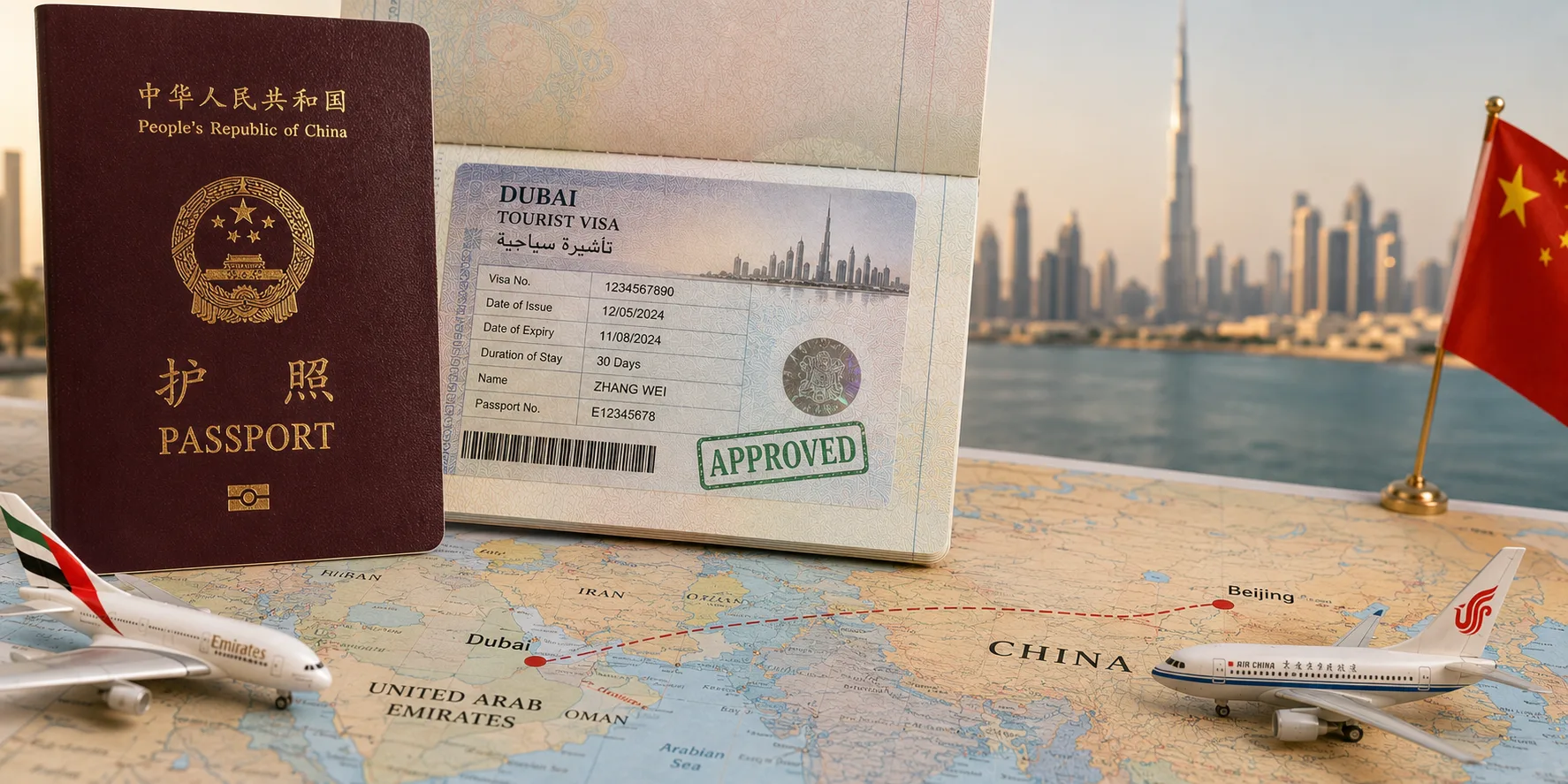
The Dubai visa for Chinese citizens is simpler than many older search results make it sound. If you travel on an ordinary People’s Republic of China passport, you normally do not need to arrange a tourist visa before a short trip to Dubai or another emirate. Under the current 2026 arrangement, you can stay in the UAE for up to 90 days in total during a 180-day period, with that period counted from your first entry. If you want to understand how arrival-based entry differs from a pre-arranged visa, start with our Dubai visa on arrival guide.
The part that causes confusion is not whether Chinese ordinary-passport holders can travel visa-free; it is how the 90 days are counted. A weekend outside the UAE does not automatically give you another 90 days, and old 30-day information is still visible on parts of the web. This guide focuses on the rule you should plan around now, the documents that genuinely matter, repeat visits, longer-stay options and the situations where a different visa route may need to be checked.
Quick answer for 2026
Ordinary PRC passport holders can enter the UAE without arranging a tourist visa in advance and may stay for up to 90 days in total within the applicable 180-day period. Your passport should have more than six months of validity, and normal immigration entry checks still apply.
Do Chinese Citizens Need a Visa for Dubai in 2026?
For a normal holiday, family visit or short business trip, an eligible Mainland Chinese traveller holding an ordinary PRC passport does not generally need to apply for a standard Dubai tourist visa before flying. The UAE Ministry of Foreign Affairs currently lists the People’s Republic of China as visa-free.
You may also see the arrangement described by airlines as a 90-day visa on arrival. The wording differs, but the practical point for an ordinary Chinese passport holder is the same: there is no normal requirement to obtain a pre-approved tourist visa for this short-stay route before departure.
This page is specifically about ordinary Mainland PRC passports. Diplomatic, service, special passports and other travel documents can follow different entry arrangements. Hong Kong SAR, Macau SAR and Taiwan travel documents should be checked separately rather than treated as if they were ordinary Mainland Chinese passports.
30 Days or 90 Days? Use the Current 90-in-180 Rule
A large share of the confusion around a UAE visa for Chinese citizens comes from older 30-day material. Chinese travellers were previously widely described under a 30-day entry arrangement, and some embassy or consular pages have not been updated consistently. More recent travel guidance changed the planning position for ordinary PRC passport holders to 90 days in total within 180 days.
The key date is your first UAE entry. The 180-day period begins from that first arrival, and your days in the UAE can be used continuously or across several visits. Once the total reaches 90 days, leaving the country for a short trip does not create a new allowance inside the same 180-day period.
| Travel pattern | How the allowance works |
|---|---|
| 10-day Dubai holiday | 10 days used; the remaining allowance stays available within the same 180-day period. |
| 25 days in Dubai + 20 days later in Abu Dhabi | 45 days used in total. Changing emirates or making a later UAE trip does not create a separate allowance. |
| Three visits totalling 80 days | 10 days remain in the applicable period. |
| Full 90 days already used | Do not expect a quick exit and re-entry to reset the clock. Plan the next trip only after the applicable 180-day period has been completed or another lawful status has been confirmed. |
Do not calculate a future trip from memory. Keep your actual entry and exit dates, especially if you visit the UAE regularly. The difference between visa validity, entry validity and permitted stay can also cause confusion, so our Dubai visa validity guide is useful if you are comparing this arrangement with another visa type.
Why are 30-day results still showing online?
Because visa information is often copied for years after a policy changes. Some search results still repeat the older 30-day rule, and some pages mix the old rule with newer 90-day language. For travel in 2026, use the current 90-days-in-180 arrangement for an eligible ordinary PRC passport rather than building your itinerary around an outdated 30-day limit.
Check the Passport Before You Check the Flight
Nationality is only one part of the entry decision. The document you will actually present at immigration matters just as much.
- Use the ordinary PRC passport covered by the arrangement. Do not apply its rules automatically to another passport or travel document.
- Keep more than six months of passport validity. If the passport is close to expiry, renew it before committing to a complicated itinerary.
- Make sure the booking name matches the passport. Even a small mismatch can become a boarding problem.
- Check single-name passports carefully. Current airline guidance warns that travellers whose passport contains only one name can face UAE entry restrictions in some circumstances.
- Check every family member separately. A Chinese parent travelling with a spouse or child of another nationality should not assume the same UAE entry rule covers the whole booking.
If you renew your passport between booking and travel, check whether the airline needs the new passport details before departure. If you are travelling on a non-standard document, confirm the rule for that exact document instead of relying on a general article about Chinese citizenship.
What Should Chinese Passport Holders Have Ready at the Airport?
The standard visa-free route does not require you to manufacture a tourist-visa application file when no advance application is being submitted. That means there is no reason to turn bank statements, invitation letters, hotel vouchers or fixed photo specifications into universal requirements for every Chinese visitor.
For a normal trip, keep the practical travel information that supports the itinerary you are genuinely taking:
- your valid ordinary PRC passport;
- confirmed flight details and your planned departure or onward journey;
- the address of your hotel, serviced apartment, family member or host;
- a working contact number for the accommodation or host;
- documents required by any country you will visit after the UAE; and
- travel insurance details if you have purchased cover for the trip.
An airline or immigration officer can ask for additional information depending on the journey. Keep real documents that match the trip rather than trying to satisfy a generic checklist copied from a paid visa application. For travellers who actually need a pre-arranged visa, the document rules are different; see our Dubai visitor visa requirements page for that separate process.
Repeat Visits, Side Trips and Re-Entry to the UAE
A multi-country holiday is where the 90-in-180 rule becomes most important. Suppose your route is Shanghai → Dubai → Muscat → Dubai → Shanghai. You have entered the UAE twice, but the second Dubai visit does not begin a fresh 90-day allowance. The days from both UAE stays belong to the same applicable period.
The same principle applies if you land in Dubai on one trip and Abu Dhabi on another. This is a UAE immigration arrangement, not a separate visa quota for each emirate. Travelling between Dubai, Abu Dhabi, Sharjah, Ajman or another emirate while you remain inside the UAE is domestic travel and does not create another entry.
If you travel often, keep a simple list with four items: arrival date, departure date, days used and total days used so far. That small habit is more reliable than trying to reconstruct several months of travel at the airport.
What if the airline gives a different answer?
Airlines use live travel-document systems for boarding decisions, so a last-minute discrepancy deserves attention. Check the passport nationality, passport type and your recent UAE travel history first. If the issue is a complicated previous stay or a different travel document, resolve it before departure rather than relying on an old screenshot or forum answer.
When Another UAE Visa Route May Be Relevant
For most ordinary Chinese passport holders taking a normal short trip, buying a standard 30-day or 60-day tourist visa simply for reassurance is unnecessary. The better question is whether your actual situation falls outside the standard 90-in-180 visitor arrangement.
A different route may need to be checked when:
- you are travelling on a passport or travel document that is not covered by the ordinary PRC rule;
- you have already used most or all of the available 90 days;
- your purpose is employment, residence, long-term study or another activity that requires a different immigration status;
- you travel to the UAE frequently enough that a longer-term product may suit your plans; or
- you are already in the UAE under a separately issued tourist or visit visa rather than the standard Chinese visa-free arrangement.
Frequent travellers can review the UAE five-year multiple-entry tourist visa. It has its own eligibility, financial and insurance conditions and should be assessed as a separate visa category, not as an automatic extension of the Chinese 90-day allowance.
If another pre-arranged visa genuinely fits your case, compare the Dubai visitor visa types by purpose, stay length and number of entries. You can also review the Dubai visa cost guide before choosing a paid service.
Already in the UAE on a separate tourist or visit visa?
This is where inside-country extension services can become relevant. They are not an automatic extension of the normal Chinese 90-in-180 visa-free allowance. They are for travellers whose existing tourist or visit visa is eligible for an extension based on the status they actually hold.
For eligible cases, Dubai Visitor Visa currently offers a 30-day inside-country extension at USD 550 Regular or USD 575 Express. The 60-day inside-country extension is USD 670 Regular or USD 700 Express. Regular processing is generally targeted at 2–3 working days, while eligible Express requests may be handled within 24 hours.
Those are service package prices for eligible extension cases. Before paying, have the current visa or entry document checked so you do not buy an extension that does not match your status.
Unsure Which UAE Entry Route Applies to You?
Share the passport you will travel with, your planned dates and any recent UAE visits. We can help you identify whether the standard China entry arrangement is enough or whether another visa route needs to be checked.
Check My Travel SituationCan Chinese Citizens Work or Attend Business Meetings?
Visitor entry and employment permission are not the same thing. A short trip can include meetings, exhibitions, conferences or discussions when those activities fit a normal visit, but the visitor entry itself does not authorise you to start paid employment in the UAE.
If you accept a UAE job, move into a long-term assignment or intend to live in the country, the employer or relevant sponsor must use the correct work and residence process. Do not start working simply because you still have unused days within the 90-in-180 visitor allowance.
What Happens If You Stay Longer Than Allowed?
The 90-day limit is a legal stay limit, not a suggested itinerary. Current guidance uses an overstay rate of AED 50 per chargeable day once the permitted stay has been exceeded. Other immigration consequences can depend on the actual record and circumstances, so do not wait until departure to investigate a day-count problem.
If your travel history is close to the limit, check it before booking the next flight. Our UAE visa fine and overstay guide explains how overstay checks work more broadly, but the relevant immigration record is what ultimately matters for your case.
Four Common China-to-Dubai Travel Scenarios
1. Ten-day holiday in Dubai. An eligible ordinary PRC passport holder would normally use the standard visa-free/arrival arrangement. There is no reason to purchase a 30-day tourist visa just because the trip is international.
2. Dubai twice in the same six-month period. Count the first and second stays together. If the visits total 38 days, you have used 38 days of the 90-day allowance in that period.
3. A 100-day stay planned from the start. The ordinary 90-in-180 arrangement does not cover the full itinerary. Do not assume a 10-day overstay, short border run or standard inside-country extension will solve the problem. Check whether another lawful visa or residence category fits the real purpose before travel.
4. Family members hold different passports. Check each traveller separately. One person may qualify under the Chinese ordinary-passport arrangement while another needs a different arrival or pre-arranged visa route.
Before You Fly: A Practical Final Check
- Confirm the passport type. Make sure the rule you are using applies to the document in your hand.
- Check passport validity. Keep more than six months available for the planned entry.
- Write down your recent UAE dates. Count every stay within the relevant 180-day period.
- Check your itinerary for repeat UAE entries. A side trip does not automatically reset the allowance.
- Keep genuine travel details ready. Your accommodation, onward journey and contact details should match the trip you are actually taking.
- Separate visitor status from work or residence. A 90-day visit allowance is not an employment permit.
- Check another visa only when the trip genuinely requires one. Do not pay for a tourist visa that your passport does not normally need.
The most useful way to think about a Dubai visa for Chinese citizens in 2026 is straightforward: ordinary PRC passport holders normally travel without a pre-arranged tourist visa, but the stay is controlled by a 90-days-in-180 limit rather than an unlimited series of fresh entries. Plan from your first arrival date, keep track of the days already used and check the exact passport being used for the journey.
If your case falls outside that normal route, such as a different passport, exhausted stay allowance, separate existing UAE visa or a purpose that requires another immigration status, get the route checked before paying for anything. When a pre-arranged visa is genuinely appropriate, you can continue to the Dubai visa application options.